

Buying an agriculture drone flight controller in India is the single most important component decision you will make in your entire drone build — more important than the motor, more important than the battery. The flight controller (FC) is the brain of your agriculture drone. It collects real-time data from GPS, accelerometers, gyroscopes, barometers, and radar sensors, processes everything simultaneously, and translates that information into precise motor commands that keep your drone stable, on-course, and spraying accurately over Indian crop fields.
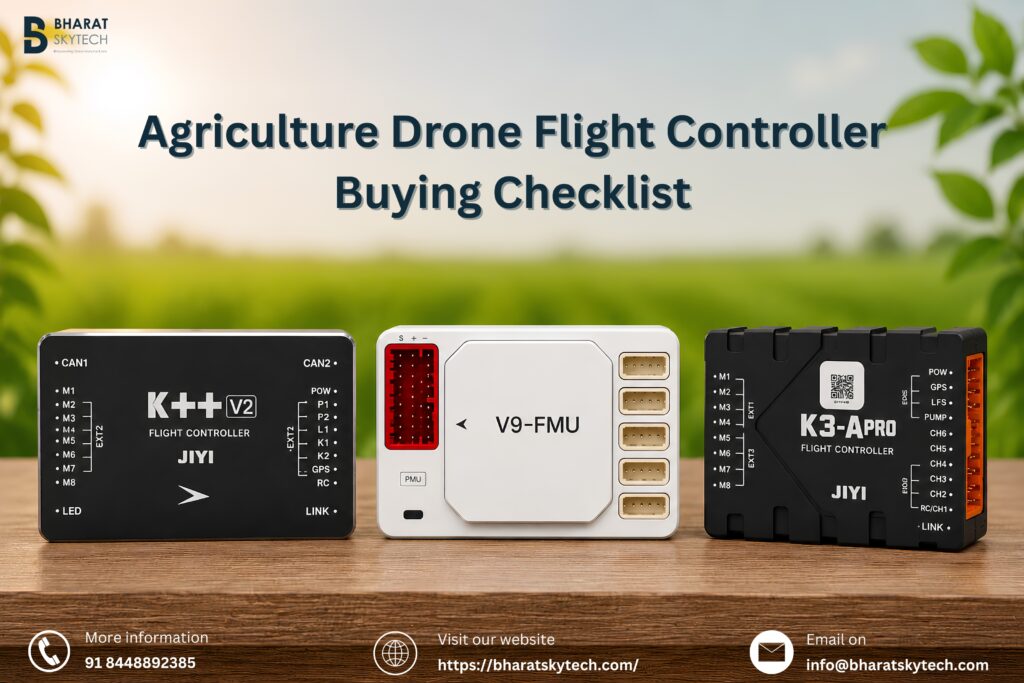
At Bharat Skytech, India’s authorised reseller of professional agriculture drone components, we stock three battle-tested flight controller systems — the Jiyi K-3A Pro, the Jiyi K++V2, and the VK V9 — each suited to a different operational profile and budget. Before you buy any of them, this complete checklist will walk you through every feature, specification, and safety factor that actually matters when selecting an agriculture drone flight controller for Indian conditions in 2026.
Why the Flight Controller Determines Everything About Your Drone's Performance
Most buyers focus on motor power and battery capacity when planning a drone build. Both matter — but neither one compensates for a weak or mismatched flight controller.
The agriculture drone flight controller is responsible for:
- Stability — holding the drone level and on-target during spraying passes over uneven Indian terrain
- Spray precision — matching pump output to flight speed in real-time so every metre of field receives the correct chemical dose
- Autonomous flight — executing pre-planned polygon routes, AB point missions, and terrain-following paths without manual input
- Safety — triggering return-to-home, emergency stop, and low-voltage protection the moment a sensor detects an anomaly
- Payload management — handling the constantly changing weight of the spray tank as liquid is dispensed during flight
A poor-quality flight controller means an unstable drone, uneven spray coverage, unreliable autonomous operation, and increased crash risk over your crops. Getting this decision right protects your entire component investment.
The Complete Checklist — What to Look for Before Buying
1. IMU Redundancy — The Most Critical Safety Feature
The IMU (Inertial Measurement Unit) is the sensor cluster inside the flight controller that measures the drone’s orientation, acceleration, and angular velocity. If the IMU fails or gives incorrect readings mid-flight, the drone loses stability immediately.
What to check: How many redundant IMUs does the FC have?
- Single IMU — acceptable for hobby drones; not acceptable for a commercial agriculture drone carrying 10–20 litres of pesticide over crops
- Dual IMU — provides one backup if the primary sensor fails; adequate for entry-level agri operations
- Triple redundant IMU — the professional standard; if one sensor fails, the FC switches to a backup instantly with no disruption to flight
At Bharat Skytech: The Jiyi K++V2 is equipped with a triple redundant IMU and dual redundant barometers — real-time monitoring of all sensor data through advanced diagnostic algorithms, with automatic switchover if any sensor reports an anomaly. This is the highest level of IMU redundancy currently available in the Indian agriculture drone market.
2. GPS Accuracy and GNSS Support
GPS positioning accuracy determines how precisely your drone follows its pre-planned spraying route. In agriculture, a drone that drifts 2–3 metres off its intended path wastes chemical on already-covered strips or leaves gaps in coverage.
What to check:
- Does the FC support multi-constellation GNSS — GPS, GLONASS, BeiDou, and Galileo simultaneously? More constellations = more satellite signals = better accuracy and reliability, especially in signal-weak rural areas
- What is the hover accuracy — horizontal and vertical?
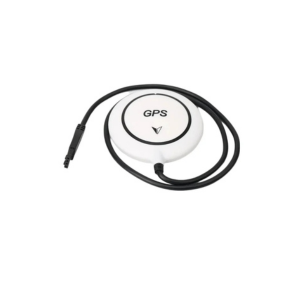
- Does the FC support RTK (Real-Time Kinematic) GPS for centimetre-level precision on high-value crops?
- Is there a dual GNSS magnetic compass configuration for redundant heading control?
At Bharat Skytech: The Jiyi K-3A Pro features a dual GNSS magnetic compass configuration that delivers greater redundancy of heading positioning control — ensuring safe, stable, and reliable flight even when one compass source is interfered with. The VK V9 also supports advanced GNSS for precise positioning, making it strong for both spraying and mapping applications.
3. Terrain Following Capability
Indian agricultural fields are rarely flat. Rice paddies, orchards, hillside tea gardens, and sugarcane fields all present variable ground elevation. A drone that maintains a fixed altitude above sea level — rather than a fixed height above the crop canopy — will spray too high over rises and dangerously low over dips.
What to check:
- Does the FC support terrain following via a connected radar sensor?
- Can it maintain a constant height above the crop canopy in real-time as ground elevation changes?
- Is it compatible with terrain following radar modules that can be added to the system?
At Bharat Skytech: Both the Jiyi K-3A Pro and the Jiyi K++V2 support terrain following function — maintaining consistent altitude above the ground across uneven Indian terrain for even spraying. Both are compatible with the Jiyi Terrain Following Radar available at Bharat Skytech. The VK V9 also supports terrain following via compatible radar peripherals.
4. Autonomous Flight Modes and Mission Planning
Manual drone operation limits how much ground you can cover per day and increases operator fatigue. Autonomous flight modes are what make agriculture drones commercially viable — allowing one operator to manage large field coverage without hands-on control of every movement.
What to check:
- Does the FC support autonomous waypoint navigation — can it follow a pre-planned polygon route over an entire field automatically?
- Does it support AB point operation — the most commonly used spraying mode in India for row crop operations?
- Can the FC execute a breakpoint resume — restart spraying from the exact point where it stopped if the battery runs out or the mission is interrupted?
- Does it support area calculation and route memory for tracking coverage across multi-day operations?
5. Spray System Integration — Pump and Flow Sensor Control
An agriculture drone flight controller is not just a flight stabilisation system — it must also directly control your spraying system. The FC should integrate with your spray pumps, flow meters, and liquid level sensors to automate and optimise chemical application.
What to check:
- How many pumps does the FC support? Single pump only, or dual pump systems?
- Does it integrate with flow meters to monitor actual liquid flow rate in real-time?
- Does it support liquid level sensors to alert when the tank is running low?
- Can it adjust spray volume automatically based on flight speed — faster flight, more output; slower flight, reduced output — for consistent application rates per hectare?
- Does it support precision spraying modes — including interval spraying and auto-stop at field boundaries?
6. Frame and Configuration Compatibility
Not all flight controllers support all drone configurations. Before purchasing, confirm the FC is compatible with your specific drone frame type.
What to check:
- Does the FC support your frame configuration — quadcopter, hexacopter, or octocopter?
- Does it support the specific arm layout — X type, + type, Y type coaxial, V type?
- What battery voltage range does the FC support — is it compatible with your 6S, 10S, or 12S LiPo system?
- What ESC communication protocols does it support — PWM analog, CAN digital, or both?
7. Safety and Failsafe Features
Agriculture drone operations happen over active crop fields — sometimes near workers, irrigation channels, livestock, and rural habitation. A flight controller with robust failsafe systems is not optional; it is a regulatory and operational necessity in India in 2026.
What to check:
- Return-to-Home (RTH) — does the FC automatically return the drone to its launch point if signal is lost or battery runs critically low?
- Low voltage protection — does the FC alert the operator and trigger RTH before the battery is depleted to a point where the drone cannot return safely?
- Out-of-control protection — what does the drone do if RC signal is lost entirely?
- Emergency stop — can the operator immediately cut motor power if a critical situation develops?
- Geofencing / No-fly zone — can flight boundaries be set to prevent the drone from leaving a defined operating area?
- Vibration protection — does the FC detect abnormal vibration and alert the operator before it causes a propeller or motor failure?
8. Peripheral Compatibility and Expandability
As your operation grows, you may want to add radar sensors, RTK GPS modules, FPV cameras, IoT connectivity, or additional sensors to your drone. The FC needs to support these expansions without requiring a system replacement.
What to check:
- Does the FC support obstacle avoidance radar integration?
- Can you add RTK modules for centimetre-level GPS precision?
- Does it have enough CAN bus ports to connect multiple peripherals simultaneously?
- Is a CAN Hub available for expanding the number of connected devices?
- Does it support FPV camera feeds for visual monitoring during autonomous operations?
9. Ease of Setup and Calibration
A complex flight controller that requires hours of initial calibration and continuous recalibration in the field reduces your productive spraying time. For Indian operators — especially first-time drone builders and rural service providers — ease of initial setup matters enormously.
What to check:
- How many times does the FC need to be calibrated after installation?
- Does it require recalibration when the operating environment changes (different field, different temperature zone)?
- Is there a dedicated mobile or PC-based ground station app for configuration, firmware updates, and flight data review?
- How many language options does the app support?
10. Weight and Build Quality for Indian Field Conditions
Agriculture drone FCs operate in dusty, humid, chemically exposed field environments across India — from the high-humidity rice paddies of Tamil Nadu and West Bengal to the dusty flatlands of Punjab and Rajasthan. Build quality and weight directly affect both reliability and your drone’s flight time.
What to check:
- What is the total system weight of the FC kit — including GPS, PMU, and LED modules?
- Is the housing designed for vibration resistance and field durability?
- Is the FC protected against dust, moisture, and chemical spray exposure?
- Does it feature double shock-absorbing structure for harsh airframe vibration environments?
Bharat Skytech's Agriculture Drone Flight Controller Range — The Right FC for Every Operation
Jiyi K-3A Pro Flight Controller — Best for Precision Spraying and Terrain Following
The Jiyi K-3A Pro Flight Controller Kit is an upgraded version of the industry-standard K3-A — the best-selling flight controller in the Indian agriculture drone market for the past three years. It is purpose-built for agricultural sprayer drones, with smart spray control, terrain following, dual GNSS redundancy, and real-time pesticide flow monitoring as its defining features. Contact Bharat Skytech for current pricing
Key highlights:
- Dual GNSS magnetic compass for redundant heading control
- Real-time pesticide flow monitoring with intelligent volume matching
- Terrain following function for consistent canopy height over uneven ground
- Route memory, area calculation, and intelligent polygon route design via Android ground station
- Supports manual, semi-autonomous, and fully autonomous flight
- Total system weight under 200 grams
- Multi-flight mode switching: attitude stabilisation, altitude-fixed, GPS-speed, GPS-angle, autonomous
Best for: Agri-tech businesses, precision farming operations, contract spraying services, and operators who need the most trusted and proven FC system in India’s agriculture drone ecosystem.
Jiyi K++V2 Flight Controller — Best for Industrial-Grade Redundancy and Advanced Operations
The Jiyi K++V2 Flight Controller Kit — is Jiyi’s flagship professional FC, combining the proven reliability of the K3-A platform with triple IMU redundancy, dual barometer backup, CAN bus peripheral support, one-time lifetime calibration, and intelligent vibration analysis. It is the FC of choice for operators who need maximum sensor redundancy and industrial-grade reliability across high-duty-cycle commercial operations. Contact Bharat Skytech for current pricing
Key highlights:
- Triple redundant IMU + dual redundant barometers — automatic sensor switchover on anomaly detection
- Route accuracy improved 25% and vertical control accuracy improved 20% over previous generation
- One-time lifetime calibration — no recalibration needed after installation even as environment changes
- Dual CPU — more powerful processing, supports up to 1000Hz ESC control
- Backup power port — more reliable power supply
- Motor noise 3x smaller than previous generation, power saving 5–15%
- Supports RTK, IoT, obstacle avoidance radar, terrain following radar, FPV camera, flow meters — widest peripheral ecosystem of any FC on this list
- Breakpoint continuous spray — resumes from exact stop point after interruption
- Battery: 3S–12S LiPo | Wind resistance: Level 4 continuous, Level 5 gust
Best for: Commercial drone fleets, industrial agriculture operations, FPO deployments, and operators who need the highest available level of sensor redundancy, CAN bus expandability, and autonomous mission performance.
VK V9 Flight Controller — Best for Versatility, Multi-Application Operations, and First-Time Buyers
The VK V9 Flight Controller with GPS is a next-generation agriculture drone FC with a high-speed processor, industrial-grade IMU, built-in GPS, and support for the widest range of agricultural drone applications — sprayers, foggers, seeders, throwers, and strip-tillers. Its multi-language app support and beginner-friendly flight modes make it the most accessible FC in Bharat Skytech’s range without compromising on professional-grade features. Contact Bharat Skytech for current pricing
Key highlights:
- Built-in GPS for accurate positioning, stable hovering, and intelligent flight control
- Supports 4 pump outputs, dual flow meters, and dual liquid level meters — the most flexible spraying system integration in the range
- Dual signal drive support — PWM and CAN — compatible with both older and newer ESC systems
- Flight modes: GPS Mode, Attitude Mode, Manual Mode, AB Point, Skyway, Fruit Tree, Point Throw
- Advanced vibration management — new shock absorption and filtering algorithms
- Flight data recording for up to 50 sessions — for incident analysis and performance optimisation
- VK Agriculture App in English, Chinese, Thai, Japanese, Korean, Russian, Portuguese, Spanish, and Turkish
- Return to Home (RTH), GPS position hold, failsafe protection, real-time LED status indicators
Best for: First-time agriculture drone builders, operators running multiple drone types (sprayers, seeders, foggers), and operations requiring broad multi-application FC flexibility at a competitive price.
Conclusion
Buying an agriculture drone flight controller in India is not a decision to make on price alone or by picking whatever other operators in your district are using. The FC is the central intelligence of your entire drone system — and every checklist item in this guide directly impacts how safely, how accurately, and how profitably your drone operates across every Indian spraying season.
At Bharat Skytech, all three flight controllers in our range — the Jiyi K-3A Pro for precision terrain-following spray operations, the Jiyi K++V2 for industrial-grade redundancy and maximum CAN bus expandability, and the VK V9 for versatile multi-application operations — are in stock, genuine, and backed by Bharat Skytech’s after-sales support. Whichever model fits your operation, you are investing in the most critical component of your agriculture drone’s performance.