

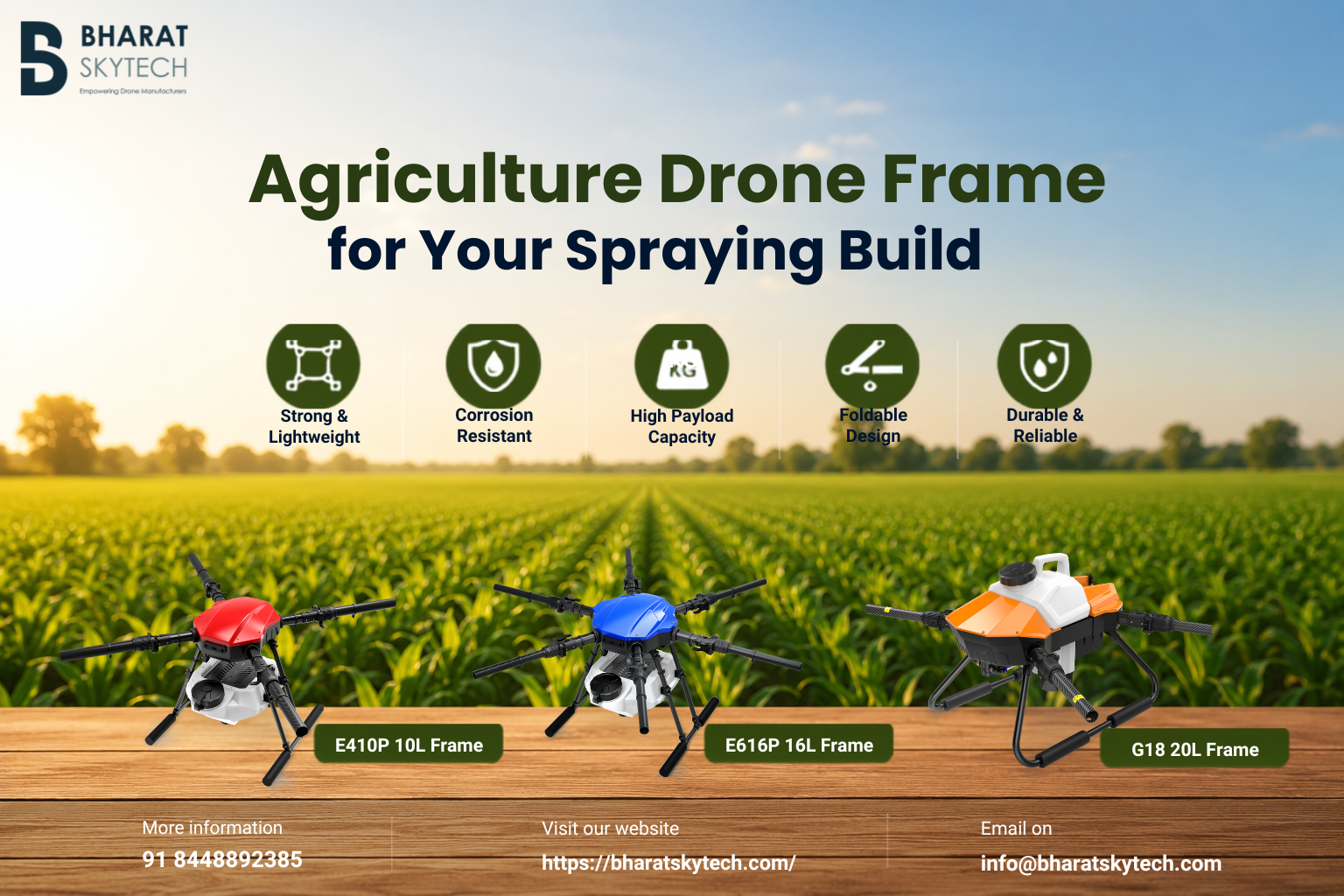
When people picture the “power” of an agriculture drone, they think of motors and batteries. When they picture the “brains,” they think of the flight controller. Almost nobody gives much thought to the frame — the skeleton that holds all of it together. And yet the frame is the single most consequential decision in the entire build, because it silently dictates what every other component can be. Choose the wrong agriculture drone frame and nothing downstream can save you: your propellers won’t have clearance, your payload won’t fit, your arms will flex and vibrate, or the whole airframe will corrode after one season of chemical spray. Choose the right one, and every other component slots into place around a rigid, reliable foundation.
This guide walks through exactly how to choose a spraying drone frame — wheelbase and payload class, motor configuration, arm strength, foldability, weather resistance, and how the frame ties into the rest of your power system.
Why the Frame Decides Everything Else on Your Drone
The frame is the foundation, and like any foundation, everything else is built on top of it and constrained by it.
The frame’s size determines how large a propeller you can swing without the blades clashing, which in turn determines how much thrust you can generate, which determines how much payload you can lift. The frame’s arm layout determines how many motors you run. Its material and construction determine how much vibration reaches your flight controller and sensors. Its weather sealing determines how long your electronics survive in the field. And its mounting points determine whether your tank, battery, and pump actually fit.
In other words, you do not choose a frame to match your components — you choose a frame first, and it sets the envelope your components must live within. Getting this order right is the whole point of understanding your agriculture drone power system before you buy anything.
Wheelbase & Payload Class — Matching the Frame to Your Tank
The most important frame specification is its wheelbase — the diagonal distance between opposite motors, usually given in millimetres. Wheelbase is shorthand for size, and size is shorthand for how much the frame can lift.
10L, 16L, 20L+ — reading frame sizes correctly
Agriculture frames in India are usually described by the spray tank they are built to carry: 10-litre, 16-litre, 20-litre, and larger. That figure is the most useful number for a buyer, because it tells you directly what payload class the frame is designed for. A 10L frame has a smaller wheelbase and lighter construction; a 16L or 20L frame is physically larger, with a longer wheelbase, beefier arms, and space for bigger propellers and motors.
Match the frame’s rated payload class to the tank you actually intend to fly. A frame rated for 10L will be structurally overwhelmed if you try to bolt a 16L tank onto it — the arms flex, the motors strain, and stability collapses.
Why tank size sets the frame, not the other way around
Here is the logic chain that trips up most first-time builders: your desired tank capacity sets your payload, your payload sets your required thrust, your required thrust sets your propeller size, and your propeller size sets the minimum wheelbase your frame must have to give those props clearance. So the decision genuinely flows from the tank down to the frame.
Decide how much you want to spray per trip first — honestly, based on your plot sizes and refill logistics — and then buy the frame class that supports it. Buying a frame because it looks impressive, then discovering it can’t lift the tank you need, is an expensive mistake. Tank capacity is a payload decision, as we explain in our agriculture drone spraying system guide.
Quadcopter vs Hexacopter vs Octocopter Frames
Agriculture frames come in different motor configurations, and the choice affects lift, redundancy, and cost.
A quadcopter (4 motors) is the simplest and most cost-effective layout. Fewer motors, ESCs, and propellers mean lower cost and easier maintenance, and modern heavy-lift quad motors are powerful enough for many spraying drones.
A hexacopter (6 motors) spreads the same total thrust across more motors, so each motor works less hard and runs cooler. Crucially, a hexacopter offers a degree of redundancy — if one motor fails, the remaining five can often keep the drone controllable enough to land safely. For an expensive drone carrying costly chemical over a field, that safety margin has real value.
An octocopter (8 motors), including coaxial X8 layouts where motors are paired, pushes redundancy and lift even further, and is used on the heaviest-payload platforms.
Motor count, redundancy and cost
There is no single right answer — it is a trade-off. More motors mean more thrust, more redundancy, and smoother load-sharing, but also more cost and more components to maintain. For most Indian spraying operations, a well-built quad or hexa frame in the right payload class is the sweet spot. Whatever you choose, the frame’s motor count directly sets how many ESCs and motors you’ll need to buy.
Arm & Tube Diameter — The Strength Number That Matters
If wheelbase tells you how big a frame is, arm tube diameter tells you how strong it is. The arms carry the motors, and the motors carry the entire weight of the drone plus payload through thrust. Under-built arms are one of the most common weak points in cheap frames.
Agriculture frames use hollow carbon-fibre tubes for the arms because carbon fibre offers an excellent strength-to-weight ratio. The tube’s diameter (and wall thickness) determines how much load it can bear without flexing. Thicker, larger-diameter tubes resist the bending and twisting forces that a heavy, vibrating motor puts on them.
Carbon fibre quality and why cheap tubes crack
Not all carbon fibre is equal. Genuine, properly-cured carbon-fibre tube is stiff and strong; cheap imitation tube can be under-cured, thin-walled, or partly fibreglass, and it flexes or cracks under sustained load. A flexing arm is not just a strength problem — it introduces vibration that degrades flight-controller stability and can throw off sensor readings.
When comparing frames, look at arm diameter, wall thickness, and the quality of the joints where arms meet the centre plate. Those joints are where stress concentrates and where poor frames fail first. Applying the same scrutiny to a frame that you would to any critical part is exactly the mindset in our drone components quality checklist.
Foldable vs Fixed Frames — Transport, Durability & Field Life
Most modern agriculture frames offer folding arms, and for good reason. A drone with a 16L or 20L wheelbase is a large object, and folding arms make it dramatically easier to transport between fields, load into a vehicle, and store. For a contract sprayer moving between multiple farms daily, foldability is close to essential.
The trade-off is at the folding joint. A folding mechanism is, by definition, a moving joint in a load-bearing arm — so it must be engineered well and locked securely before every flight. A quality folding frame uses robust clamps that hold the arm rigid in flight with no play; a poor one develops slop over time, introducing vibration and, in the worst case, arm movement mid-flight. Fixed frames avoid this entirely and can be marginally stiffer, but the transport penalty is significant.
For most Indian operators who move between fields, a well-made foldable frame is worth it — provided you inspect and lock the arms every single time.
IP Rating & Corrosion Resistance for Indian Field Conditions
This is the specification that separates a frame built for agriculture from a frame that merely looks the part — and it is increasingly a headline feature in 2026.
Chemical, dust and monsoon exposure
Agriculture drones operate in the harshest environment any drone faces. They are sprayed with corrosive pesticides and fertilizers, flown through dust, and used in humid, monsoon-affected conditions. An IP (Ingress Protection) rating tells you how well the frame and its sealed components resist dust and water. Higher IP ratings mean better sealing against the fine dust and moisture that destroy unprotected electronics.
For a spraying drone specifically, corrosion resistance is critical, because chemical residue attacks unprotected metal fasteners, connectors, and joints over time. Look for frames with corrosion-resistant hardware, sealed electronics bays, and good drainage so liquid doesn’t pool inside the airframe. A frame that survives one season but corrodes into unreliability by the next is a false economy. This weather resilience is also why your electronics — from the flight controller to the wiring — need matching protection.
Landing Gear, Tank Mounts & Component Layout
A good frame is not just arms and a centre plate — it is a thought-out platform for everything else.
Landing gear must be tall enough to give clearance for a full spray tank and the nozzles mounted beneath, and strong enough to absorb the repeated hard landings of field work. Tank mounts should securely hold the spray tank low and centred, because a tank that shifts in flight moves the drone’s centre of gravity and forces the flight controller to constantly compensate. Component layout matters too: the frame should provide protected, accessible space for the battery, flight controller, pump, and wiring, with sensible routing that keeps high-current power leads away from sensitive signal wires.
The best frames make assembly and maintenance easy. The worst force you to fight the layout every time you need to swap a battery or clear a clogged line.
Matching the Frame to Your Power System
The frame is the first link in the power chain, and everything connects back to it.
Frame → propeller clearance → motor → ESC → battery
The frame’s wheelbase sets your maximum propeller size (blades must clear each other and the frame). The propeller size sets the motor you need to swing it. The motor’s current draw sets the ESC rating. And the motor and ESC together set the battery voltage and capacity. This is why the frame can’t be chosen in isolation — it is the anchor point for the entire system, and a mismatch here cascades through every other component. Choose the frame with the finished drone in mind, not just the airframe.
Frame Price in India & What Drives Cost
Frame prices vary widely based on payload class, construction quality, and features. Larger frames with longer wheelbases, thicker carbon arms, folding mechanisms, and higher weather sealing cost more — and are worth more, because they are carrying more and enduring more.
The temptation to save money on the frame is strong, since it has no moving electronics and looks like “just structure.” Resist it. A frame is the one component whose failure is almost always catastrophic — a cracked arm mid-flight brings down the entire drone and everything mounted on it. Spending sensibly on a rigid, well-sealed, correctly-sized frame protects every rupee you spend on the expensive components bolted to it. (Prices shift with brand, size, and supply — confirm current figures before buying.)
Buy Agriculture Drone Frames from Bharat Skytech
The frame is the foundation of your entire drone, and it deserves the same care you give your motors and flight controller. Get the payload class, wheelbase, arm strength, and weather sealing right, and you have a platform that carries your investment reliably for seasons.
At Bharat Skytech, we supply genuine agriculture drone frames built for real Indian field conditions — correctly sized by payload class, with quality carbon-fibre construction and features suited to spraying work — along with the canopies, motors, and electronics that complete the build, and sales support to help you match the frame to the drone you actually want to fly. Explore our agriculture drone frame range and build on a foundation you can trust.
Frequently Asked Questions (FAQs)
How do I know what size frame I need?
Start from your target spray tank capacity. Choose a frame rated for that payload class (10L, 16L, 20L, etc.). The tank sets the payload, which sets the thrust and propeller size, which sets the minimum wheelbase — so the frame follows from the tank.
Is a quadcopter or hexacopter frame better for spraying?
A quad is simpler and cheaper; a hexacopter shares the load across more motors (so each runs cooler) and offers redundancy if a motor fails. For most operations, a well-built frame in the correct payload class matters more than the motor count itself.
Are foldable frames reliable enough for heavy payloads?
Yes, provided the folding clamps are well-made and you lock and inspect them before every flight. Foldability is a major transport advantage for operators moving between fields. Avoid frames with loose or worn folding joints.
Why does IP rating matter for an agriculture drone frame?
Because spraying drones face corrosive chemicals, dust, and moisture. Better sealing and corrosion-resistant hardware keep water and dust out of your electronics and prevent the frame from degrading after a season of field use.
Can I put a bigger tank on my existing frame later?
Only within the frame’s rated payload class. Fitting a tank heavier than the frame is designed for overstresses the arms and motors and destabilises the drone. If you want more capacity, plan for a larger frame class from the start.