

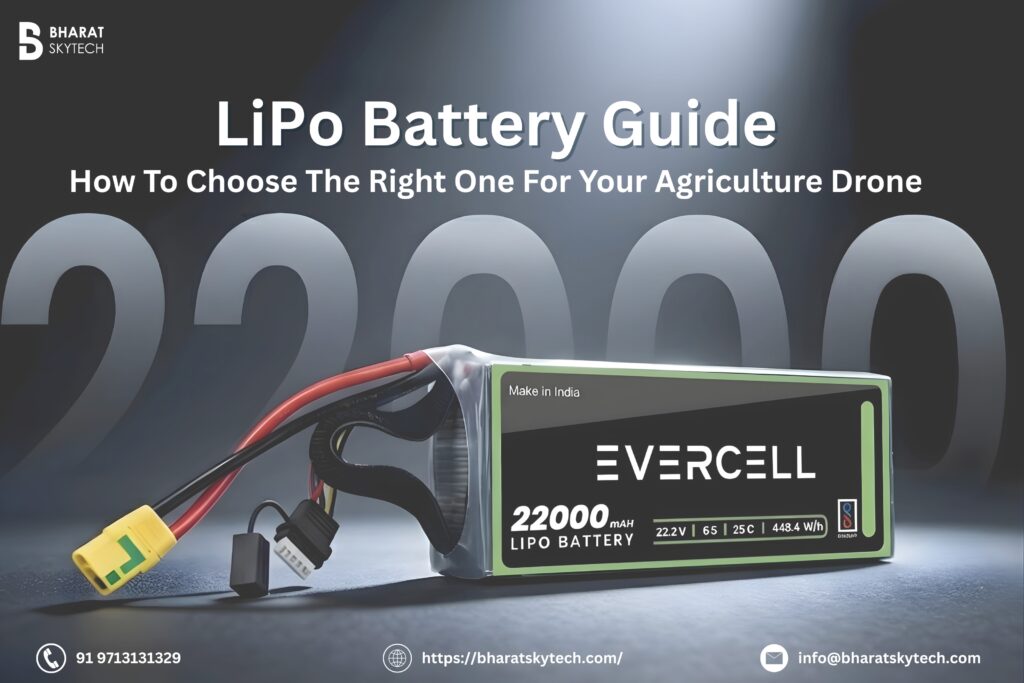
LiPo battery selection is one of the most critical decisions you will make when setting up or upgrading your agriculture drone. Get it wrong, and you risk mid-flight failures, crop coverage gaps, or even costly equipment damage. Get it right, and your drone becomes a reliable workhorse capable of covering hundreds of acres season after season. Whether you are a drone operator, an agri-tech entrepreneur, or a farmer exploring precision agriculture, this guide will walk you through everything you need to know to make a confident, informed choice.
What Is a LiPo Battery and Why Does It Matter for Agriculture Drones?
A Lithium Polymer (LiPo) battery is a rechargeable energy storage solution that uses a polymer electrolyte instead of a liquid one. This design results in a lightweight, high-energy-density pack that can deliver large bursts of current — exactly what heavy-lift agriculture drones demand during take-off, payload carrying, and rapid directional changes.
Agriculture drones are not recreational quadcopters. They carry pesticide tanks, seed spreaders, and multispectral sensors while flying low and fast over fields. This operational profile demands batteries that can:
- Sustain high continuous discharge without voltage sag
- Endure repeated charge-discharge cycles across an entire spray season
- Operate reliably in hot summers, humid monsoons, and cold winter mornings
- Comply with Indian regulatory safety standards
This is precisely why choosing the right drone battery goes far beyond picking the cheapest option on a marketplace.
Key Specifications to Evaluate Before Buying
1. Cell Count (S Rating) and Voltage
Agriculture drones typically run on 6S LiPo configurations (six cells in series), which deliver a nominal voltage of 22.2V and a maximum charge voltage of 25.2V. Higher voltage means the motors can spin efficiently with less current draw, reducing heat buildup and extending both flight time and motor lifespan.
Always match the battery’s S rating to your drone’s ESC (Electronic Speed Controller) and motor voltage specifications. Running a mismatched battery can permanently damage your propulsion system.
2. Capacity (mAh)
Battery capacity is measured in milliampere-hours (mAh). For agriculture drones, capacity directly translates to coverage area per flight. A 22,000 mAh (22 Ah) battery can typically support 10–15 minutes of loaded flight, covering several acres before needing a swap.
When evaluating capacity, also consider the payload weight of your drone. A heavier tank of liquid fertiliser draws more current, reducing effective flight time. Always calculate your real-world flight time under load, not just manufacturer estimates.
3. Discharge Rate (C Rating)
The C rating tells you how fast a battery can safely discharge relative to its capacity. For agriculture drones, you need:
- Continuous discharge rate of at least 10C for sustained flight operations
- Pulse discharge rate of 25C or higher for short bursts during aggressive manoeuvres
A higher C rating also means better voltage stability under load — your motors receive consistent power even when the battery is partially depleted, preventing the erratic flight behaviour that can lead to crashes.
4. Operating Temperature Range
Indian agriculture spans environments from the scorching plains of Rajasthan to the misty hills of Assam. Your drone battery must handle:
- Charging temperatures between 0°C and 45°C
- Discharge temperatures from -20°C to as high as 60°C in peak summer conditions
- Storage temperatures between 0°C and 35°C for long off-season periods
Batteries not rated for extreme temperatures will suffer accelerated capacity degradation, swelling, or outright failure.
5. BIS Certification
For commercial agricultural drone operators in India, BIS (Bureau of Indian Standards) certification is not optional — it is increasingly a regulatory expectation and a sign that the battery has been tested against Indian safety benchmarks. Always verify this before purchasing batteries for professional use.
Understanding Battery Chemistry: Why LiPo Still Leads
While newer chemistries like Li-Ion (Lithium-Ion) and LiHV (Lithium High Voltage) are gaining ground, LiPo batteries remain the dominant choice for agriculture drones for several reasons:
- Superior power-to-weight ratio compared to NiMH or lead-acid
- Flexible form factors allow manufacturers to design compact, aerodynamic battery packs
- Fast charge capability (up to 1C fast charging) minimises downtime between flights
- High discharge current supports the multi-motor, multi-ESC architecture of modern spray drones
The trade-off is that LiPo batteries require careful storage and handling. Storing them at full charge for extended periods degrades cell health. Always store at 50–60% charge (storage voltage) and avoid puncture, overcharging, or deep discharge below the cut-off voltage.
How to Match Battery Capacity to Your Operational Needs
Here is a practical framework for agriculture drone operators:
| Farm Size | Recommended Capacity | Expected Flights Per Day |
|---|---|---|
| Small (under 5 acres/day) | 6,000–10,000 mAh | 4–6 |
| Medium (5–20 acres/day) | 12,000–16,000 mAh | 6–10 |
| Large (20+ acres/day) | 20,000–22,000 mAh | 8–14 (with multiple packs) |
Note: Investing in multiple LiPo battery packs and a multi-port fast charger is often more cost-effective than relying on a single high-capacity pack, as it helps reduce downtime during long spraying operations.
Introducing Evercell LiPo Battery by Bharat Skytech – Built for Indian Agriculture
One of the most promising battery solutions now entering the Indian agriculture drone market is the Evercell LiPo Battery – 6S Series, offered by Bharat Skytech. Designed specifically for professional UAV applications across agriculture, surveillance, and mapping, the Evercell range is available in capacities from 1,500 mAh to 22,000 mAh, making it suitable for a wide spectrum of drone platforms and operational requirements.
Evercell 6S LiPo Battery – Technical Specifications
| Parameter | Specification |
|---|---|
| Battery Chemistry | Lithium Polymer (Li-Po) |
| Rated Capacity | 22 Ah (22,000 mAh) |
| Charge Voltage (Max) | 25.2 V |
| Discharge Cut-off Voltage | 20.0 V |
| Standard Charge Current | 0.5C (11 A) |
| Fast Charge Current | 1C (22 A) |
| Continuous Discharge Rate | 10C (220 A) |
| Pulse Discharge Rate | 25C (≤ 3 seconds) |
| Cell Type | Li-Po Pouch Cell |
| Operating Temp (Charge) | 0°C to 45°C |
| Operating Temp (Discharge) | -20°C to 60°C |
| Storage Temperature | 0°C to 35°C |
| Certification | BIS Certified |
| Application | Agriculture Drone, Surveillance UAV, Mapping Drone |
Why Evercell Stands Out for Indian Drone Operators
The 10C continuous discharge rate delivering up to 220 A ensures that your drone’s motors receive stable, high-power output even during demanding operations like spraying on windy days or navigating uneven terrain. The 25C pulse capability handles the sudden current spikes that occur during rapid ascent or payload shift without causing voltage drops that could destabilise the flight controller.
The -20°C to 60°C discharge temperature range is a standout feature for Indian operators. Whether you are spraying winter wheat in Punjab at dawn or working rice paddies in Andhra Pradesh through the summer afternoon heat, the Evercell battery maintains reliable performance across these extremes.
The BIS certification gives commercial drone operators in India the assurance that these batteries comply with national safety standards — reducing liability and ensuring insurability for professional operations.
With its Li-Po Pouch Cell construction, the Evercell battery achieves an optimal balance of energy density and form factor, making it easy to integrate into the standard battery bays of most mid-range and heavy-lift agriculture drones available in the Indian market.
LiPo Battery Safety Tips for Agriculture Drone Operators
Even the best LiPo battery can become dangerous without proper handling. Follow these essential practices:
- Never discharge below cut-off voltage (20V for 6S): deeply discharged LiPo cells can vent or catch fire during recharging
- Use a balance charger to ensure all cells charge evenly and remain within tolerance
- Inspect for swelling before every flight — a puffy battery is a damaged battery and must be retired immediately
- Store in a LiPo-safe bag or fireproof container, especially during transport
- Avoid charging in direct sunlight or inside a hot vehicle; charging temperature should stay within 0°C–45°C
- Log your charge cycles — most agriculture drone LiPo packs have a usable life of 200–500 cycles depending on usage intensity and care
Final Thoughts: Invest Wisely in Your Drone Power System
Your LiPo battery is not an accessory — it is the heart of your agriculture drone’s power system. Choosing a high-quality, specification-matched, safety-certified battery like the Evercell 6S LiPo by Bharat Skytech is an investment that pays dividends in operational uptime, crop coverage consistency, and long-term cost savings.
As India’s drone-based precision agriculture sector continues to expand — driven by government support, rising input costs, and the need for sustainable farming practices — the demand for reliable, India-ready drone power solutions will only grow. Make sure your battery choice is ready to scale with your operations.