


Every agriculture drone that lifts a heavy spray tank into the air and holds it steady over a field is really a carefully balanced team of five components working as one. Get that team right and your drone flies efficiently, lifts its rated payload, and lasts for seasons. Get one part wrong and the whole thing overheats, underperforms, or falls out of the sky. That team is called the agriculture drone power system — the propeller, motor, ESC, battery, and flight controller that together turn stored electrical energy into controlled, payload-carrying flight. This guide explains how the whole system works as a chain, how to match each component to the next, and how to calculate the thrust and all-up weight that determine everything. Think of it as the map; each component also has its own detailed guide linked along the way.
What Is an Agriculture Drone Power System?
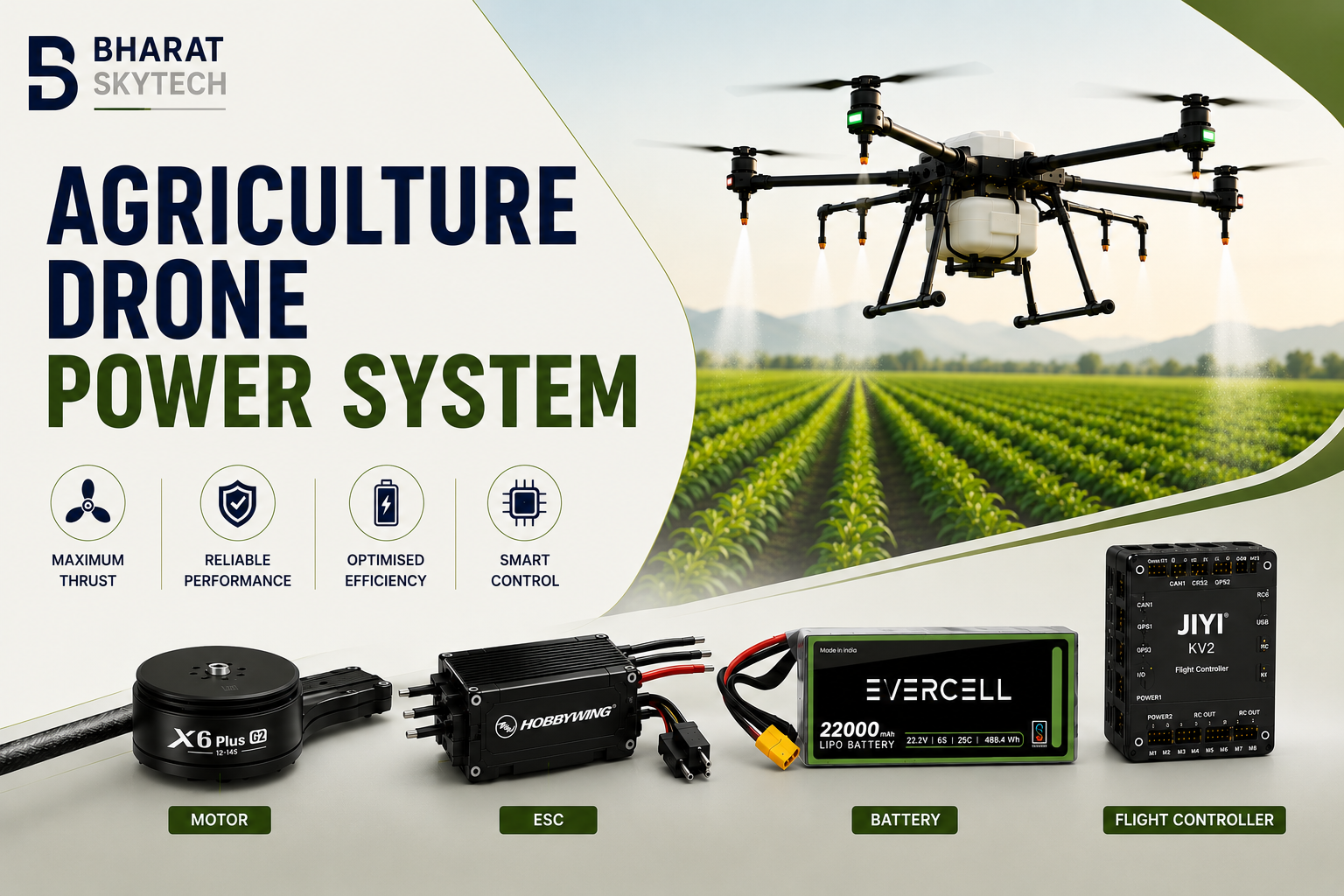
The power system is the set of components responsible for generating and controlling lift. In a spraying drone it consists of five parts, each depending on the one before it:
- Propeller — bites the air and converts rotation into thrust.
- Motor — spins the propeller, converting electrical power into mechanical rotation.
- ESC (Electronic Speed Controller) — feeds the motor precisely timed power based on flight controller commands.
- Battery — supplies the high-voltage, high-current energy the whole system draws.
- Flight controller — the brain that decides how fast each motor should spin to keep the drone stable and on course.
The payload — your spray tank and its liquid — is not part of the power system, but it is the reason the power system has to be as strong as it is. Everything is sized around how much weight you need to lift. This is exactly why an agriculture drone components guide has to treat these parts together rather than in isolation.
How the Power Chain Works — Why Payload Decides Everything
The single most important idea in this whole guide is that the power system is a chain, and the chain is designed backwards from your payload.
Here is the logic. You decide your tank size — say 16 litres. That fixes your maximum payload weight. Add the weight of the frame, battery, and components, and you get your total all-up weight (AUW). To lift that weight with stability and reserve, you need a certain amount of total thrust. That thrust requirement dictates how large your propellers must be. The propeller size and pitch dictate how much torque and power the motor must produce, which fixes the motor’s specification. The motor’s maximum current draw then dictates the ESC’s current rating. And the motor and ESC together fix the battery voltage and the current the pack must safely deliver. The flight controller sits across all of it, commanding the system.
Miss one link and the chain breaks: an oversized propeller on an undersized motor stalls; a powerful motor on a weak ESC burns the ESC; a high-draw system on a low-C-rating battery sags and crashes. Drone motor, ESC and propeller matching is not a detail — it is the entire discipline of building a reliable agriculture drone.
Component 1 — The Propeller (Where Thrust Begins)
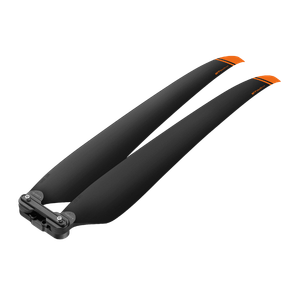
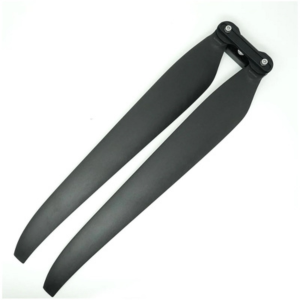
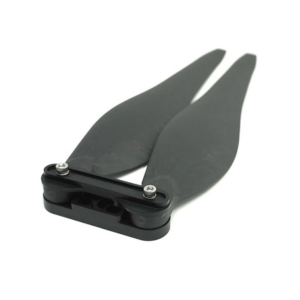
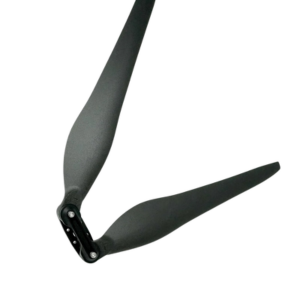
Thrust starts at the propeller. It is the part that actually pushes air downward to lift the drone, so its diameter and pitch set the ceiling on how much weight your drone can carry. Agriculture drones use large propellers — often in the range of 28 to 36 inches — because bigger blades move more air and generate the high thrust heavy tanks demand. Most are made of carbon fibre and fold for transport and storage.
What to look for in an agriculture drone propeller
Match the propeller to your motor and payload, not the other way around. Too large or too aggressive a pitch and the motor and ESC will pull more current than they are rated for, overheating both. Too small and you will not generate enough lift. Balance, stiffness, and build quality also matter enormously, because an unbalanced or flexing prop creates vibration that degrades flight stability and stresses every other component. For the full breakdown of sizing and selection, see our drone propeller solutions guide.
Component 2 — The Motor (Turning Power into Lift)
The motor spins the propeller. For agriculture drones these are brushless motors built for high torque and sustained heavy load rather than high speed. Their key rating is KV — the revolutions per minute per volt. This is where farming drones differ sharply from racing drones.
Why low-KV motors rule heavy-lift farming
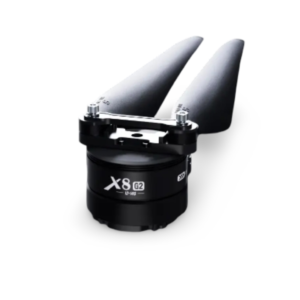
Heavy-lift agriculture motors use a low KV rating (commonly around 100 KV), because low KV produces high torque at lower RPM — exactly what you want to swing a large propeller and lift a heavy tank efficiently. A high-KV motor spins fast but lacks the twisting force to turn big blades under load, and it runs hot doing so. Choosing the right motor means reading its thrust chart: how much lift it produces at a given voltage and propeller, and how much current it draws to do it. That current figure is what you will size your ESC and battery around. Our guide on the CW brushless motor for high-payload agriculture drones explains how to read those numbers, and you can browse options in the agriculture drone motor category.
Component 3 — The ESC (The Critical Link)
The ESC is the translator between the flight controller’s commands and the motor’s movement. It converts the battery’s DC power into the timed three-phase power a brushless motor needs, adjusting motor speed hundreds of times per second. It is the most overlooked component and one of the most common points of failure.
Current and voltage matching in one line
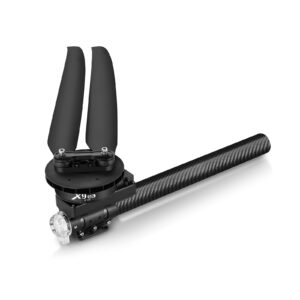
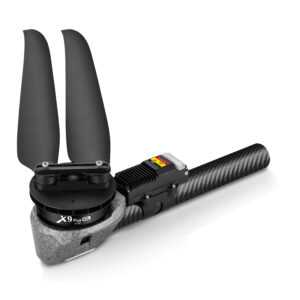
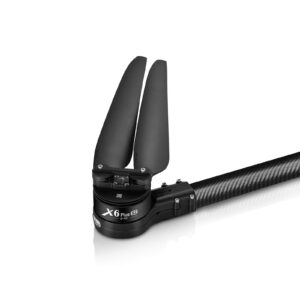
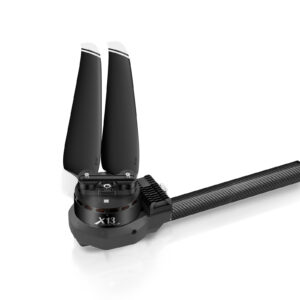
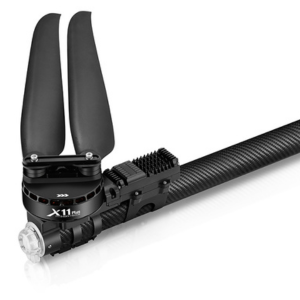
Two numbers keep an ESC alive: its continuous current rating must exceed your motor’s maximum current draw by at least 20–30%, and its voltage range must match your battery’s cell count. Ignore either and the ESC overheats and burns out, often taking the motor with it. Many agriculture builds avoid this guesswork entirely by using integrated power systems — like the Hobbywing X-series — where motor, ESC, and propeller come matched as a unit. The full detail is in our dedicated ESC for agriculture drones guide, and matched combos are covered in our Hobbywing X6, X8, X9 and X11 guide.
Component 4 — The Battery (Fuel for the System)
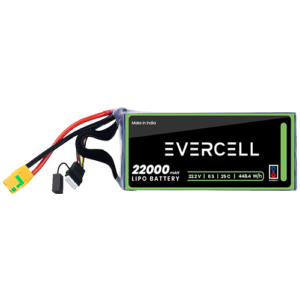
The battery powers everything above it. Agriculture drones run on high-voltage LiPo packs because lifting heavy payloads demands large amounts of power. Two specifications define a pack: its voltage (expressed as cell count, such as 12S or 18S) and its capacity (in mAh), which together with the current draw determine flight time.
Voltage, capacity and flight time
Higher voltage lets the system deliver more power at lower current, which reduces heat and stress across the ESC and motor — one reason larger drones move to higher cell counts. Capacity determines how long you can fly per charge, but bigger packs also weigh more, which eats into payload. The pack’s C-rating matters too: it must be able to discharge enough current to feed the motors during peak demand without voltage sag. Choosing the right battery is a balance of voltage, capacity, weight, and discharge rate, all covered in our LiPo battery guide for agriculture drones. Explore packs in the drone battery category.
Component 5 — The Flight Controller (The Brain)
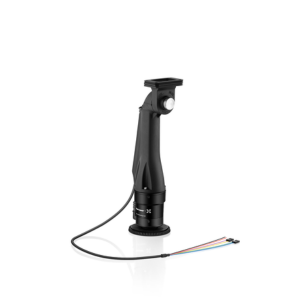
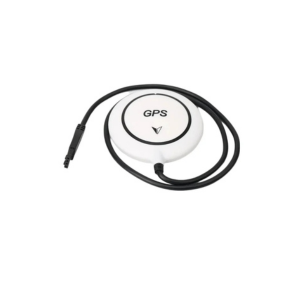
If the other four components are the muscles, the flight controller is the brain. It reads sensors — gyroscope, accelerometer, compass, GPS — and constantly adjusts how fast each motor spins to keep the drone level, stable, and on its planned path. For agriculture drones it also manages autonomous spraying missions, waypoint routes, and the spray pump.
Where RTK precision fits in
A standard flight controller with GPS holds position to within a metre or two. For precision spraying, many operators add an RTK module, which upgrades positioning to centimetre-level accuracy — eliminating spray overlap and skipped rows across autonomous missions. Whether you need it depends on your operation’s scale. Start with our guide on selecting the best flight controller for agriculture drones, learn how to connect everything in our flight controller pairing guide, and decide on precision with our RTK module for agriculture drones guide.
The Agriculture Drone Power System at a Glance
Before the math, here is the whole chain in one view — what each component does, its key rating, and what decides that rating:
| Component | Its job | Key rating to check | Dictated by |
|---|---|---|---|
| Propeller | Generates thrust from rotation | Diameter & pitch (e.g. 28–36 in) | Payload / required thrust |
| Motor | Spins the propeller | KV rating (low, ~100 KV) + thrust chart | Propeller size & thrust target |
| ESC | Controls motor speed & power | Continuous current (A) + voltage class | Motor’s max current draw (+20–30%) |
| Battery | Powers the whole system | Voltage (12S/18S), capacity (mAh), C-rating | Motor/ESC voltage & peak current |
| Flight controller | Coordinates & stabilises | Sensor suite, protocol, RTK support | The whole system + mission needs |
Read the table top to bottom and you are reading the build order in reverse: payload sets the thrust, thrust sets the propeller, the propeller sets the motor, the motor sets the ESC, and the motor and ESC together set the battery — with the flight controller commanding all of it.
Thrust, All-Up Weight & Payload — The Math That Ties It Together
This is the section that turns theory into a real build. Everything comes down to two calculations: how much your drone weighs, and how much thrust it can produce.
Thrust-to-weight ratio explained
For a stable agriculture drone that can hover comfortably and still fight wind, aim for a thrust-to-weight ratio of about 2:1. That means your motors’ combined maximum thrust should be roughly double your all-up weight. At 2:1, the drone hovers at around half throttle, leaving plenty of headroom for control, gusts, and a full tank. Anything much lower and the drone struggles to lift or becomes unstable; there is little reserve for safety.
A practical way to express usable payload is:
Usable payload ≈ (single-motor max thrust × number of motors × 0.7) − empty weight
The 0.7 factor keeps roughly a 30% thrust reserve so you are never flying at the ragged edge. These are rules of thumb, not precise engineering figures — always cross-check against your motor’s actual thrust chart.
A worked example for a 10L spraying drone
Suppose you want a 10-litre spraying drone. Water and chemical fill the tank to roughly 10 kg. Add the frame, battery, motors, and electronics — call the empty weight around 9 kg. Your all-up weight is therefore about 19 kg with a full tank.
At a 2:1 thrust-to-weight ratio, you need about 38 kg of total thrust. On a four-motor (quad) layout, that is roughly 9.5 kg of thrust per motor at full power — so you would choose a motor and propeller combination rated to deliver that with margin, then select an ESC rated 20–30% above that motor’s current draw, and a battery whose voltage and C-rating can feed the whole system. On a six-motor (hexacopter) layout, the same total thrust is spread across more motors, so each motor needs to produce less — around 6.3 kg — which is gentler on every component and adds redundancy. This is precisely how the chain flows from payload back through every part of the power system.
Voltage Classes — 12S vs 18S Power Systems
Agriculture power systems are usually built around a voltage class, and it is worth choosing deliberately. 12S packs are a common choice for mid-size spraying drones in the 10–16 litre range, offering a strong balance of power and cost. 18S systems — such as those built around the high-thrust Hobbywing X13 — suit larger, heavier drones that need more power delivered efficiently.
The trend in 2026 is toward higher voltage as farms adopt bigger payloads, because higher voltage delivers the same power at lower current, which means less heat and less stress on the ESC, wiring, and connectors. Whatever class you pick, every component — motor, ESC, and battery — must be rated for it. Mixing voltage classes is one of the fastest ways to destroy expensive parts.
Common Power System Mistakes (and How to Avoid Them)
Even experienced builders trip over the same issues. Watch for these:
- Sizing components in isolation. Buying a “powerful” motor without checking whether your ESC, propeller, and battery match it is the number one cause of failures. Always design the whole chain together.
- Ignoring the current safety margin. An ESC rated exactly at the motor’s max draw will overheat. Keep that 20–30% headroom.
- Over-propping. Fitting a larger propeller than the motor and ESC support forces excess current and burns out the ESC.
- Under-rating the battery. A pack with too low a C-rating sags under peak load, causing power loss mid-flight.
- Mismatched voltage classes. Running an 18S pack into 12S-rated electronics is instantly destructive.
- Buying counterfeit parts. A fake ESC or battery that fails under load can take the whole power system down. Genuine components are cheaper than the crash they prevent — a principle we detail in our drone components quality checklist for new buyers.
Build Your Agriculture Drone Power System with Bharat Skytech
An agriculture drone is only as good as the weakest link in its power system. The real skill is not buying the single best part — it is matching all five components into a balanced, reliable chain sized for your payload and your fields.
At Bharat Skytech, we supply genuine, performance-tested motors, ESCs, propellers, batteries, and flight controllers for Indian agriculture drones — including complete matched Hobbywing power systems — backed by expert sales support that helps you build the chain correctly the first time. Whether you are assembling a new 10L or 16L spraying drone or upgrading to higher payload, start with the motor, drone electricals, and battery ranges and build a power system that performs season after season.
Frequently Asked Questions (FAQs)
What are the five parts of a drone power system?
The propeller, motor, ESC, battery, and flight controller. The propeller generates thrust, the motor spins it, the ESC controls the motor, the battery powers everything, and the flight controller coordinates it all.
How do I match a motor, ESC, propeller and battery?
Start from your payload and all-up weight, size your propeller and motor to produce about twice that weight in thrust, choose an ESC rated 20–30% above the motor’s max current draw, and pick a battery whose voltage and C-rating support the system. Read each component’s dedicated guide for detail.
What thrust-to-weight ratio should an agriculture drone have?
Around 2:1 is the practical target — total motor thrust roughly double the all-up weight — so the drone hovers near half throttle with reserve for wind and control.
Should I choose 12S or 18S?
12S suits many 10–16L drones; 18S suits larger, heavier, high-thrust builds. Higher voltage runs cooler at the same power. Ensure every component is rated for whichever class you pick.