
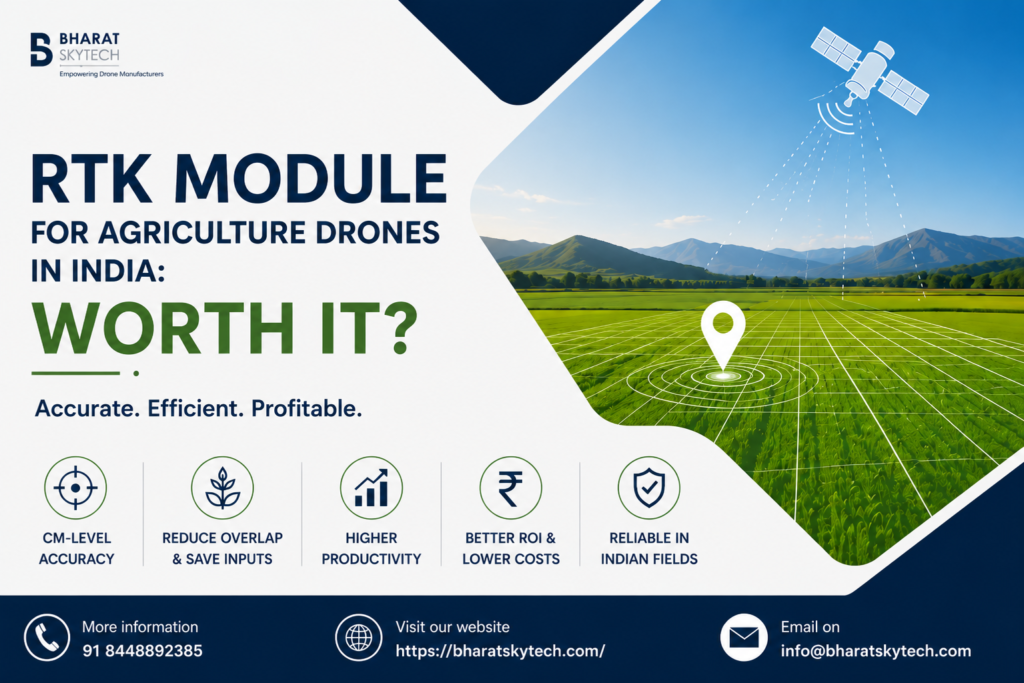
If you operate or build agriculture spraying drones in India, you have almost certainly heard the phrase “centimetre-level accuracy” thrown around in every 2026 product launch. Behind that promise sits one component: the RTK module. An RTK module for agriculture drones can be the difference between a clean, gap-free spray pass and a field with double-sprayed strips, wasted chemical, and missed rows.
But RTK is also expensive, slightly more complex to set up, and not strictly necessary for every operator. So the real question for Indian farmers, FPOs, and contract sprayers is simple: do you actually need it, and is it worth the money in 2026? This guide answers that in plain language — covering how RTK works, RTK vs GPS, real India price bands, compatibility, DGCA and subsidy relevance, and how to choose the right module for your drone.
What Is an RTK Module and Why Indian Farmers Are Asking About It in 2026
RTK stands for Real-Time Kinematic positioning. In simple terms, it is a technology that upgrades your drone’s standard satellite navigation from “roughly here” to “exactly here.” It does this by adding a correction signal that cancels out the tiny errors normal GPS receivers cannot fix on their own.
For a spraying drone, position is everything. Every waypoint, every swath width, every turn at the edge of the field depends on the drone knowing precisely where it is. A small positioning error multiplied across hundreds of passes becomes overlapping spray, skipped rows, and uneven coverage — which directly translates into wasted pesticide and lower crop protection.
RTK vs standard GPS — the centimetre-vs-metre difference
A standard GPS or GNSS module — the kind found in most flight controllers — typically delivers accuracy in the range of 1 to 3 metres. That is perfectly fine for holding position, returning to home, and basic autonomous flight. But a 1–2 metre drift on a spray boom is enormous when crop rows are spaced just centimetres apart.
An RTK system tightens that accuracy to roughly 1 to 2 centimetres. That is around a hundred times more precise. For autonomous, waypoint-driven spraying missions, this is the level of accuracy that eliminates double-spraying overlaps and ensures no part of the field is left untreated.
Why RTK is suddenly trending in Indian precision agriculture
Three forces are pushing RTK system for precision farming in India into the spotlight in 2026. First, agriculture drone adoption has exploded thanks to government subsidy schemes, creating a large base of operators who now want better results, not just a working drone. Second, contract spraying has become a genuine rural business, and service providers covering 200–300 acres a month cannot afford chemical wastage or re-spraying. Third, newer subsidy-grade and DGCA-aligned drones increasingly ship with RTK as a headline feature, making farmers aware of it and curious whether their existing or self-built drone can match that precision.
How RTK Works on an Agriculture Drone (Base, Rover & NTRIP Explained Simply)
Understanding how RTK works in agriculture drones makes the buying decision far easier. An RTK setup has two parts working together.
The base is a fixed reference point whose exact location is precisely known. It continuously watches the same satellites your drone sees and calculates the small errors creeping into those signals — errors caused by the atmosphere, satellite timing, and signal bounce.
The rover is the RTK module sitting on your drone. It receives the base’s correction data in real time and applies it to its own raw satellite readings. The result is a position fix accurate to a couple of centimetres, updated live during flight. When everything locks in correctly, your system reports an “RTK FIX” status — the green light that tells you the drone is flying with survey-grade precision.
Base station vs NTRIP network correction — which suits Indian connectivity
There are two ways to get that correction signal, and the right choice depends heavily on where you fly.
A physical base station is your own receiver, set up near the field, broadcasting corrections directly to the drone. It works anywhere — including remote farms with no mobile signal — but it is extra hardware to buy, carry, and set up before each job.
An NTRIP correction service streams the same data over the internet from a network of permanent reference stations, removing the need to own a base station. It is faster to start and ideal where 4G coverage is reliable. The trade-off is that in low-network rural belts — exactly where a lot of Indian spraying happens — NTRIP can be unreliable, making a portable base station the safer pick. Many serious operators keep both options open.
How RTK talks to your flight controller and GPS module
The RTK module does not work in isolation. It feeds its corrected position into your drone’s flight controller, which uses it to follow the planned spray route. This is why compatibility matters so much: your RTK module, GPS/navigation unit, and flight controller all need to speak the same language. If you are still finalising your build, our guide on how to pair your drone flight controller with agriculture drone components walks through getting these parts to work together cleanly.
RTK vs GPS for Agriculture Drones — Side-by-Side Comparison
The core decision most buyers face is RTK vs GPS for drones. Both get the job done — but at very different levels of precision, cost, and complexity.
Accuracy, spray overlap and chemical savings
A standard GPS module holds the drone within a metre or two of its intended path. Over a single pass that sounds acceptable, but precision farming is about cumulative accuracy. RTK’s centimetre-level fix keeps every swath edge tight against the next, which means dramatically less overlap and far fewer skipped strips. Tighter passes reduce chemical usage — a meaningful saving when input costs keep rising — and produce more uniform crop protection, which is the entire point of switching to drone spraying in the first place.
Cost, power draw and setup complexity
GPS modules are inexpensive, draw little power, and are essentially plug-and-fly. RTK modules cost more, demand a correction source (base station or NTRIP), and require a few extra setup steps to achieve a stable FIX. RTK also draws slightly more power and can be sensitive to a weak fix in poor conditions. None of this is a deal-breaker — but it is real, and it is why RTK is an upgrade rather than a default.
When a good GPS module is "enough" (and when it isn't)
Here is the honest truth that many sellers skip: a well-tuned standard GPS module — paired with a properly configured flight controller — can deliver perfectly acceptable coverage for smaller operations. In Indian skies with GPS, GLONASS, and BeiDou all visible, it is common to see 15–25 satellites locked with excellent signal quality, which gives standard GPS a strong baseline.
RTK becomes genuinely worth it when you are running professional, high-volume, autonomous waypoint missions where every centimetre and every litre of chemical counts. If that is not yet your operation, a reliable GPS module like the JIYI GPS module for the K++ V2 flight controller may be the smarter starting investment.
Do You Actually Need RTK? A Decision Guide by Farm Size & Crop
The best RTK decision is based on how you fly, not just on the marketing.
Small farms and contract sprayers under 20 acres
If you spray small, irregular plots or are just starting a contract-spraying side business, RTK is usually optional. A quality GPS module with good flight-controller tuning will cover these jobs well, and the saved budget is often better spent on spare batteries, propellers, and nozzles that keep you flying through the season.
FPOs, CHCs and large commercial operators
For Farmer Producer Organisations, Custom Hiring Centres, and full-time service providers covering large daily acreage, RTK pays for itself. At scale, the chemical savings from eliminated overlap and the productivity gains from confident, fully autonomous missions add up quickly. This is the segment where best RTK GPS for a spraying drone is a serious search, not a curiosity.
Crop-specific cases (paddy, cotton, sugarcane, orchards)
Crop type matters too. Dense, uniform row crops like paddy, cotton, and wheat benefit most from RTK’s tight, repeatable swaths. Orchards and tree crops, where flight paths are more variable and canopy penetration is the priority, may depend more on payload, nozzle choice, and flight height than on raw positioning accuracy. Matching the component to the crop is the same principle we cover in our drone components quality checklist for new buyers.
RTK Module Price in India (2026) & What Affects Cost
Let’s talk numbers, because agriculture drone RTK price in India is what most buyers really want to know.
Entry vs professional RTK kits — typical price bands
As a broad 2026 guideline, RTK GPS units for drones in India commonly range from around ₹25,000 to well over ₹1,00,000 for the module alone, depending on brand, GNSS capability, and build quality. Entry-level RTK options sit at the lower end and suit operators upgrading a single drone. Professional, multi-constellation modules with rugged, field-grade construction occupy the upper bands and are aimed at commercial fleets. (Prices move with import duties, brand, and supply, so always confirm current pricing before purchase.)
Hidden costs: base station, NTRIP subscription, and a compatible flight controller
The module price is only part of the story. A full RTK setup may also need a base station if you fly in low-network areas, or an ongoing NTRIP subscription if you rely on internet corrections. You may also need a flight controller that properly supports RTK input. Factoring these in upfront prevents an unpleasant surprise after you have already bought the module. Browsing the complete flight controllers and radars category first helps you confirm compatibility before you commit.
How to Choose the Right RTK Module for Your Drone
Once you have decided RTK is right for you, choosing the correct unit comes down to a few practical checks.
Flight controller and GPS module compatibility checklist
This is the number one mistake new buyers make. Your RTK module must be compatible with your flight controller and overall navigation stack. Confirm supported protocols, connectors, and firmware before buying. If you are choosing a controller around the same time, our guide on how to select the best flight controller for agriculture drones pairs perfectly with this step.
GNSS constellation support (GPS, GLONASS, BeiDou, Galileo)
A good RTK module should track multiple satellite constellations — GPS, GLONASS, BeiDou, and Galileo. More constellations mean more satellites in view, faster fixes, and more stable performance, which is especially valuable across India’s varied terrain and weather. Multi-constellation support is one of the clearest markers separating a basic unit from a professional one.
Build quality for Indian field conditions (dust, humidity, heat)
Indian agriculture is hard on hardware. Dusty environments, high kharif-season humidity, intense heat, and rough transport all take their toll. Choose an RTK module built to withstand these conditions rather than the cheapest option available. Durability here protects your larger investment in the drone itself — the same logic that drives operators toward reliable, field-tested parts across every component category.
RTK, DGCA Compliance & Subsidy-Grade Drones
There is a regulatory and financial angle to RTK that is easy to overlook.
Why precision logging matters for approvals and subsidies
India’s drone ecosystem runs on registration, certification, and increasingly on data. Precise positioning and clean flight logs support compliant, well-documented operations — which matters when accessing subsidy schemes and meeting operational expectations. Government programmes such as SMAM (offering 40–50% subsidy to eligible farmers and higher support to FPOs and CHCs) and the Drone Didi initiative (with substantial financial assistance for women-led self-help groups) have created a large, fast-growing base of operators who want their drones to perform to a professional standard. RTK fits naturally into that picture. To stay on the right side of the rules, pair this with our breakdown of the DGCA drone rules in India for 2026.
Setting Up & Maintaining Your RTK System
RTK is not “fit and forget” — but it is not difficult either once you understand the basics.
Common RTK FIX issues and quick fixes
The most frequent frustration is failing to achieve or hold an RTK FIX. Usual culprits include a weak or interrupted correction signal, obstructed sky view, loose connections, or incorrect configuration in the flight controller. The fixes are usually straightforward: ensure a clear line of sky, verify your base or NTRIP connection is stable, double-check wiring and firmware settings, and allow the system enough time to converge before launch. Our K++ V2 setup guide for better flight accuracy covers the configuration mindset that carries directly into RTK tuning.
Buy Genuine RTK & Navigation Components from Bharat Skytech
RTK delivers its promised centimetre accuracy only when every part of the chain — module, GPS, flight controller, and wiring — is genuine and correctly matched. Counterfeit or mismatched components are the fastest way to lose your FIX in the middle of a paying job.
At Bharat Skytech, we supply authentic agriculture drone navigation and flight-control components built for real Indian field conditions, backed by sales support that helps you choose the right setup the first time. Whether you are upgrading an existing sprayer to RTK precision or building a new drone from the ground up, the right guidance saves you money and downtime. Explore our flight controllers and navigation components to get started.
Frequently Asked Questions (FAQs)
Is an RTK module worth it for a 10L agriculture drone?
For occasional small-plot spraying, a quality GPS module is often enough. If you run that 10L drone as a busy contract-spraying business across large daily acreage, RTK’s reduced overlap and chemical savings make it worth considering.
Can RTK work without internet in remote villages?
Yes. NTRIP correction needs the internet, but a physical base station provides corrections locally with no mobile signal required — which is why it is popular for remote Indian farms.
What accuracy does RTK give compared to normal GPS?
RTK delivers roughly 1–2 cm accuracy versus 1–3 metres for standard GPS — about a hundred times more precise.
Do I need a special flight controller for RTK?
Your flight controller must support RTK input. Always confirm compatibility before buying the module so the two work together smoothly.
RTK is one of the most impactful upgrades in Indian precision agriculture right now — but it is an upgrade, not a default. Match it to your farm size, crop, and business model, choose genuine and compatible components, and it will reward you with cleaner spraying, lower chemical costs, and confident autonomous flight season after season.