
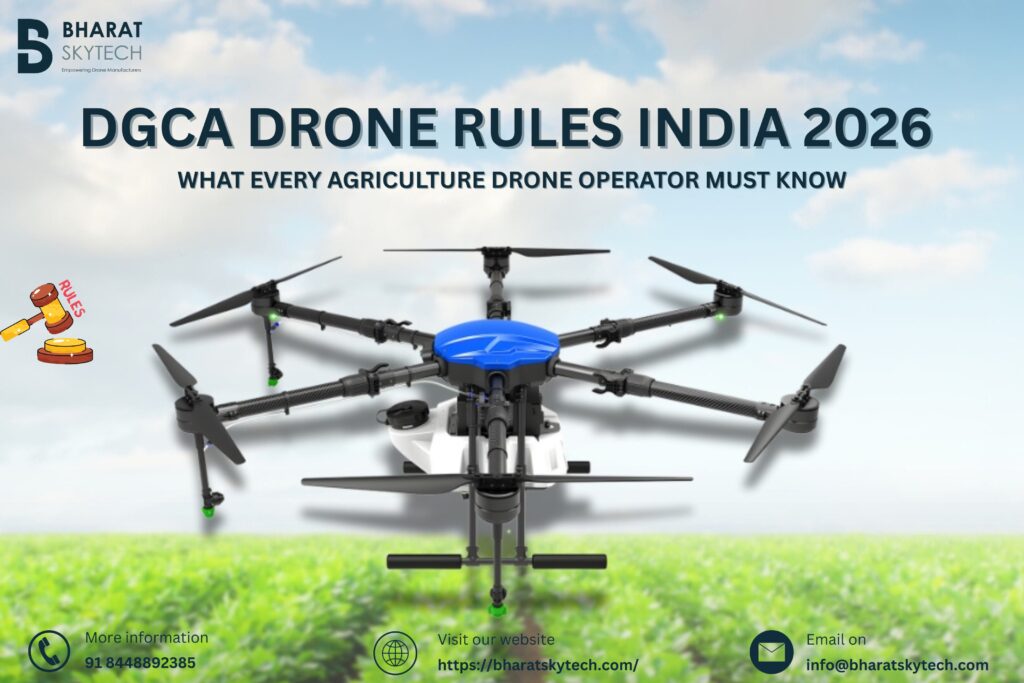
If you operate an agriculture drone in India, the DGCA drone rules are the single most important set of rules you need to understand before your next flight. The DGCA drone rules India 2026 govern everything — from how you register your drone, to where you can fly, what licence you need, and what happens if you don’t comply. India’s drone industry is no longer a niche; it is a fast-growing, policy-driven ecosystem reshaping agriculture, logistics, surveillance, and manufacturing at scale. For farmers and service providers, drone operator rules India are now as important as understanding your soil health or crop cycles.
But with opportunity comes responsibility. If you are operating an agriculture drone today — or planning to launch a drone service business — you absolutely need to understand the DGCA drone rules India 2026. Flying without compliance is not just a legal risk. It is a business risk.
As of 2026, India has over 38,500 registered drones, nearly 40,000 DGCA-certified remote pilots, and 244 approved Remote Pilot Training Organisations (RPTOs). The numbers speak to how seriously the government and the industry are taking drone regulation.
This guide breaks down every key rule, policy, and compliance requirement you need to know — from registering your drone to understanding drone airspace map India, battery rules, agriculture drone subsidy India, and what happens if you violate the law. Whether you are a farmer, a drone service provider, a startup building drones, or a component manufacturer, this is the one resource that will bring you up to speed.
What Are DGCA Drone Rules in India?
The DGCA drone policy is enforced by the Directorate General of Civil Aviation (DGCA), which operates under India’s Ministry of Civil Aviation. The DGCA is the primary regulatory body that governs all civilian drone operations in the country.
The foundational document governing drone regulations India is the Drone Rules, 2021, which replaced the outdated Unmanned Aircraft System Rules (UAS Rules) of 2021. Since then, several amendments have been made to simplify and strengthen the framework. Importantly, the Bharatiya Vayuyan Adhiniyam, 2024 — which came into effect in January 2025 — replaced the old Aircraft Act of 1934, though the Drone Rules 2021 continue to govern day-to-day operations.
A landmark development came in September 2025, when the Ministry of Civil Aviation introduced the Draft Civil Drone (Promotion and Regulation) Bill, 2025 — a comprehensive new law that, once enacted, will replace the Drone Rules 2021 entirely. Until then, the 2021 framework remains the law of the land for drone laws India 2026.
Latest DGCA Drone Rules India 2026 — Key Updates Every Operator Must Know
Here are the most important updates and provisions under drone compliance India that operators must know in 2026:
- The NPNT (No Permission No Takeoff) mandate is strictly enforced for all drones above the Nano category.
- DGCA type certification is mandatory for all commercial drones before they can be manufactured, sold, or operated.
- Import of fully assembled drones (CBU/CKD/SKD) is prohibited — only drone components can be freely imported.
- The PLI (Production Linked Incentive) scheme for drone manufacturing India has been expanded to a ₹2,000 crore outlay for 2025–28.
- GST on drones has been reduced to a uniform 5%, down from earlier rates of 18% and 28%.
- The Draft Civil Drone (Promotion and Regulation) Bill, 2025 proposes stricter penalties and a more comprehensive regulatory structure, including provisions for BVLOS (Beyond Visual Line of Sight) operations.
- DGCA RPTO rules have been streamlined — RPTO-certified training is now the only approved pathway to a Remote Pilot Certificate.
- Three drone corridors for BVLOS commercial operations have been approved — in Ladakh, Telangana, and Andhra Pradesh.
Drone Weight Categories Under DGCA Drone Rules India 2026
Before anything else, it is important to know which weight category your drone falls under. The UAV rules India classify unmanned aircraft systems into five categories based on Maximum All-Up Weight (MAUW):
| Drone Category | Weight (MAUW) | Typical Use Case |
|---|---|---|
| Nano | ≤ 250 grams | Hobby drones, indoor photography |
| Micro | 250g – 2 kg | Aerial photography, surveying |
| Small | 2 kg – 25 kg | Agriculture spraying, cargo operations |
| Medium | 25 kg – 150 kg | Advanced cargo delivery, surveillance |
| Large | > 150 kg | Industrial and defence applications |
(Important for Agriculture Operators: Most agriculture UAV regulations India apply to the Small category, since agriculture spraying drones typically weigh between 5 kg and 25 kg. These require full UIN registration, a Remote Pilot Certificate, and operational permissions.)
Key rules by category:
- Nano drones (non-commercial): No UIN or RPC needed. Limited to 50 feet (15m) altitude in green zones.
- Micro drones: Must be registered. Can fly up to 200 feet (60m) within visual line of sight.
- Small and above: Full compliance required — UIN, RPC, NPNT, type certification, and third-party insurance.
DGCA Drone Rules India 2026 for Agriculture Drone Operators
Agriculture drone rules India are designed to enable large-scale precision farming while maintaining safety. If you are using a drone to spray pesticides, herbicides, or fertilizers on crops, here is what the DGCA mandates:
Operator Eligibility
- Must be a citizen of India
- Minimum age: 18 years
- Medically fit (as assessed under DGCA requirements)
- Must hold a valid DGCA remote pilot certificate
Operational Rules
- Fly only within Visual Line of Sight (VLOS)
- Maximum altitude: 400 feet (120 metres) AGL in green zones
- Do not fly over populated areas, wildlife sanctuaries, or restricted zones
- Comply with the Insecticides Act, 1968 for chemical spraying — only CIBRC-approved pesticides and correct dilution rates
- Log every flight through the Digital Sky drone registration platform
- Obtain flight permission via the NPNT system before every takeoff
Common Compliance Mistakes Agriculture Operators Make
- Flying without pre-flight permission through Digital Sky (NPNT violation)
- Using drones that are not DGCA approved drone models with valid type certification
- Skipping third-party insurance renewal
- Applying non-CIBRC-approved chemicals via drone spraying
- Letting the RPC expire without renewal
NPNT Explained — No Permission, No Takeoff
NPNT drone India is one of the most important compliance features in the Indian drone regulatory framework. Simply put: your drone cannot take off unless it has received digital permission from the DGCA through the Digital Sky platform.
Here is how NPNT works in practice:
- The operator logs into the Digital Sky Platform and requests a flight permission (specifying location, altitude, time window, and purpose).
- The platform cross-checks the request against the airspace map, active NOTAMs, and other restrictions.
- If approved, a digital permission token is issued and transmitted to the drone’s firmware.
- The drone will physically refuse to arm and take off without this token.
- After the flight, data is automatically logged.
NPNT applies to all drones above the Nano category. For agriculture operators, this means every spraying run — even on the same field you flew yesterday — requires a fresh permission if the previous permission window has expired.
The NPNT system uses DigiFlight and the Digital Sky App as the primary interfaces. NPNT-compliant firmware is a mandatory requirement during DGCA type certification for all commercial drones.
Digital Sky Registration Process — Step by Step
The Digital Sky drone registration platform (digitalsky.dgca.gov.in) is the single window for all drone-related compliance in India. Here is the step-by-step process:
Step 1: Create an Account
Visit the Digital Sky platform and register using your mobile number and government-issued ID.
Step 2: Drone Registration (UIN)
- Go to “Register a Drone”
- Enter drone model, type certificate number, serial number, and manufacturer details
- Upload required documents (purchase receipt, manufacturer certificate)
- Pay the registration fee
- Receive your drone UIN registration India — a unique alphanumeric number
Step 3: Mark the UIN on Your Drone
The UIN must be physically etched or affixed on the drone in a legible manner.
Step 4: Apply for Remote Pilot Certificate
(See detailed steps in the next section)
Step 5: Request Flight Permissions
Before each flight (or a batch of flights), log in, submit a flight request with GPS coordinates, altitude, and time window. The system will auto-approve or flag for DGCA review depending on the zone.
Step 6: Fly and Log
Execute the flight within the approved window. The NPNT system logs all data automatically.
Drone Pilot License Rules in India
The drone pilot license India system was completely overhauled under the Drone Rules 2021. The earlier requirement for a traditional pilot licence was scrapped. In its place, the DGCA remote pilot certificate (RPC) was introduced — making drone licensing more accessible while maintaining safety standards.
Who Needs a Remote Pilot Certificate?
Anyone operating a Micro, Small, Medium, or Large category drone commercially needs an RPC. For Nano drones (non-commercial), no licence is required.
DGCA RPTO Rules — Training Requirements
Training must be completed at a DGCA-approved Remote Pilot Training Organisation (RPTO). As of 2026, there are 244 approved RPTOs across India.
Basic training for Small category drones typically includes:
- Ground theory classes (airspace rules, meteorology, navigation, regulations)
- Simulator training
- Solo flying practice
- Night flying
- Final skill test
The typical training duration is 5–6 days for a basic Small category RPC.
Remote Pilot Certificate Requirements
The DGCA remote pilot certificate is the formal licence that authorises you to fly drones commercially in India. Here is a quick breakdown of eligibility and process:
| Requirement | Details |
|---|---|
| Minimum Age | 18 years |
| Maximum Age | 65 years |
| Education | Minimum 10th class (Matriculation) |
| Citizenship | Indian citizen (or as per DGCA norms for foreign nationals) |
| Medical Fitness | Self-declaration of fitness; no formal medical exam for Small category drones |
| ID Proof | Any valid government-issued ID with address proof |
| Training | Mandatory training from a DGCA-approved RPTO |
Steps to Get Your RPC:
- Enrol at a DGCA-approved RPTO
- Complete ground training and flying hours
- Pass the Theory Test on the Digital Sky platform
- Complete Simulator Test, Solo Flying, and Final Skill Test
- Submit RPC application on Digital Sky
- Download your digital RPC certificate
The RPC is valid for 10 years and can be renewed through the Digital Sky platform.
Airspace and Flying Permissions
Understanding drone flying permission India begins with understanding how Indian airspace is structured. The DGCA has divided the entire airspace into three zones, accessible through the interactive drone airspace map India on the Digital Sky platform.
Red, Yellow, and Green Zones — Explained Simply
🟢Green Zone — Fly Freely (with basic rules)
Green zones are areas where Micro and above category drones can fly up to 400 feet (120m) AGL without prior DGCA permission. However, you still need:
- NPNT-compliant drone with Digital Sky login
- Valid UIN and RPC
- Active third-party insurance
Nano drones in green zones are limited to 50 feet (15m).
Even in green zones, temporary restrictions (NOTAMs) may apply during elections, VVIP movements, defence exercises, or public events.
🟡 Yellow Zone — Permission Required
Yellow zones cover controlled airspace near airports, air bases, controlled corridors, and densely populated urban regions. Operations here require:
- Prior permission from the relevant Air Traffic Control (ATC)
- Coordination through the Digital Sky platform
- Strict adherence to height and time limits
🔴 Red Zone — No-Fly Areas
Flying in a red zone without explicit government authorisation is a serious offence under DGCA drone guidelines. Red zones include:
- All airspace above 1,200 feet AGL
- Areas within 3–5 km of active airport boundaries
- Military airfields and defence installations
- International border regions
- Sensitive government areas (Parliament, Rashtrapati Bhavan, etc.)
Tip for Agriculture Operators: Always check the Digital Sky airspace map before your flight, not after. Seasonal changes, new NOTAM announcements, and local temporary restrictions can change zone classifications overnight.
Battery and Charger Compliance Rules
One area that is frequently overlooked — but critically important — is drone battery compliance India. The battery is not just a power source; it is a safety-critical component that directly affects flight safety, fire risk, and operational reliability.
What the Rules Say
Under the DGCA drone guidelines and the broader type certification framework:
- Batteries must meet the specifications declared during type certification. Any unapproved battery substitution can invalidate the drone’s type certificate and UIN.
- Batteries used in certified drones must comply with the performance and safety parameters approved by the DGCA.
- Battery data (State of Charge, charge cycles, temperature) must ideally be logged for commercial operations.
The BIS Certification Angle
The drone battery BIS certification is increasingly important for drone component manufacturers and importers. The Bureau of Indian Standards (BIS) sets quality and safety benchmarks for lithium-based batteries used in electronics and equipment. For drone batteries — particularly the high-capacity Li-ion and LiPo packs used in agriculture drones — BIS-certified batteries provide:
- Assured safety against overcharging, short circuit, and thermal runaway
- Compliance with Indian quality standards
- Higher acceptance by insurers and OEM manufacturers
- Alignment with the Make in India drones policy of using domestically manufactured, certified components
Smart Charging Systems
Using the right charger matters as much as using the right battery. Agriculture drones typically operate in remote, outdoor environments where power quality is unpredictable. Smart chargers with overcharge protection, balance charging, and temperature cutoffs are essential for safe field operations.
Indian manufacturers building drone charging systems for agriculture applications are increasingly incorporating these safety features — and compliant chargers are a key part of a drone operator’s drone safety guidelines India toolkit.
BIS Certification — Why It Matters for Drone Operators and Manufacturers
Drone battery BIS certification and component-level quality standards are not just a regulatory checkbox. They are a reflection of the maturity of India’s drone manufacturing ecosystem.
Here is why BIS certification is becoming a key compliance marker:
- Safety assurance: BIS-certified batteries undergo standardised tests for thermal stability, charge/discharge cycles, mechanical shock resistance, and short-circuit protection.
- Insurance alignment: Many drone insurance providers in India are beginning to require certified, trackable batteries as a condition of cover.
- OEM credibility: If you are a drone manufacturer seeking DGCA type certification, using BIS-certified components strengthens your compliance documentation.
- End-user trust: Farmers and drone service operators increasingly ask for certified components — because a battery fire in a field can cause enormous damage.
As a leading Indian manufacturer of drone batteries and chargers, the focus on BIS-certified drone batteries and India-made smart chargers is a direct contribution to building a drone compliance India ecosystem that is safe, scalable, and future-ready.
Drone Manufacturing Rules in India
DGCA type certification is the gateway for any drone manufacturer in India. Without it, a drone cannot be legally manufactured for commercial sale, operated commercially, or exported.
How the Type Certification Process Works
- Application Submission: Submit technical specifications, design documents, test plans, and safety analysis to the DGCA.
- Prototype Testing: The Quality Council of India (QCI) or its accredited agencies conduct performance, reliability, and safety tests.
- Flight Testing: Certified test pilots conduct prescribed flight evaluations.
- DGCA Review: The DGCA reviews all test reports and grants or rejects certification.
- Certificate Issuance: A type certificate is issued per drone model.
Any design change after certification (including battery, firmware, or hardware changes) requires a design change approval from the DGCA before the modified drone can be sold or operated.
DGCA agriculture drone regulations for Manufacturers
Agriculture-specific drones (spraying, seeding, crop monitoring) must comply with additional requirements:
- Spray system integration must be part of the certified design
- Flight endurance, payload capacity, and nozzle specifications must be validated
- Software updates and firmware changes must be tracked and reported
Make in India Opportunities
The Make in India drones push is one of the most significant industrial policy shifts in the drone sector globally. Here is the big picture:
- Production Linked Incentive (PLI) Scheme: Initially launched with a ₹120 crore outlay, the PLI scheme for drones and drone components has been expanded to ₹2,000 crore for 2025–28. The PLI rate is 20% of value addition, with a minimum value addition threshold of 40%.
- Incentive coverage: Drones, drone components, drone software, counter-drone systems, and allied services are all eligible.
- Industry growth: India’s drone manufacturing sector was valued at just ₹60 crore in 2020–21 and is projected to touch ₹900 crore by 2025, growing at an extraordinary pace.
- Import prohibition: Fully assembled drones (CBU/CKD/SKD) cannot be imported — protecting domestic manufacturers.
- GST rationalisation: Drones are now taxed at a uniform 5% GST, making the economics of domestic manufacturing and operations more attractive.
For Indian companies manufacturing drone batteries, drone motors, propellers, flight controllers, and smart chargers, this is an era of unprecedented opportunity. The government’s focus on building a complete domestic supply chain — from components to finished drones — means every Indian manufacturer has a role to play.
Import vs. Indian Manufacturing — A Quick Comparison
| Factor | Importing Drones | Made in India |
|---|---|---|
| Legality | Finished drones (CBU/CKD/SKD) — PROHIBITED except for R&D and Defence | Fully legal and encouraged under government PLI schemes |
| Components Import | Free and allowed | Components can be sourced domestically or imported |
| PLI Incentive | Not applicable | Up to 20% of value addition |
| Type Certification | Required for any commercially operated imported drone | Required under domestic certification process |
| GST | 5% | 5% |
| Supply Chain Risk | High due to forex fluctuations and global supply disruptions | Lower risk with domestic sourcing support |
| Compliance Alignment | Harder to customise for NPNT and Digital Sky requirements | Easier to build compliance from day one |
The prohibition on drone import rules India for finished drones is a powerful signal. The government wants India to be a global drone hub — not just a market for Chinese or American drones. For drone manufacturing India, this is the inflection point.
Safety and Operational Guidelines
Beyond registration and licensing, every drone operator in India must follow day-to-day drone safety guidelines India:
- Pre-flight checklist: Inspect battery charge, propeller condition, firmware status, and payload integrity before every flight.
- Weather awareness: Do not fly in rain, high winds (>20 knots), or low-visibility conditions.
- VLOS compliance: Always maintain visual line of sight with your drone unless you have BVLOS approval (currently limited to approved corridors).
- Emergency procedures: Know how to execute a Return-to-Home (RTH) or emergency landing if connectivity is lost.
- Third-party insurance: Keep your insurance active at all times for Small and above category drones.
- Battery handling: Never charge damaged LiPo packs. Use a fireproof LiPo bag. Do not overcharge. Store at 50–60% charge when not in use.
- No-fly checks: Always verify the airspace map on Digital Sky before flying — even in areas you have flown before.
- Incident reporting: Any accident, crash, or near-miss must be reported to the DGCA.
Penalties for Violating Drone Rules
The drone laws India 2026 come with real enforcement teeth. Here is a summary of the penalties under the current framework:
| Violation | Penalty |
|---|---|
| Flying without UIN registration | Fine up to ₹50,000 |
| Operating without RPC | Fine up to ₹25,000 |
| Flying in a restricted/red zone | Fine up to ₹1,00,000 |
| Unauthorized drone import | Fine up to ₹5,00,000 |
| Endangering persons or property | Imprisonment up to 2 years and/or fine |
| Non-NPNT compliant operations | Drone seizure + financial penalty |
Additionally, the DGCA can:
- Suspend or cancel your Remote Pilot Certificate
- Deregister your drone’s UIN
- Initiate criminal proceedings under the Bharatiya Vayuyan Adhiniyam, 2024
The Draft Civil Drone Bill 2025 (proposed) would increase penalties further — with unregistered drone use potentially attracting up to 3 years of imprisonment or fines up to ₹1 lakh. Stay compliant.
How Agriculture Drone Businesses Can Stay Compliant
Running an agriculture drone service in India is a legitimate, growing, and highly profitable business — but only if you stay on the right side of compliance. Here is a practical checklist:
For Drone Service Providers (DSPs):
- All drones registered on Digital Sky with valid UIN
- All pilots hold valid DGCA Remote Pilot Certificates
- All drones have valid type certificates
- NPNT firmware updated and active
- Third-party insurance active for all drones
- Flight logs maintained for all operations
- Battery maintenance and replacement logs updated
- Chemical application records maintained (for spraying operations)
For Drone Manufacturers and Component Suppliers:
- Drones have valid DGCA type certification
- Design change approval obtained for any modifications
- Components (batteries, chargers, motors) meet applicable BIS/quality standards
- PLI scheme applications filed (if eligible)
- Manufacturing unit registered with MCA and GST authorities
Conclusion
The DGCA drone rules India 2026 represent both a regulatory obligation and a strategic opportunity. For farmers, the rules ensure that drone-assisted agriculture is carried out safely, with certified equipment and trained operators. For drone service providers and businesses, compliance is the foundation of a sustainable and scalable operation. And for drone manufacturers — whether you are building complete UAVs or supplying precision components like batteries, chargers, propellers, and flight controllers — alignment with drone compliance India standards is what separates serious players from the rest.
India is building one of the most dynamic drone ecosystems in the world. The Make in India drones initiative, the PLI scheme, the proliferation of certified RPTOs, and the Digital Sky infrastructure are all signs of a sector that is growing up — fast.
Whether you are a farmer in Maharashtra trying to understand agriculture drone rules India, a startup pursuing DGCA type certification, or a component manufacturer contributing to the drone manufacturing India supply chain, the path forward is the same: stay informed, stay certified, and stay compliant.
The sky is open — but only for those who fly right.