
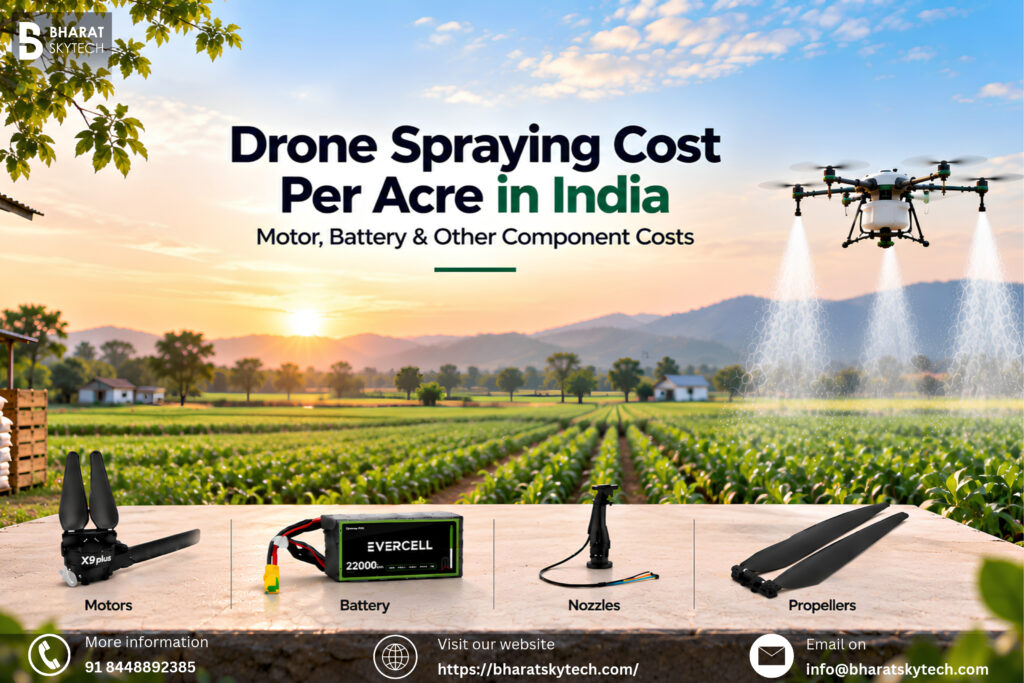
Drone spraying cost per acre in India is a number almost every operator asks for and almost nobody answers with real math, and heading into 2026 it’s still the least standardised figure in the industry. Search for it and you’ll mostly find Australian, UK, and Canadian pricing pages — flat per-hectare service rates that have nothing to do with Indian input costs, Indian GST, or the way Indian operators actually run their fleets. Bharat Skytech doesn’t sell spraying services, so we won’t quote you a service rate. What we can do is show you the part of the cost stack we actually control: what the motors, batteries, nozzles, and propellers cost to buy, how long each one lasts in the field, and what that works out to per acre once you divide hardware cost by service life.
This is the component-cost side of the equation — the wear-and-tear economics that sit underneath whatever a service provider eventually charges a farmer. If you’re building your own cost model, pricing a service, or just trying to understand why one crop spraying drone price per acre quote is cheaper than another, this is the math that explains it.
Why "cost per acre" needs to be split into two halves
Any honest drone spraying price per acre figure has two components: the operating cost (fuel or electricity, chemical, labour, transport) and the component depreciation cost (motors, batteries, nozzles, propellers wearing out and needing replacement). Most online calculators bundle these together into one vague number. We’re isolating the second half, because that’s the part determined by hardware quality, buying price, and replacement discipline — the part an operator can actually plan for with a spare-parts budget.
The formula is simple: (component price ÷ expected service life in acres) = cost per acre for that component. Add up motors, battery, nozzles, and propellers, and you get the true wear cost of running the aircraft, separate from whatever margin a service provider builds in.
GST-exclusive vs GST-inclusive — read this before you build a spreadsheet
Every price quoted below is GST-exclusive, matching how component prices are listed on our drone motor and drone battery category pages. Drones and most agriculture-drone components currently attract a uniform 5% GST, so every number in this article needs 5% added before it matches what actually lands on an invoice.
If you’re modelling costs for a quote or your own spare-parts budget, decide upfront whether you’re working in GST-exclusive or GST-inclusive terms and stay consistent — mixing the two is the single most common reason a component-cost model comes out wrong, and it’s usually the reason a “surprise” shows up on the final invoice. We’ve flagged it here explicitly so it doesn’t happen to you.
The four components that actually wear out
A typical Indian agriculture hexacopter — a 10-litre tank build on an EFT-class frame with six motor arms — has four wear categories that drive replacement spend: motors, battery, nozzles, and propellers. Here’s what each one costs and how long it typically lasts.
Motor service life
Brushless motors are the single largest component investment on the aircraft and also the most durable, provided they’re kept clean of spray chemical and dust. A six-motor set built around a Hobbywing X9 Plus-class motor and propeller combo, priced in the ₹17,000–₹19,000 (Exclusive of GST) range per unit, puts total motor investment at roughly ₹1,00,000–₹1,15,000 (Exclusive of GST) for a full hexacopter.
Quality brushless agri-drone motors of this class typically deliver several hundred flight hours before bearings or windings need attention, with regreasing intervals coming earlier than full replacement. Translated to acreage at a working pace of roughly 6–10 minutes of flight per acre, that puts the motor set’s cost of ownership at somewhere in the region of ₹35–₹40 per acre, before GST — the largest single line item in the component stack, but also the one with the longest payback window.
Battery cycle life
Battery degradation is the most predictable wear cost on the aircraft, because LiPo packs are rated in charge cycles rather than vague “hours of use.” A comparable 6S 22.2V 22000mAh 25C LiPo battery, priced in the ₹15,000–₹17,000 (Exclusive of GST) range, is typically rated for 500+ charge cycles by leading Indian suppliers.
At a working assumption of roughly one battery cycle per acre sprayed (standard for a 10-litre tank at typical Indian dosage rates), that 500-cycle rating works out to approximately ₹32 per acre before GST, purely on battery depreciation. This is the cleanest number in the whole model, because cycle count doesn’t drift the way motor or nozzle life does — a pack that’s done 500 cycles needs replacing regardless of how gently it’s been flown.
Nozzle wear rate
Nozzles take the most direct chemical abrasion of any component on the aircraft and are the cheapest to replace individually, which is exactly why operators under budget for them. A four-nozzle set built from a premium aerosol-style agriculture nozzle, priced in the ₹6,000–₹8,000 (Exclusive of GST) range each, comes to roughly ₹24,000–₹32,000 (Exclusive of GST) for a full set.
Nozzle orifices erode from repeated exposure to corrosive formulations — the more acidic or abrasive the chemical, the faster the wear. Operators typically see meaningful flow-rate drift within 150–200 flight hours, which at 6–10 minutes per acre works out to roughly ₹20–₹25 per acre before GST for nozzle replacement across a season. This is also the component most worth checking against Bharat Skytech’s broader agriculture drone spare parts price list, since nozzle wear rate varies significantly by crop and chemical, and having a second or third set on hand avoids downtime during peak spraying windows.
Propeller replacement per season
Propellers absorb dust, crop debris, and chemical overspray, and unlike motors, they’re a wear item that most operators replace on a seasonal cadence rather than waiting for visible damage. A full hexacopter set of X9 Plus-class propellers with hub, priced in the ₹4,000–₹4,500 (Exclusive of GST) range per pair, runs to roughly ₹24,000–₹27,000 (Exclusive of GST) for six arms.
Most Indian operators replace propellers once, sometimes twice, per spraying season, regardless of visible chipping, because micro-fractures from chemical exposure aren’t always visible before they affect balance. Spread across a season’s acreage, that puts propeller cost in the ₹18–₹22 per acre range before GST.
Adding it up: the component-only cost per acre
| Component | GST-Exclusive Cost Per Acre |
|---|---|
| Motors (6-motor set) | ₹35–₹40 |
| Battery (per cycle) | ₹32 |
| Nozzles (4-nozzle set) | ₹20–₹25 |
| Propellers (6-arm set) | ₹18–₹22 |
| Total, GST-Exclusive | ≈₹105–₹120 |
| Total, GST-Inclusive (5%) | ≈₹110–₹126 |
That figure — roughly ₹110 to ₹125 per acre once GST is added — is the pure hardware depreciation cost of running a well-maintained agriculture hexacopter. It excludes chemical, fuel or charging electricity, labour, transport, insurance, and whatever margin a spraying service builds on top. Those operating costs are what actually determine the drone spraying price per acre a farmer sees on an invoice, and they’re set by each service provider individually — not something we sell or price, which is exactly why we’re not putting a number on them here.
What this component figure does give you is the floor. Any service quote priced meaningfully below the component depreciation cost either isn’t accounting for replacement spend properly, or is cutting corners on the parts themselves — which shows up later as unscheduled downtime and a much higher drone repair cost India operators end up paying when a worn nozzle or a fatigued propeller causes a mid-flight failure instead of a planned replacement.
Why replacement discipline matters more than the acquisition price
The cheapest motor or nozzle on paper is rarely the cheapest per acre once you factor in service life. A motor that costs 20% less but lasts half as long doesn’t save money — it roughly doubles the per-acre cost. This is the trap in most online cost comparisons: they compare sticker prices instead of cost-per-acre-of-service-life, which is the only number that actually matters for a working fleet.
It’s also why keeping a stocked spares inventory — sourced from a single reliable supplier rather than pieced together from multiple vendors of varying quality — tends to lower total cost of ownership even though it looks like a bigger upfront spend. Our full agriculture drone components supplier catalogue is built around exactly this: authorised-distributor pricing on the motors, batteries, nozzles, and propellers that make up this cost model, all listed with GST-exclusive pricing so you can build your own numbers without guessing.
Conclusion
The drone spraying cost per acre in India conversation gets muddled because most of what’s published online is either a foreign service rate or a vague headline number with no breakdown. The component side of the equation — motors, battery cycles, nozzle wear, and propeller replacement — is the one part of the cost stack that’s actually calculable from published prices and known service life, and it lands at roughly ₹110–₹125 per acre, GST-inclusive, for a well-specified hexacopter. Everything above that floor — chemical, labour, fuel, and service margin — is set by the operator, not the parts supplier. Know your component cost per acre first, Contact Bharat Skytech and then every other pricing decision downstream gets a lot easier to defend.
Frequently Asked Questions
Is the drone spraying cost per acre GST-inclusive?
It depends on the source. Component prices are often GST-exclusive, so always confirm whether GST is included before comparing quotes.
Which component costs the most?
Motors are usually the largest component cost, while batteries are a close second when cycle-based depreciation is included.
How often do agriculture drone batteries need replacement?
Quality LiPo batteries commonly support 500+ charge cycles. After that, reduced capacity and performance usually make replacement more practical.
Does a lower spraying cost per acre mean lower-quality parts?
Not always. Lower costs may come from better efficiency, but it’s important to check component quality and replacement costs.
Does Bharat Skytech offer drone spraying services?
No. Bharat Skytech supplies drone components such as motors, batteries, nozzles, and propellers to manufacturers and service operators.