

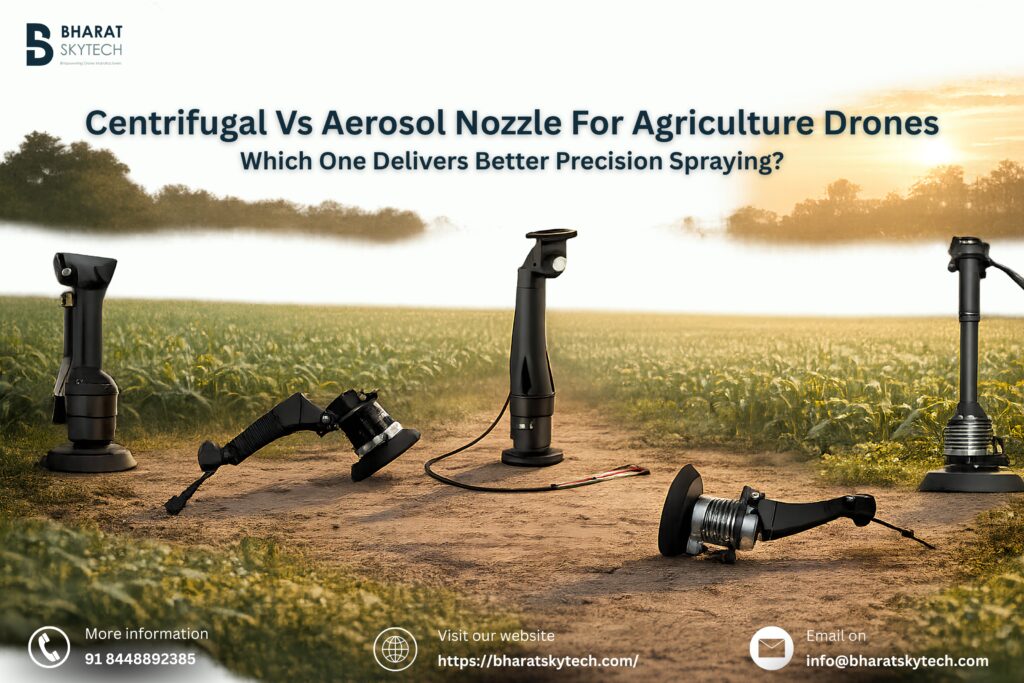
Centrifugal vs aerosol nozzle for agriculture drone is one of the most important buying decisions any drone operator, agri-service provider, or farmer in India needs to make before setting up or upgrading a spraying system. At Bharat Skytech — India’s trusted agriculture drone components store — we stock both nozzle types across multiple models, including the Hobbywing 9L Centrifugal Nozzle, Folding Aerosol Nozzle Model 4820, Aerosol Nozzle Pro Model 5820, Aerosol Nozzle Max Model 8820, and Aerosol Nozzle Model 4810. Each one is built for a different spraying need, crop type, and field condition. This guide will help you understand how both nozzle types work, where each one performs best, and exactly which Bharat Skytech nozzle is right for your operation.
Why the Nozzle Decides the Success of Your Drone Spraying Operation
You can invest in the best agriculture drone motor, the most accurate flight controller, and a high-capacity LiPo battery — but if your spray nozzle is wrong for your crop or field conditions, your entire spraying run will underperform.
The drone spray nozzle controls three things that directly determine your results:
- Droplet size — too fine and the liquid drifts away from the target; too coarse and coverage becomes uneven
- Spray pattern — determines how uniformly the liquid reaches the crop canopy
- Flow rate — controls how much chemical is applied per acre per minute
Getting these three factors right is what separates a productive spraying operation from one that wastes expensive chemicals and leaves crops under-treated. That is exactly why choosing between a centrifugal nozzle and an aerosol nozzle matters so much.
What Is a Centrifugal Nozzle and How Does It Work?
A centrifugal nozzle — also called a rotary atomiser — uses a high-speed spinning disc to break liquid into fine, uniform droplets. Liquid flows onto the disc, and centrifugal force throws it outward in all directions, atomising it into a fine mist.
The key advantage is control. By adjusting disc rotation speed and liquid flow rate, operators can precisely control droplet size — something fixed orifice nozzles cannot offer.
How Rotary Atomisation Delivers Ultra-Fine Droplet Coverage
The spinning disc typically rotates at 6,000 to 12,000 RPM, producing droplets in the 50–150 micron range. Droplets this fine cover more surface area per litre of liquid, meaning better crop penetration and higher chemical efficiency. A well-set centrifugal nozzle can cover the same field area using 30–40% less chemical volume compared to aerosol nozzles — directly reducing your input cost per acre.
Centrifugal Nozzle: Hobbywing 9L
At Bharat Skytech, the centrifugal option we stock is the Hobbywing 9L Centrifugal Nozzle Spray for UAV Drones.
This is a professional-grade rotary atomiser with a 9-litre per minute flow capacity, built specifically for large-scale agriculture UAV spraying operations. Its brushless motor-driven spinning disc delivers consistent ultra-fine droplet output and is designed to integrate with Hobbywing X-series motor and ESC systems — making it a natural fit if your drone already runs Hobbywing components.
Best suited for:
- Large open fields — wheat, soybean, mustard, rapeseed in Punjab, Haryana, and MP
- High-capacity drones with 16L or 20L spray tanks
- Calm wind conditions — ideally early morning spraying (6–9 AM)
- Operations where reducing chemical cost per acre is a priority
What Is an Aerosol Nozzle and How Does It Work?
An aerosol nozzle — also called a flat fan nozzle or pressure nozzle — uses liquid pressure to force fluid through a precision-shaped orifice in the nozzle body, producing a flat fan-shaped spray pattern. There are no moving parts. The orifice shape determines droplet size, spray angle, and coverage width.
Most agriculture drone aerosol nozzles produce droplets in the 150–300 micron range — medium to coarse — which makes them far more resistant to wind drift than centrifugal nozzles. This is why aerosol nozzles are the recommended starting point for most Indian drone operators.
Why Aerosol Nozzles Are the Preferred Choice Across India
Aerosol nozzles suit Indian farming conditions well for several key reasons:
- Larger droplets resist wind drift — critical in Punjab, Rajasthan, Uttar Pradesh, and the Deccan Plateau where afternoon winds are common and unpredictable
- No moving parts — fewer maintenance issues, longer operational life, easier to clean
- Compatible with most pesticide formulations — SC (suspension concentrate), WP (wettable powder), and WG (water-dispersible granule) formulations all work well
- Lower clogging risk — larger orifices handle thick formulations without blocking
- Foldable models from Bharat Skytech reduce drone arm width during transport and storage
Bharat Skytech Aerosol Nozzle Range: 4810, 4820, 5820 Pro, 8820 Max
Bharat Skytech stocks four aerosol nozzle models, each designed for a different scale and type of operation. Here is what each one is built for:
Aerosol Nozzle Model 4810 — Compact Precision for Smaller Drones
The Aerosol Nozzle Model 4810 is a compact, fixed aerosol nozzle built for smaller agriculture drones or precision spot-spraying setups. It delivers consistent fan-spray coverage at standard pressures, making it a reliable, no-fuss option for routine pesticide spraying and liquid fertiliser application.
Best suited for:
- Compact drones with 10L spray tanks
- Small crop plots, test setups, or greenhouse operations
- First-time buyers who want a simple, dependable starting nozzle
- Precision application where targeted droplet delivery matters more than volume
Folding Aerosol Nozzle Model 4820 — Versatile, Foldable, Beginner-Friendly
The Folding Aerosol Nozzle Model 4820 combines aerosol atomisation technology with a foldable arm mount, making it ideal for medium-size agriculture drones where portability matters. The fold mechanism reduces overall drone arm width during transport — a real practical advantage for operators moving between multiple farms.
Key features:
- Compact, foldable design for easy transport and storage
- Fine aerosol atomisation for uniform crop coverage
- Uniform droplet size for consistent pesticide distribution
- Energy-efficient with low power consumption
- Easy to clean and maintain after each spraying run
Best suited for:
- Medium drones with 10–16L spray tanks
- Multi-crop contract spraying operators
- Operators who frequently transport drones between farm locations
- Beginners looking for a versatile, reliable first nozzle
Folding Aerosol Nozzle Pro Model 5820 — For Professional Daily Operations
The Folding Aerosol Nozzle Pro Model 5820 upgrades the 4820 with an enhanced motor system for better spray stability and accuracy during continuous high-duty-cycle operations. If your drone runs 6–8 hours per day across multiple farms, the 5820 Pro handles that workload without performance degradation.
Key features:
- Pro-grade foldable aerosol design built for daily commercial use
- Precise atomisation for efficient chemical usage
- Durable build for long-term drone spraying applications
- Compatible with multiple agriculture drone models
- Enhanced spray uniformity and consistent output under pressure
Best suited for:
- Agri drone spraying service businesses with high daily workloads
- Multi-farm deployments covering 50+ acres per day
- Professional contract sprayers who need consistent output every run
- Medium to large drones (16L tanks) in commercial operations
Aerosol Nozzle Max Model 8820 — Maximum Output for Large-Scale Operations
The Aerosol Nozzle Max Model 8820 is Bharat Skytech’s highest-output aerosol spray nozzle — designed for large agriculture drones that need to cover wide field areas at high flow rates in minimum time.
Key features:
- Designed specifically for large UAV spraying drones (16–20L tanks)
- Produces ultra-fine, consistent droplets at high output volumes
- Supports high-speed wide-area spraying operations
- Wide-angle spray coverage for broad field passes
- Corrosion-resistant and chemical-damage resistant build
Best suited for:
- Large-scale drone operations covering 100+ acres per day
- Corporate agribusinesses, FPOs, and large farming cooperatives
- Orchard applications and wide-canopy crop spraying
- Operations where spraying speed and field coverage per run are the top priorities
Centrifugal vs Aerosol Nozzle — Complete Comparison Table
| Feature | Centrifugal Nozzle | Aerosol Nozzle |
|---|---|---|
| Droplet Size | 50–150 microns (very fine) | 150–300 microns (medium–coarse) |
| Spray Pattern | 360° rotary, wide spread | Flat fan, directional |
| Wind Drift Risk | Higher – fine droplets are more prone to drift | Lower – coarser droplets fall faster |
| Chemical Volume Used | 30–40% lower per acre | Standard spray volume |
| Moving Parts | Yes (spinning disc + motor) | No |
| Maintenance Needs | Regular cleaning of disc and motor | Periodic flushing of the nozzle orifice |
| Best Operating Conditions | Calm weather (wind below 10 km/h) | Suitable for calm to moderate wind conditions |
| Clogging Risk | Moderate with thick formulations | Low |
| Canopy Penetration | Excellent – fine droplets penetrate dense crop canopies | Good – suitable for most crop applications |
| Bharat Skytech Models | Hobbywing 9L Centrifugal Nozzle | 4810, 4820, 5820 Pro & 8820 Max Aerosol Nozzles |
Which Crops and Conditions Suit Each Nozzle Type?
India’s diverse cropping patterns and regional weather conditions mean there is no single “best” nozzle for every farm. Use this table to match nozzle type to your crop and region:
| Crop | Recommended Nozzle | Why It’s Recommended |
|---|---|---|
| Paddy (Rice) | Aerosol (4820 / 8820) | Ideal for flooded fields, high humidity, and moderate wind conditions. |
| Wheat | Either (Centrifugal preferred in calm weather) | Open fields and uniform crop canopy allow effective coverage with both nozzle types. |
| Cotton | Aerosol (5820 Pro / 8820) | Performs well in windy conditions common in cotton-growing regions. |
| Soybean | Centrifugal (Hobbywing 9L) | Fine droplets provide better penetration into dense crop canopies. |
| Sugarcane | Aerosol (8820 Max) | Coarser droplets improve coverage of tall, dense crops and lower leaves. |
| Mustard / Rapeseed | Centrifugal (Hobbywing 9L) | Fine spray coverage enhances chemical absorption in open canopies. |
| Vegetables & Horticulture Crops | Aerosol (4810 / 4820) | Lower drift helps protect nearby crops, residential areas, and sensitive environments. |
Wind Conditions Across India — Which Nozzle to Use When
Wind drift is one of the most underestimated risks in agriculture drone spraying across India. Droplets smaller than 100 microns can travel hundreds of metres from the target area in winds above 15 km/h, damaging neighbouring crops or reaching water bodies.
- Spray in early morning (6–9 AM) or late evening (4–7 PM) when winds are typically calm → centrifugal nozzle can perform excellently in these windows
- Spraying through the late morning or afternoon in open plains of Punjab, Haryana, or Rajasthan → aerosol nozzle is significantly safer and more reliable
- Operations near orchards, vegetable farms, or residential areas → always use aerosol to minimise off-target drift
How to Maintain Your Drone Spray Nozzle for Longer Life
The difference between a nozzle that lasts one season and one that lasts three years is entirely maintenance. Follow this routine after every spraying run:
- Empty the tank completely — never store liquid overnight inside the tank
- Fill the tank with clean water and run the pump for 2–3 minutes to flush all lines and pipes
- Remove nozzle heads individually and rinse in clean water
- For the centrifugal nozzle — wipe the spinning disc gently with a soft cloth; never use wire brushes or abrasives on the disc surface
- For aerosol nozzles — check the orifice for wear or partial blockage; flush with a soft brush if needed
- Dry all components fully before storage — residual moisture degrades disc motor performance over time
Signs it is time to replace your nozzle:
- Spray pattern is uneven or noticeably one-sided
- Flow rate has dropped with no visible blockage
- Visible cracks, chips, or deformation on the nozzle body
- Centrifugal disc vibrates or wobbles during operation
- Chemical residue cannot be cleared even after full flushing
A worn drone spray nozzle does not just reduce spraying quality — it wastes expensive pesticides and leaves crops under-treated or inconsistently covered. Budget for nozzle replacement every 2–3 seasons under regular commercial use.
For more guidance on your full spraying setup, read our guide on the Hobbywing Drone Pump 8L vs 5L and our Agriculture Drone Components Quality Checklist.
Conclusion
Choosing between a centrifugal nozzle and an aerosol nozzle for your agriculture drone is not a matter of one being better than the other — it is about matching the right nozzle to your crop, your region, and your daily operating conditions.
If you run a large-scale operation on open wheat, soybean, or mustard fields in calm morning conditions and want to reduce chemical consumption per acre, the Hobbywing 9L Centrifugal Nozzle from Bharat Skytech delivers outstanding fine-droplet coverage with exceptional efficiency. If your operation covers diverse crops, windy regions like Punjab or Rajasthan, or runs through different times of day, the aerosol nozzle range — 4810, 4820, 5820 Pro, and 8820 Max — gives you reliable, low-drift spraying performance across every field condition India throws at you.
The nozzle is the last point of contact between your chemistry and your crop. Getting it right protects your chemical investment, improves crop coverage uniformity, and directly impacts your yield outcomes season after season. Whether you are setting up your first agriculture drone spraying system or upgrading an existing fleet, Bharat Skytech has the right drone spray nozzle in stock — at competitive prices, with fast shipping across India.
Explore the Full Nozzle Range at Bharat Skytech and make every drop count.