

Agriculture drones have transformed modern farming in India — from precision spraying to real-time crop monitoring, these machines have become essential tools for today’s farmers. But every high-performing drone depends on a well-maintained battery. Knowing how to charge an agriculture drone battery correctly isn’t just about performance — it’s about safety, longevity, and keeping operational costs under control.
Improper charging remains one of the leading causes of battery failure, fire hazards, and expensive replacements in the field. Whether you’re a seasoned drone operator, an agri-tech entrepreneur, or a farmer using drones for the first time, this guide covers everything you need to know about safe battery charging practices — along with exciting news about Bharat SkyTech’s newest launch: the Make in India EvErCell battery series.
Why Battery Safety Matters in Agriculture Drones
Agriculture drones typically run on LiPo (Lithium Polymer) or Li-ion (Lithium-Ion) battery packs — both powerful, but chemically sensitive. Unlike everyday consumer electronics, these batteries carry high voltage and high current loads, particularly during intensive spraying operations across large fields.
A poorly charged or mishandled battery can result in:
- Thermal runaway (overheating that leads to fire)
- Significantly reduced battery cycle life
- Sudden mid-flight power failure
- Explosion risk during storage or charging
Safe charging is not optional — it is an absolute necessity.
How to Charge Agriculture Drone Battery — The Complete Guide ✅THE DOS
1. Always Use the Manufacturer-Recommended Charger
The golden rule of drone battery charging safety is simple: use only the charger supplied with your drone or one that is explicitly approved by the manufacturer. Generic or incompatible chargers often fail to regulate voltage and current properly, risking overcharging or dangerous cell imbalance.
2. Charge at the Correct C-Rating
Every agriculture drone battery carries a specified charge rate known as the C-rating. For most LiPo drone batteries, the safe standard is 1C — meaning a 30,000 mAh battery should be charged at 30A. Higher charge rates generate excess heat and accelerate cell degradation. Always confirm the recommended charge current in your battery’s datasheet before proceeding.
3. Monitor the Battery Throughout Charging
Never leave a charging drone battery entirely unattended. Use a smart charger or a Battery Management System (BMS) that flags abnormalities. Watch for swelling, unusual heat, or hissing sounds — all clear warning signs of a developing fault.
4. Charge in a Cool, Dry, and Well-Ventilated Area
The optimal charging temperature range for most agriculture drone batteries is 10°C to 35°C. Charging in direct sunlight or inside a closed vehicle during peak summer heat can push temperatures well beyond safe limits. Always choose a shaded, ventilated space, and consider using a LiPo-safe charging bag for added protection.
5. Charge Batteries at the Right State of Discharge
LiPo and Li-ion batteries perform best when not fully drained before recharging. Begin charging when the battery retains around 20–30% remaining capacity. Deep discharges below 3.5V per cell can permanently damage cells and significantly cut overall battery life.
6. Balance Charge Regularly
For multi-cell agriculture drone batteries, periodically use the balance charging mode. This equalises voltage across all cells, preventing cell imbalance — one of the most common causes of reduced flight time and premature battery wear
7. Keep Batteries Clean and Contacts Corrosion-Free
Before every charging session, inspect battery connector pins for dirt, moisture, or oxidation. Corroded contacts cause resistive heating during charging and can trigger connector failure mid-flight. Clean them with a dry cloth or a contact cleaner spray when needed.
How to Charge Agriculture Drone Battery — The Complete Guide ❌ THE DON'TS
Before every charging session, inspect battery connector pins for dirt, moisture, or oxidation. Corroded contacts cause resistive heating during charging and can trigger connector failure mid-flight. Clean them with a dry cloth or a contact cleaner spray when needed.
1. Don't Charge a Hot Battery
After a spraying mission, your battery will be warm. Never plug it in immediately after use. Allow it to cool down to ambient temperature — typically 20 to 30 minutes — before connecting it to the charger. Charging a hot battery speeds up cell degradation and significantly raises fire risk.
2. Don't Overcharge
Overcharging a LiPo cell beyond 4.2V per cell (or 4.35V for high-voltage variants) causes irreversible damage and is a leading trigger for thermal runaway. Always use a charger with built-in overcharge protection and verify cut-off voltage settings before starting any charge cycle.
3. Don't Store Fully Charged Batteries for Extended Periods
If you’re not flying for a week or longer, avoid leaving batteries at full charge. Instead, use the storage charge mode on your smart charger, which brings the battery to approximately 50–60% State of Charge (SoC) — the ideal level for long-term storage. This habit alone can significantly extend battery lifespan.
4. Don't Charge Damaged or Swollen Batteries
A puffed or physically deformed LiPo battery is a serious safety hazard. If you notice swelling, punctures, or signs of electrolyte leakage, do not attempt to charge or use the battery under any circumstances. Dispose of it safely following local guidelines for lithium battery disposal.
5. Don't Use Extension Cords or Low-Quality Power Strips
High-current charging demands a stable, adequate power supply. Substandard extension cords or multi-plug power strips can cause voltage drops, sparking, or overheating at connections. Always plug your charger directly into a grounded power socket rated for the required load.
6. Don't Charge Indoors Without Fire Safety Measures
Many drone operations in India are run from farm sheds or storage units — charging batteries in these spaces without precautions is a serious risk. Always keep a fire extinguisher rated for lithium fires (Class D or CO₂) within reach, and use a fireproof LiPo charging bag as a standard practice.
7. Don't Ignore Battery Management System (BMS) Alerts
Modern agriculture drone batteries commonly come integrated with a BMS. If the system signals an error — through an indicator light, app notification, or alarm — stop the charging process immediately and inspect the battery thoroughly. Never dismiss or override BMS warnings.
Best Practices for Agriculture Drone Battery Maintenance
Safe charging is only one part of the equation. Overall battery maintenance plays an equally important role in maximising longevity:
- Log every charge cycle to track battery health over time
- Rotate batteries evenly across your fleet to prevent uneven wear
- Run monthly capacity checks using a battery analyser
- Store in a temperature-controlled environment away from moisture and direct heat
- Replace batteries that drop below 80% of their rated capacity
Consistently following these maintenance practices can extend battery life from 200 cycles to 300+ cycles, delivering meaningful cost savings over an entire season.
Bharat Skytech Launches Evercell — A Make in India Battery Brand
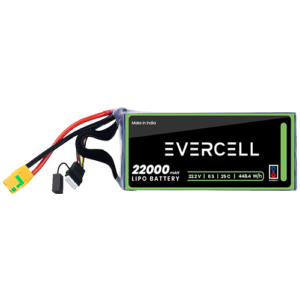
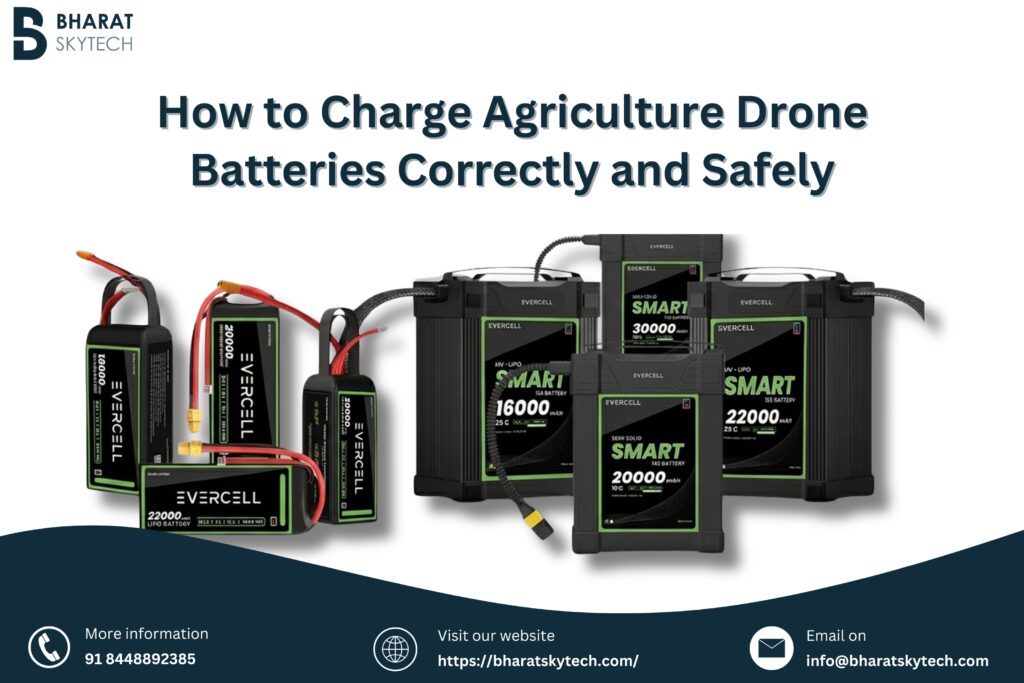
In a significant milestone for India’s agriculture drone ecosystem, Bharat SkyTech — one of India’s foremost drone technology companies — has officially launched Evercell, its own Make in India drone battery brand.
Evercell batteries are purpose-engineered for the realities of Indian agriculture: extreme heat, dusty field environments, and the demand for consistent power delivery over long operational hours. Key highlights of the Evercell range include:
- High energy density cells optimised for agriculture drone payloads
- Advanced BMS integration for real-time battery health monitoring
- Extended cycle life — engineered for 300+ charge cycles under Indian field conditions
- Full compliance with DGCA regulations for drone batteries used in India
- Complete Make in India manufacturing, supporting the Atmanirbhar Bharat vision
The Evercell launch marks a decisive step toward reducing India’s dependence on imported drone batteries — a critical milestone in the nation’s drive toward self-reliance in the agri-drone sector.
Bharat SkyTech’s decision to bring battery manufacturing in-house reflects a larger vision: not merely building better drones, but creating a complete, locally sourced drone ecosystem that genuinely empowers Indian farmers and operators.
Final Thoughts
Mastering how to charge agriculture drone battery safely is a skill no operator can afford to overlook. From selecting the right charger and respecting temperature limits to avoiding overcharging and storing batteries at the correct state of charge — every practice directly shapes your drone’s performance, your personal safety, and your long-term costs.
As India’s agriculture drone industry continues to scale rapidly, innovations like Bharat SkyTech’s Evercell batteries are making it easier than ever for operators to access reliable, locally manufactured power solutions rooted in the Make in India vision. Combine great hardware with disciplined charging habits, and your drone fleet will deliver results season after season.