
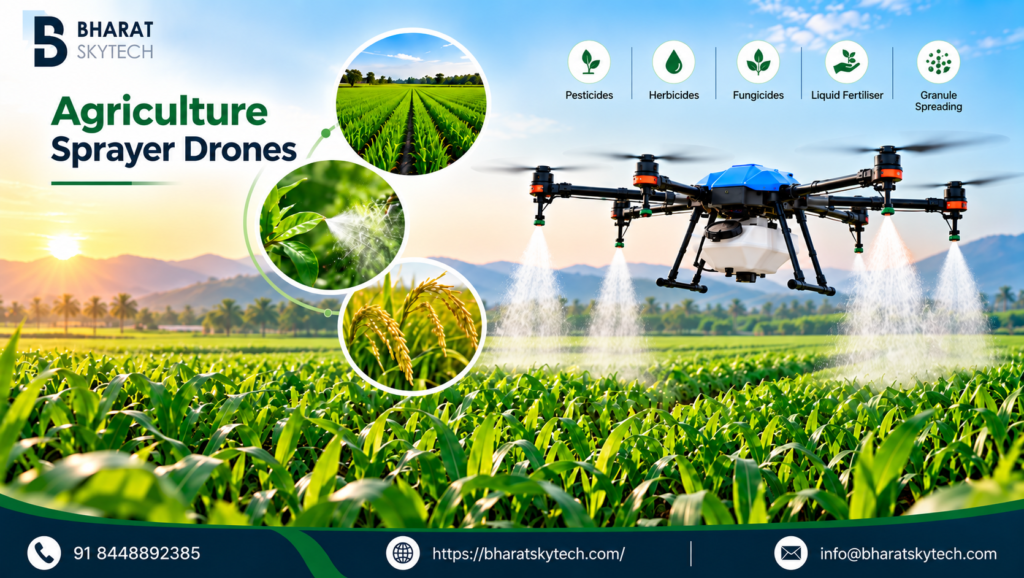
Agriculture sprayer drones are changing how Indian farmers protect their crops, replacing slow, tiring knapsack spraying with fast, uniform, low-volume application from the air. Whether you grow paddy, cotton, sugarcane, maize or vegetables, an agriculture drone can finish in a few hours what a manual spraying team takes days to complete. It also keeps the operator away from the chemical cloud.
This guide covers how these machines work, what they are built from, what they cost and how to choose one that fits your farm or spraying business.
What Are Agriculture Sprayer Drones?
An agricultural drone built for spraying is an unmanned aircraft with a liquid tank, a pump, nozzles and a flight controller that follows a programmed route over the field. Most are multirotors with four or six arms, and tank sizes run from about 5 litres for small plots to 50 litres for large-scale work.
People search for these machines under many names: drone sprayer, agricultural sprayer drone, crop spraying drone or pesticide drone. They all mean the same thing, an aircraft that applies pesticides, herbicides, fungicides, liquid fertiliser or nano-fertiliser. Many models can also be fitted with a granule spreader for seeds and fertiliser.
How Agriculture Sprayer Drones Work
The operator marks the field boundary using GPS or a handheld ground station. The flight controller then plans the route, sets the spray height and speed, and flies the pattern on its own. The key parts of the process are:
- Pump and nozzles: The pump pushes the liquid to the nozzles at a steady rate. Centrifugal nozzles break it into fine droplets, and flat-fan nozzles are another common choice.
- Radar and terrain following: A downward radar holds a constant height above the crop canopy, even on uneven ground. Obstacle-avoidance radar helps the drone detect poles and trees.
- Rotor downwash: The air pushed down by the propellers drives droplets into the canopy, so spray reaches the underside of the leaves.
- Flow control: Flow sensors adjust the pump to match the drone’s speed, so every acre gets the same dose.
Spray volumes are far lower than with conventional methods. A drone sprayer commonly uses only a few litres of solution per acre, against well over a hundred litres for tractor-mounted or knapsack equipment. That saves water, which matters most in dry regions.
Key Benefits of Agriculture Sprayer Drones
- Speed: A single operator and one 10 to 16 litre drone can cover many acres in a day. Spraying that once took a full team can be done in a morning, which is critical when a pest outbreak or weather window is closing.
- Lower chemical and water use: Precise, uniform application cuts waste and drift, and brings down input costs.
- Operator safety: The operator stands at a safe distance from the spray, so direct exposure to chemicals drops sharply.
- Access: Drones fly over standing sugarcane, tall maize, waterlogged paddy and hilly plots where tractors cannot go without damaging the crop.
- Timing: Fast turnaround lets farmers spray at the right growth stage, and that timing often matters as much as the chemical itself.
Types of Agriculture Sprayer Drones by Tank Capacity
- 5 to 10 litre drones. These suit small and medium farms, first-time buyers and training use. A 10 litre hexacopter is the most common size sold in India.
- 16 to 20 litre drones. These are a good middle ground for service providers and growers with larger, regular acreage. They carry more per flight and cut battery swaps and refills.
- 30 to 50 litre drones. These heavy-lift platforms are built for large farms and custom-hiring businesses. They need bigger batteries, stronger motors and a bigger support setup, but they have the highest hourly coverage.
- Rotor layout matters too. Hexacopters keep flying if a motor fails, which is why they are popular for heavy loads. Quadcopters are simpler and lighter.
What Is Inside an Agriculture Sprayer Drone?
A sprayer drone is only as reliable as its weakest component. The main systems are:
- Frame, arms and tank: Carbon-fibre or reinforced frames with foldable arms keep weight low and transport easy. Browse our drone frames and frame parts for tanks, canopies and spares.
- Motors, ESCs and propellers: These produce the thrust to lift a full tank. Motors with integrated ESCs, such as the Hobbywing X6, X9, X11 and X13 series, are widely used in spraying drones. See our range of drone motors.
- Batteries and chargers: High-capacity LiPo packs power the whole aircraft. Flight time depends on payload, so many operators run multiple packs and a fast charger. Explore drone batteries, including the Made-in-India Evercell range.
- Flight controller and GPS: This is the brain of the drone. It handles autonomous routes, return-to-home and failsafes. Find flight controllers and radars here.
- Pump, nozzles and flow meter: These control droplet size and dose accuracy.
- Remote controller or ground station: Handheld units with built-in screens let operators plan missions and watch live status. See RC and transmitters.
- Payloads: Some operators add a camera or gimbal for scouting alongside spraying.
Agriculture Drone Price in India: Cost Ranges
Everyone asks about agriculture drone prices, so here are realistic ranges rather than fixed figures. The agricultural drone price you quoted depends on the brand, configuration, taxes, accessories and whether the drone arrives ready to fly or as a kit. These are indicative ranges only:
The spread is wide because brand, certification, build quality and included accessories vary a lot. A lower-cost kit may need your own assembly and tuning, while a higher-priced ready-to-fly unit usually bundles a certified airframe, warranty and training.
The agriculture drone sprayer price you see online is also not the whole agricultural drone cost. Plan for batteries and chargers, spare propellers and nozzles, transport cases, insurance, pilot certification and a regular maintenance budget.
If you would rather not own a drone, hiring a spraying service by the acre is a lower-risk way to start. Service rates generally fall in a few hundred rupees per acre, depending on crop, terrain and region. It is a useful way to see results before committing capital.
Subsidies and finance: Central and state schemes, such as SMAM and Namo Drone Didi, may support eligible farmers, FPOs, custom hiring centres and women self-help groups. Eligibility and subsidy percentages change, so check the latest official guidelines before applying.
Category | Indicative Price Range |
|---|---|
5 to 6 litre entry-level drones | ₹3 lakh to ₹6 lakh |
10 litre drones (kits and ready-to-fly) | ₹2.5 lakh to ₹9 lakh |
16 to 20 litre drones | ₹3 lakh to ₹10 lakh |
30 to 50 litre heavy-lift drones | ₹6 lakh to ₹15 lakh |
Pilot training (per person) | Tens of thousands of rupees |
Buying vs Building: Two Ways to Buy a Drone for Agriculture
When you decide to buy a drone for agriculture, you have two main routes.
Route 1: Ready-to-fly drones. You buy a complete aircraft from a drone company. This is simplest for first-time users and usually includes warranty and training. Check that the model is certified for use in India, and what spares and service support are available locally.
Route 2: Build or customise with components. Many drone manufacturers, assemblers and service companies build their own sprayer drones from sourced parts. This allows you to choose motor, battery and controller specs for your own crops and payloads, and to repair quickly with parts you already stock. It also makes a large fleet easier to maintain, because you can replace a worn motor or battery without waiting for a full unit to be serviced.
If you go with Route 2, you will find a growing number of agricultural drones for sale listings that are really kits or frames without electronics. Read what is included before ordering.
How to Choose the Right Agriculture Sprayer Drone
- Match tank size to acreage. A 10 litre drone is enough for most farms under about 50 acres of regular spraying. Larger or contract operations benefit from 16 litre or bigger platforms.
- Look at the real flight time under load. Brochure numbers are for light loads. Ask about flight time with a full tank, battery cycle life and how fast packs recharge.
- Check the spray system. Look at nozzle type, droplet size range and flow rate, and whether pump and nozzles are easy to clean and replace.
- Look for radar and safety features. Terrain following, obstacle avoidance, failsafes and return-to-home are what protect your investment.
- Confirm certification and rules. Check that the model and your pilot qualifications meet current Indian drone regulations.
- Check spares and support. A drone is only useful when it is flying. Make sure motors, batteries, nozzles and propellers are available quickly.
- Plan the full cost. Compare the total farming drones price, including batteries, charger, training and a spares kit, not just the sticker price of the airframe.
Maintenance Tips for Longer Life
Spraying is hard on a drone. Chemicals, dust, humidity and heat all take their toll. These habits help a lot:
- Rinse the tank, pump and nozzles with clean water after every spraying day to prevent clogging and chemical build-up.
- Wipe down the frame and motors and keep chemical residue off connectors.
- Store batteries properly, at partial charge and away from heat, and never charge a hot battery.
- Check motors and propellers for bearing noise, play or cracks before each flight day.
- Calibrate the compass, flow meter and radar when you change location or replace parts.
- Keep a spares kit of propellers, nozzles, fuses and connectors in the field.
Why Source Components from Bharat Skytech
At Bharat Skytech we focus on the parts that make agriculture sprayer drones perform. We are an authorised distributor for brands such as Hobbywing, SIYI, EFT, Skydroid, JIYI, Tattu, Herewin and SkyRC, and we also offer Evercell, our Make-in-India battery and charger range. Our EFT Bharat line brings Made-in-India 10 litre drone frames, canopies and tanks for builders who want local support.
Whether you are building a single drone or equipping a fleet, our team helps you match motors, batteries, controllers and nozzles to your payload. Bulk buyers can use our enquiry form for volume pricing.
Conclusion
Agriculture sprayer drones have moved from experiment to everyday farm tool in India. They save water and chemicals, protect operators, reach difficult fields and let farmers spray at exactly the right time. The best choice depends on your acreage, crops and budget: a 10 litre ready-to-fly drone, a larger heavy-lift unit, or a custom build from quality components.
Look beyond the headline price and consider total cost, spare parts, certification and local support. Start with a clear idea of how many acres you spray each season, and choose components or a platform that can grow with you. If you are building or maintaining sprayer drones, explore the full range of agriculture drone components at Bharat Skytech.
Frequently Asked Questions (FAQs)
What are agriculture sprayer drones used for?
They spray pesticides, herbicides, fungicides and liquid fertilisers over crops. Many can also spread seeds and granular fertiliser with an add-on spreader.
How much does an agriculture drone sprayer cost in India?
The agriculture drone sprayer price varies by tank size, brand and whether it is a kit or ready-to-fly. A 10 litre drone typically falls between about ₹2.5 lakh and ₹9 lakh, and heavy-lift models cost more.
Which tank size should I choose?
A 10 litre drone suits most small and medium farms. Choose 16 litres or more if you spray large areas or run a custom-hiring business.
Do I need a licence to fly a sprayer drone?
Rules apply to drone operation in India, and pilot certification is usually required. Check the latest DGCA guidelines for your drone category before flying.
Can I build my own sprayer drone from components?
Yes. Many builders buy a frame, motors, batteries, a flight controller and a spray system separately, which gives them full control over specifications and repairs.