

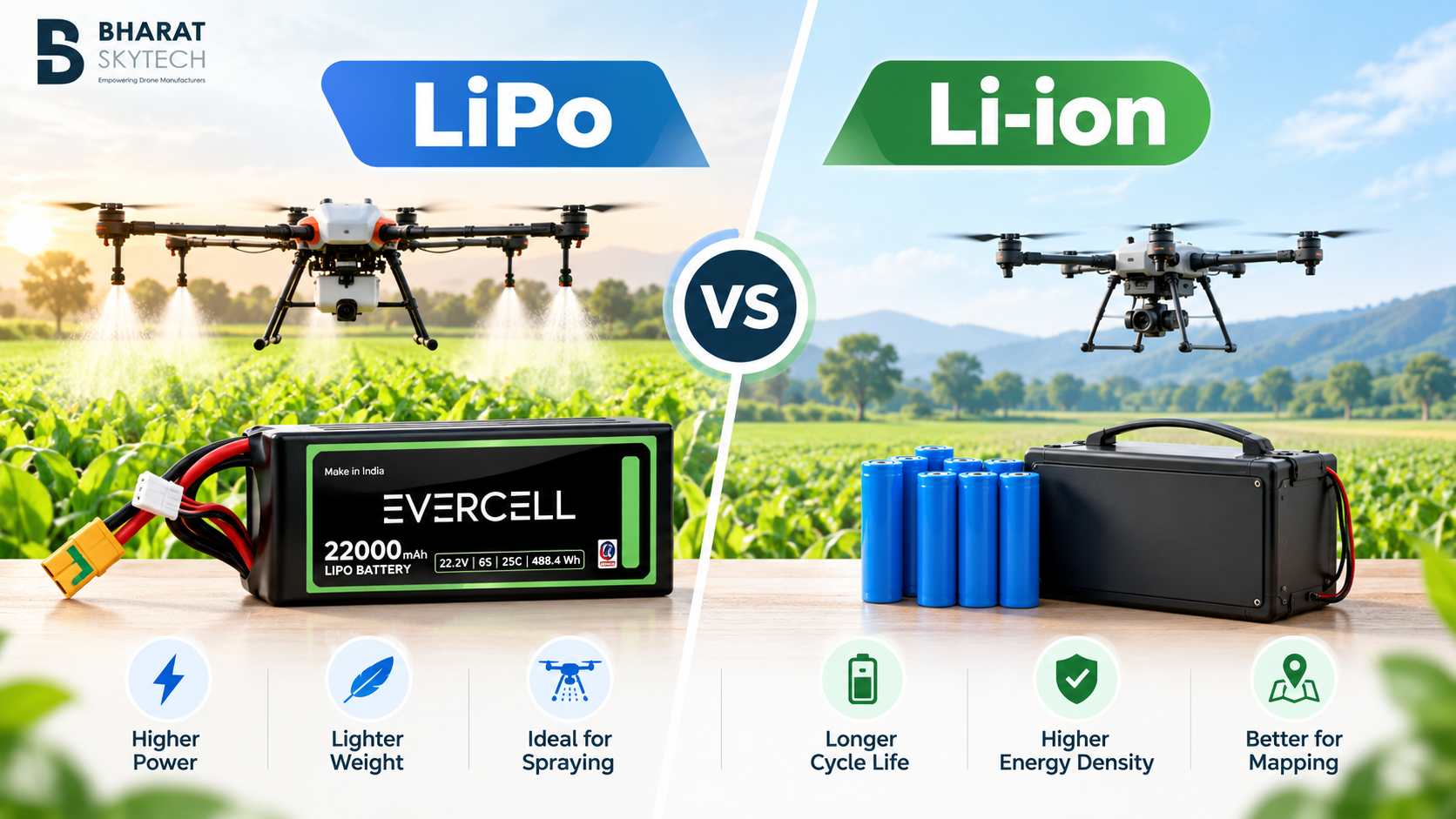
LiPo vs Li-ion battery: the short answer
For most agriculture spraying drones built in India today, a LiPo battery is still the better choice. It delivers the high current a loaded sprayer needs for take-off and hover, at a lower price per pack. Li-ion wins when you need more charge cycles or longer, gentler flights, such as mapping and survey work.
The LiPo vs Li-ion battery question gets confusing answers online. Some guides say LiPo stores more energy; others say Li-ion does. Some call LiPo safer; others call it riskier. The reason is simple: both are lithium-ion chemistries, and the result depends on the specific cell, not the label.
This guide compares the two using real drone battery specifications, not generic claims. You will see energy per kilogram, discharge ratings, cycle life and cost per cycle, plus where newer semi-solid-state batteries fit in 2026.
Quick answer by use case
- 10L–20L spraying drone: LiPo (high current, lower upfront cost)
- Mapping or survey drone: Li-ion or semi-solid (more energy per kg, gentle current draw)
- Fleet flying 1,000+ cycles a year: compare cost per cycle, not pack price (see below)
LiPo vs Li-ion battery comparison table
The biggest practical difference for drones is discharge current: LiPo packs deliver far more current for their size, while Li-ion packs usually last more cycles.
Factor | LiPo (lithium polymer) | Li-ion (cylindrical / prismatic) |
|---|---|---|
Cell format | Flat pouch in a soft foil wrap | Rigid metal can (e.g. 18650, 21700) |
Nominal cell voltage | 3.7V (4.2V full) | 3.6–3.7V (4.2V full) |
Continuous discharge | High: 10C–25C+ packs are common | Moderate: high-drain cells reach about 10C |
Energy per kg (pack) | ~190–200 Wh/kg for agri-drone packs | Similar or higher at cell level; pack overhead varies |
Cycle life | Typically 300–500+ cycles | Often 500–1,500 cycles in smart packs |
Physical toughness | Pouch can puncture or swell | Metal can resists knocks |
Shape flexibility | Any size or shape | Fixed cell sizes |
Upfront cost | Lower per pack | Higher per pack, often lower per cycle |
Best drone use | Spraying, heavy lift, FPV | Mapping, survey, long endurance |
Note: LiFePO4 is a third lithium chemistry with a 3.2V nominal cell. It is not the same as Li-ion, although some guides mix them up.
What is the difference between LiPo and Li-ion batteries?
A LiPo battery is a lithium-ion battery built as a flat pouch instead of a metal can. Both move lithium ions between the same kinds of electrodes; the main differences are the electrolyte form and the packaging.
What is a Li-ion battery?
In everyday use, “Li-ion” means cells with a liquid electrolyte sealed in a rigid metal can. The common drone sizes are cylindrical 18650 and 21700 cells. A pack is built by welding many cells together in series (for voltage) and parallel (for capacity), usually with a battery management system (BMS).
What is a LiPo battery?
A LiPo (lithium polymer) battery holds its electrodes and a gel-type or polymer-supported electrolyte inside a soft aluminium-laminate pouch. Because the pouch has no fixed shape, manufacturers can make large, flat, high-capacity cells. That is why most agriculture drone packs, like a 6S 22000mAh battery, use LiPo pouch cells.
What is a LiPo battery cell, and what does 6S mean?
One LiPo cell is 3.7V nominal and 4.2V when fully charged. “6S” means six cells in series: 6 × 3.7V = 22.2V. “P” means cells in parallel, which adds capacity. Most Indian 10L and 16L spraying drones run on 6S or 12S (two 6S packs in series) power systems.
For more on choosing a pack, see our 6S LiPo battery guide.
Which has higher energy density: LiPo or Li-ion?
Neither chemistry wins outright: energy per kilogram depends on the cell design and how much casing, wiring and electronics the pack carries. Real drone batteries show the spread.
Battery | Type | Energy | Weight | Energy per kg | Continuous discharge |
|---|---|---|---|---|---|
LiPo pouch pack | 488.4 Wh | 2.55 kg | ~191 Wh/kg | 10C (220 A) | |
Semi-solid pouch pack | 488.4 Wh | 1.74 kg | ~281 Wh/kg | 3C (66 A) | |
Li-ion cell only (no pack) | 15.5 Wh | ≤70 g | ~221 Wh/kg | ~10.7C (45 A) | |
Li-ion smart pack (NMC) | 1,560 Wh | ~12.1 kg | ~129 Wh/kg | ~11.5C |
Energy per kg is calculated from each maker’s or retailer’s listed energy and weight.
Three points stand out:
- A bare Li-ion cell can beat a LiPo pack per kg, but a finished Li-ion pack adds nickel strips, a holder, a BMS and a case. The DJI pack also carries cooling and a rugged shell, which is why its figure is lower.
- Semi-solid packs are the lightest for the same energy. The Tattu pack holds the same 488.4 Wh as the Evercell pack at roughly 0.8 kg less.
- Weight is only half the story. The lighter semi-solid pack is rated for 66 A continuous, against 220 A for the LiPo pack. The next section explains why that matters for sprayers.
Discharge rate: why spraying drones need LiPo power
A spraying drone draws its heaviest current at take-off with a full tank, so the battery’s continuous discharge rating matters more than its weight. If the drone pulls more current than the pack is rated for, voltage sags, the pack overheats and its life shortens fast.
The C-rating tells you the safe continuous current: current (A) = C-rating × capacity (Ah). A 22Ah pack rated 10C can supply 220 A continuously; the same capacity at 3C supplies 66 A.
To check a battery against your drone, work it the other way:
Example only: a power system drawing 150 A continuous from a 22Ah pack needs at least 150 ÷ 22 ≈ 6.8C. A 10C LiPo covers it with headroom; a 3C semi-solid pack of the same capacity would not. Take the real current from your motor and ESC data sheets, not this example.
Watch for burst-only ratings. A label like “25C” is often a burst figure for a few seconds. The Evercell 22000mAh pack, for example, lists 10C continuous and 25C for up to 3 seconds. Size your system on the continuous figure.
To match capacity and motor class, see 22000mAh battery: how to match it with your drone motor.
Cycle life and cost per cycle
Li-ion smart packs usually last more charge cycles, but LiPo packs cost less to buy, so the fair comparison is cost per cycle. One cycle is one full charge and discharge.
- LiPo: quality agri-drone packs are commonly rated around 500 cycles. The Evercell 6S 22000mAh is rated 500+.
- Li-ion smart packs: DJI’s DB1560 for the Agras T40 and T50 is a Li-ion NMC pack with a 1,500-cycle warranty, but it only works in DJI aircraft.
At ₹15,999 (excl. GST) and 500 cycles, an Evercell 22000mAh pack works out to about ₹32 per cycle. Any battery you compare should be judged the same way, using its real price and rated cycles. A pack that costs three times as much but lasts three times longer costs the same per cycle.
On a 10L drone, one battery cycle typically covers about one acre, so cost per cycle feeds straight into your drone spraying cost per acre.
How you charge decides whether a pack reaches its rated cycles. Charging at 0.5C, storing at about 3.8V per cell and never draining below cut-off all extend life. Our drone battery charging guide covers this in detail.
Is LiPo or Li-ion safer?
Neither is safe by default: both can catch fire if overcharged, short-circuited, punctured or overheated. They fail in different ways, so the precautions differ.
Risk | LiPo pouch | Li-ion metal can |
|---|---|---|
Physical damage | Soft pouch can be punctured in a crash | Rigid can resists knocks; pack welds can crack |
Early warning | Swells (“puffs”) as it degrades, a visible sign to retire it | Little visible warning; relies on the BMS |
Overcharge protection | Needs a balance charger | Usually handled by a built-in BMS |
Heat | Loses life quickly when charged hot | Also degrades with heat, more gradually |
Heat is the bigger risk in Indian fields
Summer field temperatures in much of India pass 40°C, and a pack just off a spraying flight is hotter still. Charging a hot battery is one of the fastest ways to shorten its life or cause swelling.
- Let packs cool to near air temperature before charging. The Evercell 22000mAh is rated for charging between 0°C and 45°C.
- Keep spare packs in shade, never on a vehicle dashboard or in direct sun.
- Retire any LiPo that has swelled. See LiPo battery swelling: causes and when to replace.
- Use a charger with balance charging and temperature cut-off, such as the Evercell EC2000 14S charger.
- Store and transport packs at about 50% charge in a fire-resistant LiPo bag.
Semi-solid-state batteries: the third option in 2026
Semi-solid-state batteries are pouch cells that replace much of the liquid electrolyte with a cured gel, packing far more energy per kilogram than standard LiPo. Tattu, for example, now lists semi-solid drone packs in 280, 300, 330 and 350 Wh/kg classes, using high-nickel cathodes and silicon-carbon anodes.
The trade-off is current. The 300 Wh/kg series 22Ah 6S pack is rated 3C continuous and 10C peak for up to 15 seconds. That suits long, steady flights well. A heavy sprayer that needs high continuous current may need a larger-capacity semi-solid pack, or it may be better served by LiPo.
Standard LiPo | Semi-solid-state | |
|---|---|---|
Energy per kg | ~190–200 Wh/kg | ~280–350 Wh/kg |
Continuous discharge | High (10C or more) | Lower (around 3C–5C on many packs) |
Best fit | Spraying, heavy lift | Mapping, survey, long-endurance flights |
Cost | Lower | Higher |
Before switching a spraying drone to semi-solid packs, run the required-C check from the discharge section with your actual motor current.
Which battery should you choose for your drone?
Choose by how much current your drone draws and how many cycles you will run, not by the chemistry label.
Your drone or operation | Best choice | Why |
|---|---|---|
10L–16L spraying drone, DIY or Indian-built | LiPo 6S packs (often two in series for 12S) | High continuous current for a full tank; lowest upfront cost; easy to replace |
20L+ heavy sprayer | High-C LiPo, or a smart pack from the drone maker | Very high current at take-off |
Mapping or survey drone | Li-ion or semi-solid | Steady, low current; lighter pack means longer flights |
Long-endurance inspection or surveillance | Semi-solid | Highest energy per kg |
DJI Agras or other closed-system drone | The maker’s own smart battery | Only compatible option; built-in BMS |
Questions to ask before you buy
- What is the drone’s continuous current at full load, and does the pack’s continuous C-rating cover it?
- Is the C-rating continuous or burst-only?
- How many rated cycles, and what is the cost per cycle?
- What are the safe charging temperature limits?
- Is the pack BIS-certified, with local stock and warranty support in India?
For most Indian 10L and 16L sprayers, a quality 6S LiPo such as the Evercell 22000mAh covers these checks: 220 A continuous, 500+ cycles, BIS approval and India-based support. Browse the full range of drone batteries.
Frequently Asked Questions (FAQs)
Is LiPo better than Li-ion for drones?
For spraying and heavy-lift drones, usually yes, because LiPo packs deliver higher continuous current at a lower price. For mapping and long-endurance drones, Li-ion or semi-solid packs are often better because they carry more energy per kilogram at gentle current draw.
Is a LiPo battery a lithium-ion battery?
Yes. LiPo is a type of lithium-ion battery built in a flexible pouch rather than a rigid metal can. “Li-ion” in everyday use usually means cylindrical or prismatic cells.
Which lasts longer, LiPo or Li-ion?
Li-ion smart packs usually last more cycles; DJI’s DB1560, for example, carries a 1,500-cycle warranty. Quality agri-drone LiPo packs are typically rated around 500 cycles. Compare cost per cycle, not cycle count alone.
Which is safer, LiPo or Li-ion?
Neither is safe by default. LiPo pouches can puncture and swell; Li-ion cans resist knocks but give less visible warning. Correct charging, cooling and storage matter more than chemistry.
Can I replace a LiPo battery with a Li-ion battery in my drone?
Only if the Li-ion pack matches the voltage (cell count), fits the frame, uses the right connector and has a continuous current rating at or above your drone’s draw. Many Li-ion packs cannot supply a loaded sprayer’s current.
What is a lithium LiPo battery?
It is another name for a lithium polymer battery: a rechargeable lithium-ion cell in a soft pouch, 3.7V nominal per cell.
What does 6S 22000mAh 25C mean?
Six cells in series (22.2V), 22Ah capacity, and a 25C discharge rating. Check whether 25C is continuous or burst; on many packs it is burst only.
How should I store LiPo and Li-ion batteries?
Store both at about 50% charge (around 3.8V per LiPo cell), in a cool, dry place out of direct sun, ideally in a fire-resistant bag.