
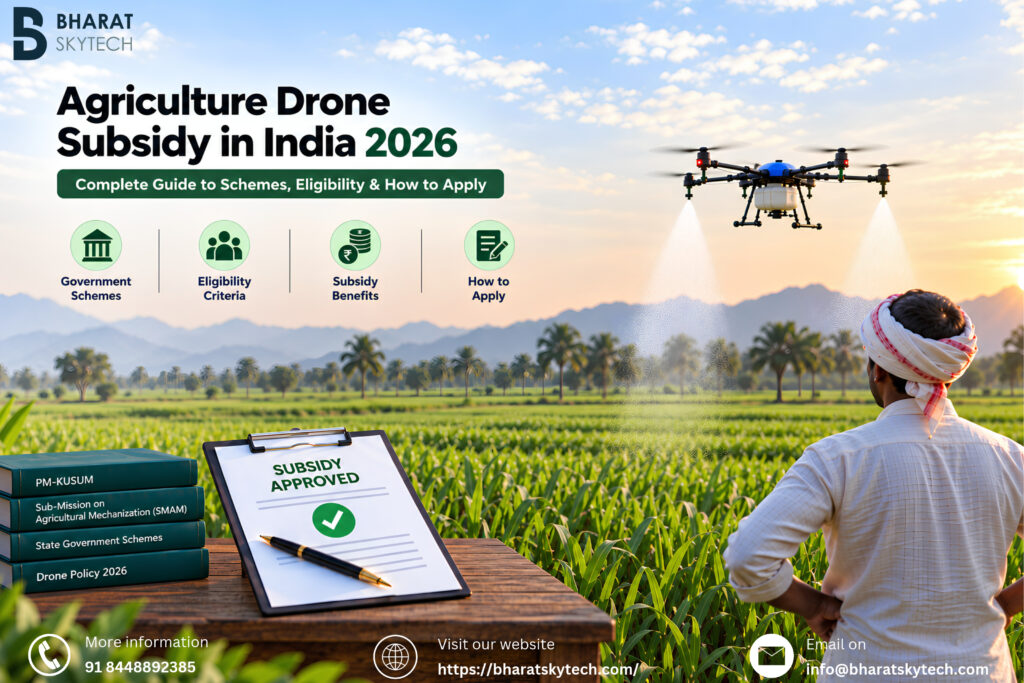
The agriculture drone subsidy landscape in India has matured significantly through 2026, with the central government and multiple state governments now running parallel schemes that bring the cost of an agriculture drone within reach of individual farmers, Farmer Producer Organisations (FPOs), Custom Hiring Centres (CHCs), and women’s Self Help Groups. What started as a pilot initiative under the 2022 Kisan Drone Yojana has evolved into a full-fledged mechanisation push, with subsidy coverage ranging from 40% for individual buyers to 100% for training institutions.
In Hindi-speaking states, the same set of schemes is often referred to as krishi drone subsidy or the krishi drone anudan yojana — “krishi” meaning agriculture and “anudan” meaning grant — so farmers researching in regional language portals should expect to see these terms used interchangeably with “Kisan Drone.” If you’re evaluating whether a drone purchase makes financial sense this year, here’s a complete breakdown of every scheme, the eligibility rules, state-specific top-ups, and the exact application process
Central Government Schemes Driving Drone Subsidy for Agriculture in India
The drone subsidy for agriculture in India is anchored by two central programmes: SMAM (Sub-Mission on Agricultural Mechanization) and the Namo Drone Didi scheme, both run under the Ministry of Agriculture & Farmers Welfare.
SMAM provides tiered subsidy percentages depending on who is buying:
- Individual SC/ST, small and marginal farmers, North-East farmers, and women farmers: 50% subsidy, capped at ₹6 lakh
- Other individual farmers: 40% subsidy, capped at ₹4 lakh
- Custom Hiring Centres (CHCs): 75% subsidy, capped at ₹7.5 lakh
- Farmer Producer Organisations (FPOs): 75% subsidy, capped at ₹7.5 lakh
- Krishi Vigyan Kendras, ICAR institutes, and State Agriculture Universities: up to 100% grant for demonstration and training purposes
Namo Drone Didi, launched to train and equip women SHGs as certified drone pilots, works differently — Central Financial Assistance covers 80% of the drone and accessory cost, up to a ceiling of ₹8 lakh per unit, with the SHG contributing the balance through bank loans. Beyond the equipment subsidy, women drone pilots under this scheme can earn recurring income of roughly ₹15,000 a month plus rental income from offering spraying services to other farmers.
Separately, PM-KISAN-linked drone support channels subsidy through FPOs specifically for small and marginal farmers, with allocations up to ₹3.75 lakh per drone and priority given to SC/ST applicants.
State-Level Top-Ups: Rajasthan, UP, and Andhra Pradesh
On top of the central SMAM allocation, several states run their own supplementary schemes — which is why the exact subsidy amount a farmer receives can vary noticeably by location.
Agriculture drone subsidy in Rajasthan is structured through the state agriculture department’s mechanisation wing, with additional support directed at drought-prone and arid-zone districts where drone spraying reduces both water usage and labour dependency. Rajasthan has also run extensive Nano Urea spraying demonstrations across its districts as part of building farmer familiarity with drone-based application before scaling up subsidy disbursement.
Agriculture drone subsidy in UP falls under the state’s Agridarshan Yojana, which bundles agricultural drones together with custom hiring centres, farm machinery banks, and crop residue management equipment into a single mechanisation subsidy umbrella. Farmers apply through the official Agridarshan portal or their nearest Common Service Centre (CSC), registering with Aadhaar and a mobile number before selecting the drone category under the equipment list.
Agriculture drone subsidy in Andhra Pradesh has been one of the more aggressive state rollouts, with FPO-level applications in districts like Guntur reporting fully subsidised drone allocations in several documented cases, reflecting the state’s push to scale precision spraying across its high-value crop belts.
Beyond these three, Maharashtra adds a further 25% state-level top-up on the central subsidy (pushing total coverage toward 100% for eligible FPOs), Telangana runs its own 40% subsidy under the 2025-26 SMAM allocation specifically for FPOs and cooperatives, and Karnataka channels support for Custom Hiring Centres through its state agriculture department.
How to Apply for Agriculture Drone Subsidy — Step by Step
Knowing how to apply for an agriculture drone subsidy matters as much as knowing the percentage, since incomplete documentation is the most common reason applications stall. The general process, whether applying centrally or through a state portal, follows this sequence:
1. Confirm eligibility
Check your category (individual farmer, SC/ST/women farmer, FPO, CHC, or institution) against the applicable subsidy slab and land or organisational registration requirements.
2. Select the scheme
SMAM applications route through agrimachinery.nic.in, while state top-ups (Agridarshan in UP, i-Khedut in Gujarat, and equivalents elsewhere) have their own dedicated portals.
3. Get a manufacturer quotation
This must come from a DGCA-empanelled drone manufacturer and is mandatory documentation for the subsidy application, not optional supporting material.
4. Complete the online application
The process to apply for an agriculture drone subsidy online requires digital copies of land records, category certificates (where applicable), bank account details for direct transfer, and the manufacturer quotation, all uploaded against your registered application ID.
5. Facility inspection
A district agriculture officer may inspect your operational setup before final approval, particularly for CHC and FPO applications.
6. Disbursement
Once approved, the subsidy amount is typically credited to the applicant’s bank account within 30–60 days of purchase confirmation.
The entire workflow sits under what’s broadly referred to as the kisan drone subsidy programme, and tracking your application ID through the portal is the most reliable way to monitor status rather than relying on offline follow-up alone.
Why DGCA Approval Is Non-Negotiable for Subsidy Eligibility
No subsidy application — central or state — moves forward without proof that the drone is a DGCA approved agriculture drone. The Directorate General of Civil Aviation maintains a type-certification list, and only drones built and sold by empanelled manufacturers against that certification qualify for subsidy disbursement. This isn’t just a paperwork formality: it also determines whether the drone can be legally flown for commercial spraying at all, since operating an agricultural drone commercially requires the pilot to hold a valid Remote Pilot Certificate (RPC) issued after training at a DGCA-empanelled flying institute. Buyers should verify type-certified status directly with the manufacturer before finalising a purchase, since an uncertified build — however capable — will be rejected at the application stage regardless of subsidy category.
Agriculture Drone Price and What Subsidy Actually Saves You
Understanding agriculture drone subsidy price in real terms means looking at actual market costs before and after the subsidy is applied. Agriculture drone price in India generally scales with tank capacity:
- 10-litre entry-level drones: roughly ₹5–8 lakh for a complete DGCA-certified build
- 15–17 litre mid-range drones: roughly ₹6.5–9 lakh depending on flight controller, camera, and battery specification
- 20 litre agriculture spraying drone price, or the 20L agriculture spraying drone price subsidy as farmers often search it, typically runs higher still, generally in the ₹10–16 lakh range before subsidy for a fully certified unit with GPS-guided autonomous route planning and a robust battery-charger combination capable of sustained daily operation
Applying the subsidy slabs above, an individual small or marginal farmer buying a 10-litre drone at ₹6 lakh under the 50% category would pay roughly ₹3 lakh out of pocket (subject to the ₹6 lakh cap), while an FPO purchasing a higher-capacity 16–20 litre unit at 75% subsidy could bring the net cost down substantially, subject to the ₹7.5 lakh ceiling. The economics improve further once operating income is factored in — drone spraying services commonly charge ₹400–1,200 per acre depending on crop type, meaning a CHC or FPO can recover its net investment within one to two spraying seasons across a modest coverage area.
Building Toward a Subsidy-Eligible Drone
For CHCs, FPOs, and agri-tech operators assembling or upgrading a spraying drone rather than buying a finished unit outright, every component in the build has to trace back to DGCA-compliant specifications for the finished aircraft to qualify. That means frames rated for the intended payload class, motors and ESCs matched to the tank capacity, flight controllers with certified autonomous route planning, and batteries sized for a full day’s spraying cycle without excessive downtime for charging. Getting this component selection right the first time avoids costly rework once a unit is already through the type-certification and quotation stage of a subsidy application.
Conclusion
The agriculture drone subsidy ecosystem in India has moved well past pilot-stage experimentation — with SMAM, Namo Drone Didi, and a growing list of state-specific top-ups in Rajasthan, UP, Andhra Pradesh, Telangana, and Maharashtra, 2026 offers the most accessible financial pathway yet for farmers, FPOs, and CHCs to adopt drone-based spraying. Whether you know it as the krishi drone subsidy, the krishi drone anudan yojana, or by its central branding as Kisan Drone, the subsidy percentage you qualify for depends heavily on category — individual farmers sit at 40–50%, while institutional and group applicants can reach 75–100%. Every path runs through the same non-negotiable requirements: a DGCA-certified drone, a valid manufacturer quotation, and complete documentation submitted through the correct central or state portal. For anyone weighing the purchase decision, the combination of falling per-acre operating costs and rising subsidy coverage makes this one of the most favourable windows India’s agri-tech sector has seen for entering commercial drone spraying.
Frequently Asked Questions
How much subsidy can I get on an agriculture drone in India?
Individual farmers get 40–50% (up to ₹4–6 lakh), while FPOs and CHCs get 75% (up to ₹7.5 lakh). Namo Drone Didi covers 80% up to ₹8 lakh for women SHGs.
Is a DGCA-approved drone mandatory for subsidy eligibility?
Yes. Only drones from DGCA type-certified manufacturers qualify, and the quotation from that manufacturer is a mandatory document in the application.
Where do I apply for the agriculture drone subsidy online process?
Central SMAM applications go through agrimachinery.nic.in; state top-ups use their own portals (e.g., Agridarshan for UP, i-Khedut for Gujarat).
Do I need a pilot licence to operate a subsidised agriculture drone?
Yes, a Remote Pilot Certificate (RPC) from a DGCA-empanelled training institute is required for commercial operation, regardless of subsidy category.
How long does it take for the subsidy amount to be credited?
Typically 30–60 days after purchase confirmation and approval, credited directly to the applicant’s registered bank account.