

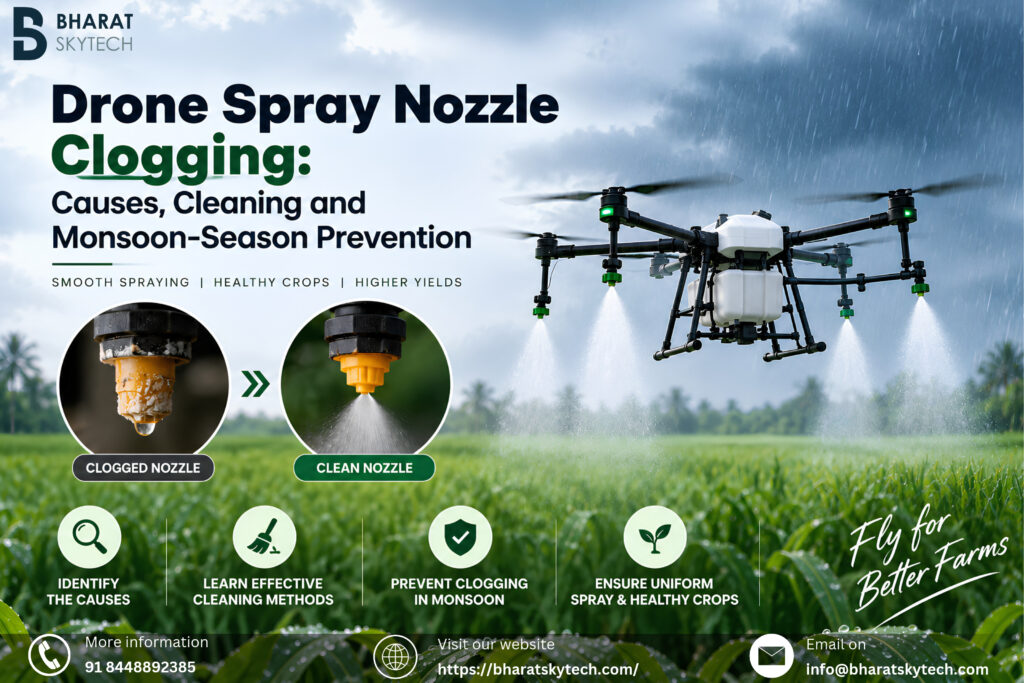
Drone spray nozzle clogging is the single most common reason an agriculture drone leaves patchy fields, burns through battery cycles re-flying missed strips, and quietly pushes up the cost per acre of every spraying job. Every operator eventually deals with it — a nozzle that dribbles instead of fanning, a boom section that runs dry while the rest keeps spraying, or a pump that sounds like it’s working harder than it should while ground output tells a different story. The frustrating part is that most clogging problems in India have very little to do with the drone itself and everything to do with what’s going into the tank, what’s growing in the tank between jobs, and what the water coming out of the borewell is carrying with it.
Most content on this topic online is written for US operators spraying clean municipal or treated well water through DJI Agras or Talos systems, leaning on FAA framing with no relevance here. Indian field conditions change the diagnosis: canal and borewell water that runs hard almost everywhere outside the coasts, a monsoon window that turns humidity into its own maintenance problem, and a spray mix built around wettable powders and water-dispersible granules far more often than the ready-to-use liquid concentrates common in Western row-crop spraying. A nozzle-cleaning guide that ignores all of that only solves half the problem.
Why a Clogged Nozzle Is an Accuracy Problem, Not Just a Maintenance One
A partially blocked nozzle rarely announces itself as a total failure. More often, the flight controller still reports normal tank output while actual delivery on the ground drops on one or two nozzles, leaving thinner coverage on part of the swath. This shows up in the field as uneven spray coverage drone patterns — visible streaking, a lighter band under one arm of the boom, or patches that need a second pass. Because the controller doesn’t know a nozzle orifice is partially obstructed, it keeps commanding the same flow rate, so the operator only finds out once crop response is uneven weeks later.
There’s a second, less obvious cost: droplet size. When a nozzle orifice narrows from scale or residue, atomization shifts away from the pattern it was designed to produce. That changes drift behaviour — a nozzle meant to throw a controlled, mid-range droplet can start throwing finer droplets that carry further on wind, which is exactly the kind of unintended movement that spray drift control practices, and DGCA’s drone rules near field boundaries and water bodies, expect operators to actively manage. A clogging nozzle changing its droplet spectrum mid-season is a drift-control problem that started as a maintenance issue.
The India-Specific Causes Worth Actually Diagnosing
- Hard water and mineral scale. A large share of groundwater used to fill spray tanks across Punjab, Haryana, UP, Maharashtra, and much of central India runs well above the 200–300 ppm hardness threshold where scaling becomes a real problem. As that water evaporates from a nozzle orifice or strainer screen between fills, dissolved calcium and magnesium leave behind a chalky white deposit that narrows the passage a little more with every tank. It rarely blocks a nozzle outright in one go — it shows up as a slow, creeping drop in output on the same nozzle week after week, often mistaken for pump weakness.
- Wettable powder and WDG formulations. Indian spray programs lean heavily on wettable powders, water-dispersible granules, and micronutrient blends that don’t stay in suspension as reliably as liquid concentrates once agitation stops. Any mix left standing in the tank or lines — even for the length of a lunch break — starts settling, and once it dries on an interior surface it doesn’t rinse away with plain water. This is one of the most frequent causes of clogged spray nozzles drone operators report after a midday break: the mix was fine at the start of the morning, and the same batch clogs three nozzles after the pause.
- Monsoon humidity. Once the season turns humid, drones stored between jobs with any residual moisture in the tank or lines create ideal conditions for a thin biological film to build up inside plumbing that never fully dries. That film catches particulate matter the way a wet surface always does — a distinctly monsoon-window problem that doesn’t show up the same way in the dry rabi season.
- Debris from source water. Canal water and open storage tanks carry silt, algae fragments, and fine sand that a tank strainer alone won’t always catch, especially if the inline filter mesh has stretched or torn from repeated handling.
Diagnosing Before You Clean
Run a clean-water test at normal operating pressure before assuming which nozzle is at fault. If only one nozzle underperforms, the cause is almost always local — debris in that screen or wear at that tip. If several nozzles across the boom are weak at once, the problem is upstream: the tank mix, the main filter, or the source water. This one check saves operators from replacing a perfectly good nozzle when the real issue is sitting in the strainer basket two steps back in the line.
Step-by-Step Drone Sprayer Nozzle Cleaning
Drone sprayer nozzle cleaning doesn’t need anything exotic, but it needs to happen in the right order and on a schedule, not only when a nozzle visibly fails:
- Flush the tank and lines with clean water at the end of every spraying session — never leave mix standing overnight, even diluted mix.
- Remove each nozzle body and rinse the screen and orifice separately; check what collects in the screen, since it tells you what’s getting through the upstream filter.
- For hardness-related white crust, soak the nozzle body in a mild descaling solution (diluted white vinegar works for light scale) for 30–60 minutes before scrubbing.
- Clean with a soft nylon brush or a purpose-made nozzle tool only — never wire, pins, or anything metal, which can enlarge or distort the orifice and permanently change the spray pattern.
- Reassemble and run a clean-water flow test across all nozzles before the next field job, comparing output side by side.
A consistent post-spray flush is the single habit that prevents most of the causes above from ever reaching the nozzle in the first place.
Choosing the Right Nozzle for the Job
Bharat Skytech’s aerosol nozzle lineup is built around five models, each suited to a different operating style and flow requirement:
- Aerosol Nozzle Model 4810 — the standard fixed aerosol nozzle in the range, suited to routine spraying where a compact, non-folding tip is sufficient.
- Folding Aerosol Nozzle Model 4820 — a collapsible variant of the 4810, useful where transport and storage space is tight between field jobs.
- Folding Aerosol Nozzle Pro Model 5820 — the upgraded folding option in the range for operators who want the folding form factor with a step up in build.
- Aerosol Nozzle Max Model 8820 — the higher-capacity option in the lineup, aimed at operators covering larger acreage per flight.
- Hobbywing 9L Centrifugal Nozzle — atomizes through a spinning disc rather than a fixed orifice, which makes it less prone to orifice-blockage in the way fixed-tip nozzles are, though the disc and inlet still need to be kept free of dried residue.
Finer-orifice aerosol models are more prone to scale-related clogging simply because their passages are narrower, which makes the descaling step in the cleaning routine more important on those tips specifically. The full range is available on Bharat Skytech.
Drone Spray Pump Troubleshooting: Where Clogging and Pump Issues Overlap
A partially clogged nozzle and a weakening pump can look identical from the operator’s seat — both show up as reduced output and inconsistent pressure. Before assuming pump failure, isolate the nozzles from the equation with a water-only test; if pressure and flow normalize with nozzles removed, the pump and lines are healthy and the fault is downstream at the tips or screens. Drone spray pump troubleshooting should always start with this elimination step, since replacing a pump when the actual fault was a scaled nozzle is a common and avoidable cost.
When to Replace Instead of Clean
Cleaning restores most clogs, but a nozzle that keeps returning the same fault after a proper descale and screen clean, or one that flow-tests noticeably off its rated output, has likely worn past the point of a clean fixing it. At that stage, replacing the tip — and ideally the full set on that boom section, to avoid uneven output between old and new nozzles — is the more reliable fix.
Conclusion
Nozzle clogging on Indian agriculture drones is rarely a single-cause problem. Hard water scaling, wettable-powder residue, monsoon-season humidity, and ordinary source-water debris all compound on top of each other across a spraying season, and the fix depends on correctly identifying which one is driving the symptom in front of you. A disciplined post-spray flush, a scheduled descale for hard-water regions, and a habit of testing before replacing will keep spray coverage even and drift risk low through the toughest months of the season — and when a tip does need replacing, the right model in the range matters as much as the maintenance routine around it.
Why does a nozzle clog only after the water source changes?
Different sources carry different mineral loads and debris. Switching from a treated line to borewell or canal water often introduces hardness or silt the previous source didn’t have, which shows up as clogging even though nothing about the drone changed.
Can I use hot water to clear a clogged nozzle?
Warm water helps loosen residue slightly faster than cold, but it won’t dissolve hard-water scale on its own — a proper descaling soak is still needed for mineral deposits.
How often should nozzles be cleaned during peak spraying season?
At minimum, flush after every spraying session and do a full strip-down clean weekly during heavy monsoon or high-hardness-water use, since residue and scale build up faster under those conditions.
Does the centrifugal nozzle need the same cleaning routine as aerosol nozzles?
The disc and inlet still need to stay free of dried residue, but centrifugal nozzles are less prone to full orifice blockage since there’s no fixed narrow opening for scale to close off.
Is a clogged nozzle a compliance risk, not just a coverage one?
Yes — a clog that shifts droplet size can increase drift beyond the target area, which runs against the drift-control expectations under DGCA’s operating rules, not just an efficiency concern.