
Agriculture drones are quickly becoming one of the most talked-about tools in Indian farming, and for good reason. What used to take a full day of manual labour with a backpack sprayer now takes minutes in the air, with far less chemical waste, far less human exposure to pesticides, and far more precision than any traditional method could offer. As India pushes toward becoming a global leader in agri-tech, agriculture drones have moved from being a novelty at farm expos to becoming a genuine working tool on farms across Punjab, Maharashtra, Andhra Pradesh, and beyond.
In this blog, we’ll break down exactly why farmers are adopting agriculture drones, where they’re being used across the crop cycle, and what the next few years of growth are likely to look like for this industry.
Benefits of Agriculture Drones
Precision Input Application
Precision farming is the single biggest benefit drones bring to Indian fields. Instead of treating an entire field uniformly, drones allow farmers to apply water, fertiliser, and pesticide exactly where and when it’s needed, based on real crop data rather than guesswork. A drone fitted with multispectral or NDVI sensors can fly over a field and flag stressed patches of crop days before the human eye would notice a problem, giving farmers a head start on disease or pest control.
Speed and Labour Savings
A single agriculture UAV fitted with a 10L to 40L tank can cover several acres in the time a labourer would take to cover a fraction of that area. With rural labour increasingly hard to source during peak spraying season, this speed isn’t a convenience — it’s often the difference between spraying on time and losing a crop cycle to delay.
Safer for Farm Workers
Manual spraying puts workers in direct, repeated contact with chemicals. Drone spraying removes the operator from the field entirely — the pilot controls the aircraft from a safe distance, and the drone applies inputs in calibrated doses through flow-controlled nozzles, cutting both chemical overuse and human exposure at the same time.
Lower Input Costs Over Time
Because drones apply inputs only where they’re needed, farmers typically use less pesticide and fertiliser per acre compared to blanket spraying. Combined with faster coverage, this brings down the overall cost per acre of a spray cycle, even after accounting for the upfront cost of the equipment.
Better Data for Decision-Making
Beyond spraying, drones give farmers a bird’s-eye view of crop health, water stress, and field variability that was previously only available through expensive satellite imagery or manual field walks. This is the essence of smart farming in India today — better decisions, made faster, with real data behind them.
Applications of Agriculture Drones
Crop Spraying
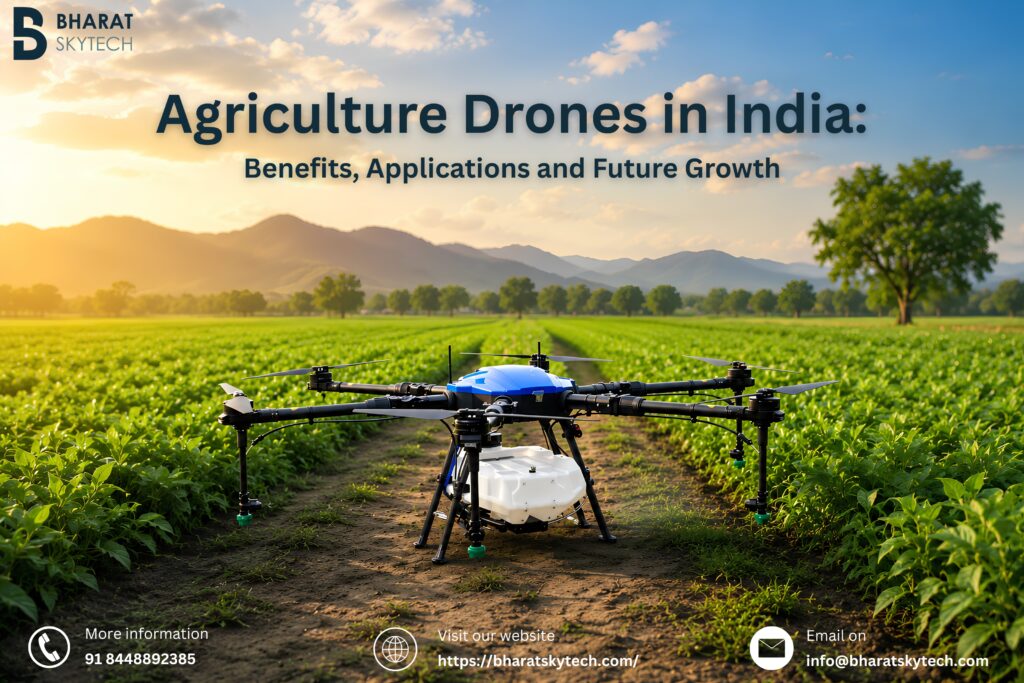
Crop spraying remains the leading use case for agriculture drones in India. A modern spray drone typically combines a flight controller that processes GPS and terrain data to keep the aircraft stable, terrain-following radar that automatically adjusts altitude so the spray boom stays at a consistent height above the crop canopy, and flow meters with centrifugal or aerosol nozzles that regulate exactly how much liquid is released per second. Together, these turn spraying into a controlled, repeatable process rather than a rough manual job.
Seed Sowing and Fertiliser Spreading
Drones fitted with granular spreading attachments are increasingly used for seed sowing and fertiliser spreading across paddy fields and other crops, particularly where terrain or waterlogging makes tractor access difficult.
Crop Health Monitoring
With multispectral cameras, drones can perform crop health monitoring across large fields in minutes, producing health maps that highlight irrigation issues, nutrient deficiencies, or early pest infestations — data that would take a scouting team days to gather manually.
Field Mapping and Land Survey
Drones are also used for field mapping — generating accurate topographic and boundary maps of farmland that help with everything from irrigation planning to land record verification.
Component Quality: The Deciding Factor Behind Performance
Here’s something many first-time spray drone buyers don’t realise: the frame is only the shell. The actual performance of an agriculture drone — how accurately it sprays, how long it flies, how well it holds up over hundreds of flight hours — comes down to its individual agriculture drone components. A weak motor under a heavy payload will overheat and shorten flight time. A poor-quality flight controller will drift off course on windy days. A low-grade battery will degrade after a fraction of its rated charge cycles.
This is where Bharat Skytech has built its position in the market. As India’s dedicated agriculture drone components store, Bharat Skytech supplies everything from motors, ESCs, propellers, and flight controllers to complete frame kits like the EFT E610P, E616P, and E620P series (covering 10L, 16L, and 20L spray drones), along with batteries, GPS modules, and remote controllers. The company is the authorised distributor in India for globally recognised names including Hobbywing, SIYI, Skydroid, JIYI, EFT, Tattu, and SkyRC — giving farmers and drone assemblers access to genuine, tested parts rather than unverified imports. Backed by Thakral Corporation, an SGX-listed group with over 120 years of experience across procurement and supply chains in 28 countries, Bharat Skytech operates with the kind of backend reliability Indian agriculture has long needed: consistent stock, warranty-backed products, and a support team that understands drone assembly, not just order fulfilment.
Evercell: Bharat Skytech's Make in India Push
Alongside its distribution business, Bharat Skytech has been building its own in-house brand — Evercell — as part of a broader Make in India commitment to reduce the country’s dependence on imported drone hardware. Evercell currently focuses on the part of the drone that matters most for uptime: power. Its lineup includes LiPo and HV LiPo batteries, smart battery chargers, and drone frames, built to withstand the heat, dust, and long working days typical of Indian farmland.
The Evercell EC2000-14S smart charger, for example, comes with four dedicated modes — Charge, Storage, Balance, and Charge Hub — so operators running multiple battery packs in a day can manage cell health and charging speed without juggling separate devices. On the battery side, Evercell’s BIS-approved 22000mAh LiPo pack is built specifically for the high current draw of agriculture spray drones, giving operators dependable flight time across long spray sessions. As India’s drone ecosystem matures, homegrown, Make in India components like these mean faster replacement availability and after-sales support that doesn’t involve waiting weeks for a part to clear customs.
Future Growth of Agriculture Drones in India
The agriculture drones market in India is still in its early-to-middle stage of adoption, but the growth trajectory is clear. Government subsidy schemes for agri-drones, rising awareness among younger farmers, and a growing base of trained drone pilots under initiatives like the Kisan Drone scheme are all accelerating uptake. Drone-as-a-service models, where custom hiring centres and cooperatives offer spraying services on demand, are also making the technology accessible to smallholder farmers who can’t justify owning a drone outright.
The next phase of this growth won’t just be about more drones in the sky — it will be about smarter, more reliable components underneath them, and about domestic manufacturing narrowing India’s dependence on imported hardware. Farmers and drone service providers who invest in genuine, well-sourced components today will see fewer breakdowns, longer operational life, and better returns than those who cut corners on hardware to save a few thousand rupees upfront.
Conclusion
Agriculture drones have moved past the pilot-project stage in India — they’re now a working part of how modern farms operate, from precision spraying to crop health monitoring and field mapping. The benefits are real: faster coverage, lower input costs, safer working conditions for farm labour, and better data for every decision along the crop cycle. But the technology only delivers on its promise when it’s built on dependable, well-sourced components. That’s the gap Bharat Skytech has set out to close — supplying genuine, distributor-backed parts for every major drone frame and application, while building Evercell as a homegrown, Make in India answer to India’s growing power and hardware needs in agri-drone technology. As adoption spreads further into India’s farmland, the farms that invest in reliable components today are the ones best placed to make the most of this growth tomorrow.