

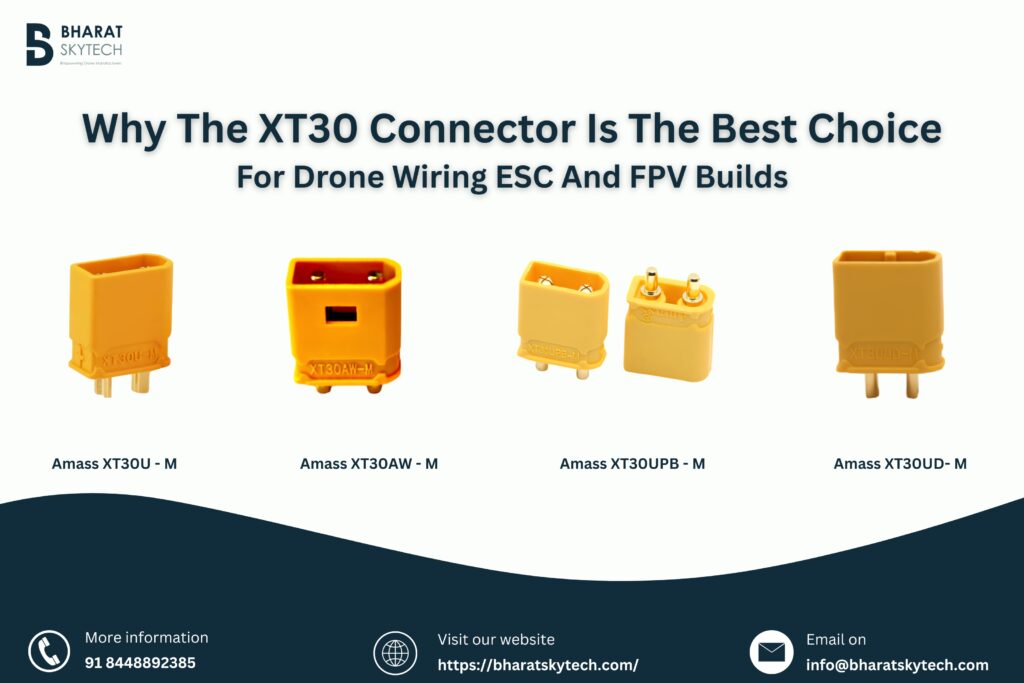
The XT30 connector is a compact, high-current DC connector used to link LiPo batteries to ESCs, power distribution boards, and flight electronics in small UAVs. Depending on the variant, it carries up to 30A of continuous current in a housing that weighs only a few grams, which is why it has become the default power connector for micro FPV quads, racing drones, RC aircraft, and light scouting drones.
Choosing the right connector is not a convenience decision. It directly affects voltage stability, thermal behaviour under load, and the working life of your ESC and motors. This guide covers what the XT30 is, how it is rated, which variant suits which build, how to solder it correctly, and how it compares to XT60, XT90, and JST connectors.
What Is an XT30 Connector?
An XT30 connector is a two-pin DC power connector built from a flame-retardant nylon (polyamide) housing with gold-plated brass contacts. The male half carries bullet pins; the female half carries matching sockets. Together they form a press-fit connection that resists loosening under vibration.
The connector belongs to the same family as the XT60 and XT90, sharing the same bullet-contact design principle at a smaller scale. It is manufactured by Amass, and you will see the same part referred to as an XT30 plug, an XT30 drone connector, an XT30 battery connector, or an XT30 pigtail when it comes with wires pre-attached. All of these describe the same connector family.
In a drone, the XT30 acts as the bridge between the battery and the rest of the power system. A poor connector in this position introduces contact resistance, which converts into heat and voltage drop, and in the worst case results in a disconnection mid-flight.
XT30 Connector Specifications and Ratings
The XT30 is not a single part. Ratings vary by variant, so always match the specification to the version you are actually fitting.
| Specification | Typical XT30 / XT30U | PCB-mount variants (XT30PW, XT30AW, XT30PB) |
|---|---|---|
| Continuous current | Up to 30A | 20A |
| Rated voltage | 500V DC | 500V–600V DC |
| Contact material | Gold-plated brass | Gold flash-plated brass |
| Housing material | Nylon / polyamide, UL94V-0 | Nylon / polyamide, UL94V-0 |
| Ingress protection | Not rated | IP40 on selected variants |
| Typical battery range | 2S to 6S LiPo | 2S to 6S LiPo |
| Mounting | Wire-to-wire | Through-hole PCB mount |
Two points are worth understanding here. First, the current rating is a thermal limit, not a hard ceiling – sustained draw close to the rating in a poorly ventilated frame will run the connector hot. Leave headroom of at least 20 per cent between your expected continuous draw and the connector rating. Second, the voltage rating is far above anything a multirotor LiPo pack will present, so voltage is rarely the limiting factor. Current and contact quality are.
Gold-Plated vs Nickel-Plated Contacts
Gold plating is applied as a thin flash over brass. It does not improve conductivity over the base metal in any meaningful way, but it resists oxidation, which matters a great deal over hundreds of mating cycles. A nickel-plated contact costs less and performs acceptably when new, but oxidises faster in humid conditions and gradually raises contact resistance. For drones flown in Indian field conditions, particularly agricultural environments with dust and moisture, gold-plated contacts are the sensible choice.
Where the XT30 Sits in a Drone Power Chain
The XT30 sits at the first and most heavily loaded junction of the power system:
Battery → XT30 connector → ESC or power distribution board → Motors → Flight controller and peripherals
Every amp your motors draw passes through this connector. Any resistance introduced here appears as a voltage drop at the ESC input, which the ESC then passes on to the motors as reduced available power. This is why the connector is not a place to economise, and why a single worn or badly soldered XT30 can degrade the performance of an otherwise well-specified drone power system.
XT30 Connector in Drone Wiring and ESC Systems
The ESC regulates motor speed in real time, and it needs a clean, stable input voltage to do this accurately. A quality XT30 in the battery-to-ESC path delivers:
- Steady power input to the ESC across the full throttle range
- Smooth motor response without hesitation or stuttering
- Low contact resistance, which limits heat build-up at the junction
- Longer component life, by shielding the ESC from repeated voltage fluctuations
When the connector is loose, corroded, or poorly made, the failure modes are predictable:
- Motor stutter or desynchronisation under rapid throttle changes
- Thermal shutdown of the ESC after sustained load
- Reduced overall thrust from voltage sag at the ESC input
- Complete power loss in flight if the connection separates
If you are selecting an ESC alongside your connector, our guide to [choosing an ESC for drones] covers current ratings and matching in more detail.
XT30 as a Drone Battery Connector
The XT30 is the standard choice for 2S, 3S, and 4S LiPo packs in small UAVs, and is used on some 6S packs where continuous draw stays modest. LiPo chemistry delivers very high burst current on aggressive throttle inputs, and the XT30’s contact geometry is designed to take these spikes without deforming or backing out of the housing.
Fitted correctly, the XT30 gives you:
- Faster throttle response, with less lag between stick input and thrust
- More consistent power delivery across the discharge curve
- Better effective battery efficiency, since less energy is lost as heat at the junction
- A lower thermal risk profile during high-drain flying
This last point deserves attention. A LiPo pack can deliver hundreds of amps into a short circuit. A connector with a marginal contact or a cold solder joint becomes the hottest point in that circuit. Housing discolouration, a softened or deformed plug body, or a connector that has become noticeably easier to separate are all signs to replace the connector before the next flight, not after it.
For packs and chargers to pair with your build, see our drone battery range and the Evercell Make in India battery line.
XT30 Connector Applications
FPV Drones
FPV builds are optimised around two constraints: agility and mass. The XT30 serves both, delivering low-resistance power transfer while adding very little weight to the frame. In the 3-inch and 4-inch build community it has become the near-universal standard, and it is equally common on cinewhoops and toothpick builds. Pilots value the secure press-fit, which holds through hard crashes, and the reduced voltage sag, which translates into better throttle linearity during freestyle manoeuvres.
Racing Drones
Racing demands instantaneous current delivery from a lightweight airframe. The XT30 suits this because it transfers current rapidly, seats tightly enough to survive sustained high-vibration flight, and fits into cramped frame layouts. Its other advantage in competition is practical: a damaged connector can be swapped quickly between heats without disturbing the rest of the wiring.
RC Aircraft and Helicopters
Fixed-wing models, small helicopters, and park flyers use the XT30 for the same reasons. The connector’s compact footprint fits inside slim fuselages where an XT60 would not, and the current rating comfortably covers typical single-motor electric power trains.
Agriculture Scouting and Monitoring Drones
Large spraying drones use XT60, XT90, or AS150 connectors because their current demands are far higher. However, the smaller scouting, mapping, and crop-monitoring drones used alongside them fall squarely in XT30 territory. These aircraft typically run 4S to 6S packs with modest continuous draw, and benefit from the weight savings on endurance-focused missions. The XT30 is also commonly used inside larger agriculture drones for auxiliary circuits – powering flight controllers, GPS modules, and radar units, FPV cameras, and receivers – even when the main propulsion bus runs on a heavier connector.
DIY and Robotics Builds
Outside aviation, the XT30 is widely used in ground robotics, battery packs, and bench power projects. It is easy to solder, tolerant of repeated mating cycles, and available in both wire-to-wire and PCB-mount forms.
Male XT30 Connector vs Female XT30 Connector
Correct orientation is a safety requirement, not a preference.
Male XT30 connector
- Carries exposed gold-plated bullet pins
- Fitted on the battery side of the circuit
- Pins are recessed sufficiently for safe handling, while remaining accessible for connection
Female XT30 connector
- Carries socketed contacts that receive the male pins
- Fitted on the drone side – the ESC, power distribution board, or main harness
- Shields the live contacts when the battery is disconnected
The logic behind this convention is worth stating plainly. When the battery is unplugged, the drone-side connector is dead, so its recessed sockets present no hazard. The battery-side connector is live, but it is stored away from the aircraft and handled deliberately. Reversing this convention puts exposed live pins on a pack that is sitting in a flight case, which is how most avoidable LiPo short circuits happen.
XT30 Connector Variants Explained
The XT30 family includes several variants that are not interchangeable. Selecting the wrong one is the most common ordering error we see.
- XT30U – The standard wire-to-wire version, used for battery leads and ESC pigtails. This is the variant most people mean when they say “XT30”.
- XT30UPB – A board-mount version of the U series, designed to be soldered directly onto a PDB or ESC PCB rather than onto wire.
- XT30PW – A PCB-mount variant rated 20A at 500V, used where the connector must be integrated into the board layout.
- XT30AW – A straight through-hole PCB-mount version rated 20A at 600V, with gold flash-plated brass contacts and a UL94V-0 housing.
- XT30(2+2) and XT30PB(2+2) – Versions carrying two additional small signal pins alongside the two power pins, used where a balance lead, temperature sensor, or ID signal must travel with the power connection. The male XT30PB(2+2) mates with the corresponding female part.
A simple rule: if the connector terminates a wire, you want the U series. If it mounts on a circuit board, you want a PW, AW, or UPB variant. If you need to carry signal alongside power, you want a (2+2) part.
The full range is available on our Amass connectors page.
XT30 Wire Connector and Pre-Wired Pigtails
An XT30 wire connector, or pigtail, ships with flexible silicone-insulated wire already attached. Silicone insulation is preferred over standard PVC for three reasons: it withstands higher temperatures without degrading, it stays flexible in cold conditions, and it tolerates the tight bend radii required when routing through a compact frame without cracking or stiffening.
Pigtails are commonly used for:
- Battery-side leads on custom packs
- Extension cables between the pack and the aircraft
- Quick field repairs where soldering time is limited
- Power take-offs for auxiliary electronics and payload systems
For builders who want consistent wiring quality without the soldering time, a pre-wired pigtail removes one of the more common sources of build error.
How to Solder an XT30 Connector Correctly
Most XT30 failures trace back to the solder joint rather than the connector itself. The procedure below produces a joint that will outlast the connector housing.
- Tin the terminal cups. Hold the connector in a clamp or helping-hands jig. Apply the iron to the outside of the cup, then feed solder in until the cup is about two-thirds full. Do not let the iron rest on the housing.
- Tin the wire ends. Strip 3 to 4 mm of insulation, twist the strands, and tin them until the solder wicks into the bundle. Trim any stray strands.
- Slide heat shrink on first. Cut two lengths of heat shrink and slide them onto the wires before joining. Doing this afterwards means desoldering.
- Seat the wire. Reheat the tinned cup until the solder flows, insert the tinned wire, then remove the iron while holding the wire still.
- Let it cool undisturbed. Movement during cooling produces a dull, grainy joint with high resistance. Count to five before releasing.
- Apply heat shrink and verify polarity. Shrink the tubing over each joint, then confirm positive and negative against the connector keying before the first connection.
Common Soldering Mistakes
- Cold joints – dull, rough-looking solder caused by insufficient heat or movement during cooling. These pass a visual check but heat up badly under load.
- Overheating the housing – a soft or distorted plug body means the contact is no longer held in correct alignment. Replace the connector.
- Excess solder wicking up the wire – this creates a stiff section that fractures under vibration. Keep solder inside the cup.
- Reversed polarity – the most expensive mistake. Always verify before connecting a pack.
XT30 Connector Maintenance and Inspection
The XT30 is a wear part. Build a short check into your pre-flight routine:
Never pull by the wire. Grip the connector body when separating. Pulling on the lead is the main cause of joint failure.
Check the fit. A connector that separates with noticeably less force than when new has worn contacts and should be replaced.
Inspect the housing. Discolouration, browning, or softening indicates the junction has been running hot. Investigate the cause before replacing the part.
Keep contacts clean. Wipe dust and residue off the pins. In dusty field conditions this matters more than most pilots assume.
Replace in pairs. If one half is worn, the mating half usually is too.
XT30 vs XT60 vs XT90 vs JST - Connector Comparison
| Connector | Continuous current | Typical battery range | Typical use |
|---|---|---|---|
| JST | 3–5A | 1S–2S | Micro drones, receivers, low-draw electronics |
| XT30 | Up to 30A | 2S–6S | Micro and mini FPV, racing quads, RC aircraft, scouting drones |
| XT60 | Up to 60A | 3S–6S | 5-inch and larger FPV builds, mid-size multirotors |
| XT90 | Up to 90A | 6S–12S | Heavy-lift multirotors, large fixed-wing |
| AS150 | Up to 150A | 12S and above | Agriculture spraying drones and high-current UAVs |
Where the XT30 fits: it offers roughly six times the current capacity of a JST at a fraction of an XT60’s bulk. If your continuous draw stays below about 24A, the XT30 is the lighter and more space-efficient choice. Above that, step up to the XT60. If you are running a large agriculture drone with a spraying payload, the XT30 is the wrong tool – those builds need XT90 or AS150 on the main bus.
You can compare the full Amass connector range, including XT60, XT90, AS150, and MR30.
XT30 Connector Price in India
XT30 pricing in India depends on four factors:
- Original versus generic. Genuine Amass parts carry a premium over unbranded copies. The difference shows up in plating quality, contact retention force, and housing flame rating.
- Bare connector versus pre-wired. Pigtails with silicone wire cost more than bare connectors, and save assembly time.
- Variant. Board-mount and signal-pin variants are priced differently from standard wire-to-wire parts.
- Order quantity. Per-unit cost falls significantly at bulk quantities.
Current pricing for each variant is listed on the Amass connectors category page. For volume requirements, use our bulk order submission form for B2B pricing.
A note on economising here: the cost difference between an original and a counterfeit XT30 is measured in tens of rupees. The cost of an in-flight power loss is the airframe. This is not a component where saving makes commercial sense.
Buy Original Amass XT30 Connectors in India from Bharat Skytech
Bharat Skytech is an authorised distributor of Amass connectors in India. We source directly from the manufacturer, which means every XT30 we supply is an original part with the correct contact plating, housing material, and flame rating – not a visually similar copy.
What you get when you order from us:
- Original, quality-checked Amass components
- GST-compliant billing
- Shipping across India, with free shipping on cart values above ₹10,000
- Technical support on connector selection for your specific build
- Retail and bulk supply from the same stock
Our XT30 range includes:
- XT30PW30 Male Connector (XT30PW-M30.G.Y) — PCB-mount, 20A / 500V
- XT30AW-M Male Connector, gold-plated — straight PCB mount, 20A / 600V
- XT30UPB30 Female Connector (XT30UPB-F30.G.Y) — board-mount female
- XT30PB(2+2) Male Connector — power plus signal pins
- XT30(2+2) Female Connector — matching female, power plus signal
Alongside connectors, we supply drone motors, batteries and chargers, flight controllers and radars, frame parts, and our Evercell Make in India battery and charger line.
If you are unsure which variant your build needs, contact our support team with your ESC and battery specifications and we will confirm the correct part.
Frequently Asked Questions
What is an XT30 connector used for?
It connects LiPo batteries to ESCs, power distribution boards, and flight electronics in compact drones and RC models. It is also used for auxiliary power circuits inside larger UAVs.
How many amps can an XT30 connector handle?
Standard wire-to-wire XT30 and XT30U variants are rated up to 30A continuous. PCB-mount variants such as the XT30PW and XT30AW are rated 20A. Always check the rating of the specific variant and leave headroom above your expected continuous draw.
What is the difference between XT30 and XT60?
The XT60 handles roughly double the continuous current and is physically larger and heavier. Use the XT30 below about 24A continuous draw, and the XT60 above it.
Is the male XT30 fitted on the battery or the drone side?
The male connector goes on the battery side, and the female on the drone side. This keeps live contacts shielded when the pack is disconnected and stored.
Can XT30 connectors be used on agriculture drones?
On small scouting and monitoring drones, yes. On spraying drones, the main power bus requires XT60, XT90, or AS150. XT30 is still commonly used inside those aircraft for auxiliary electronics.
What is the difference between XT30 and XT30U?
XT30U refers to the standard wire-to-wire version of the connector. Other suffixes — PW, AW, UPB, PB — denote board-mount or signal-pin variants that are not interchangeable with it.
Do XT30 connectors have anti-spark protection?
No. Standard XT30 connectors have no anti-spark circuitry. If you need spark suppression on a high-capacity pack, use an anti-spark connector such as the AS150, or fit an inline anti-spark plug.
How much does an XT30 connector cost in India?
Pricing depends on variant, whether the connector is pre-wired, and order quantity. Current pricing is listed on our Amass connectors page, and bulk pricing is available on request.
Conclusion
For small and mid-size drone builds, the XT30 remains one of the most sensible connector choices available. It delivers genuine 30A-class current handling in a package light enough that it does not compromise flight time, and it has been proven across enough FPV, racing, and RC builds that its behaviour is well understood.
The connector itself is rarely the weak link. The weak links are variant selection, solder quality, and counterfeit parts. Get those three right — pick the correct variant for your mounting method, solder it properly, and buy original — and an XT30 will outlast several sets of motors.