
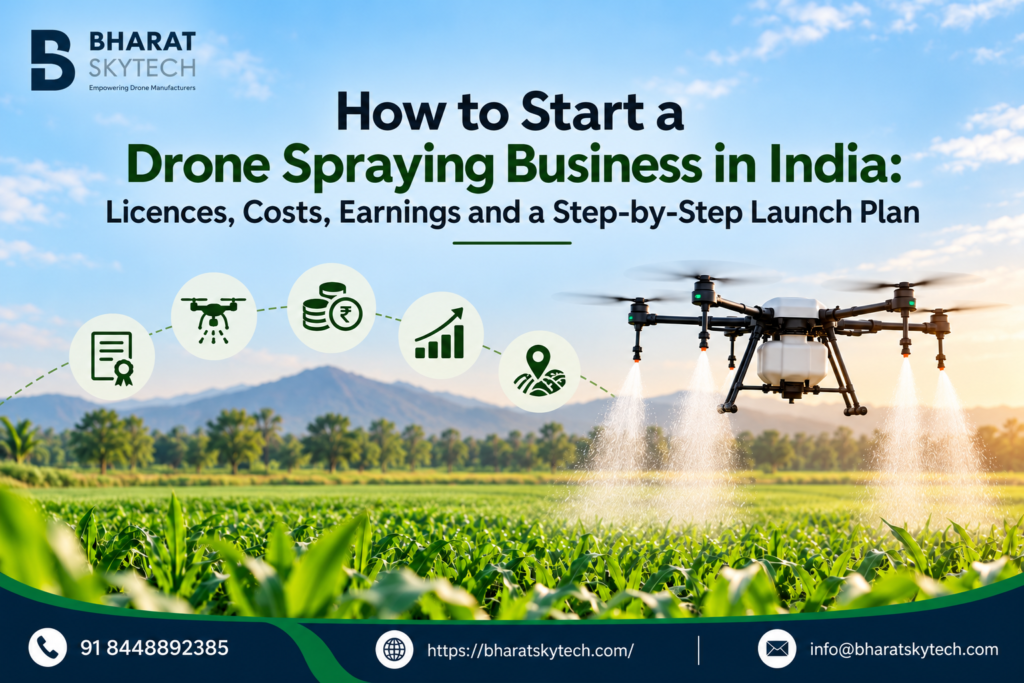
A drone spraying business is one of the most practical ways to enter agri-tech in India today. Farmers are short of labour, chemical costs keep climbing, and pest outbreaks need quick action. A spraying drone can cover an acre in minutes, uses less water and chemicals than a knapsack sprayer, and keeps the farmer away from pesticide fumes. If you have been searching for how to start a drone business, this guide covers the certification you need, the equipment, a realistic cost picture, how to price your work, and how to find customers.
All money figures in this post are my own rough assumptions for planning, not quotes. Prices change by supplier, state and season, so replace them with live quotes before you invest.
Why Start a Drone Spraying Business Now?
Spraying is repeat work. Crops need pesticide, fertiliser and nutrient applications every season, so demand returns again and again. Many farmers would rather hire a service than buy a machine, which makes the drone service business model a natural fit.
The entry barrier is also lower than in most businesses. You don’t need a factory or a large team, and one drone with a certified pilot can start earning. Government support for FPOs, Custom Hiring Centres and initiatives like the Namo Drone Didi scheme has also made farmers more open to drone technology.
Among all the drone business ideas out there, spraying stands out because it solves a clear, recurring problem.
Step 1: Understand the Drone Spraying Business Model
You take a drone and a trained pilot to the farmer’s field and charge per acre. Most operators begin with spraying and add services later:
- Pesticide, fertiliser and nutrient spraying
- Crop health monitoring with multispectral or thermal cameras
- Field mapping and surveying
- Seed broadcasting
- Crop damage assessment
Some entrepreneurs also earn from drone repairs, pilot training and component sales, which smooths out the quiet months.
Step 2: Get Your Drone Pilot Certification
To fly commercially, you need a Remote Pilot Certificate (RPC) from a DGCA-approved Remote Pilot Training Organisation (RPTO). The common requirements are:
- You must be at least 18 years old.
- You must have passed Class 10.
- You must complete training at an approved RPTO.
Training covers simulator practice, airspace rules, safety, basic maintenance and hands-on flying, and for medium-category drones it usually takes a few days. After you pass, the certificate is issued through the DGCA’s Digital Sky platform.
Assumed budget: plan roughly ₹50,000 to ₹1 lakh for training and certification together. Rules and categories change, so check the DGCA’s current requirements before enrolling.
Step 3: Register Your Business and Your Drone
Choose a structure first. A sole proprietorship is the easiest start, while an LLP or private limited company suits you better if you plan partners, investors or big contracts. Also consider:
- Udyam (MSME) registration, which can help with loans and schemes
- GST registration once your turnover crosses the applicable limit
- A separate bank account and clean bookkeeping
Then register the drone on Digital Sky to get its Unique Identification Number (UIN). Follow the “No Permission, No Take-off” (NPNT) rules, stay out of restricted airspace, and keep the identification markings on the drone. Flying without the required approvals can bring penalties or confiscation, so don’t cut corners.
Step 4: Choose the Right Agricultural Drone
Your drone is your biggest investment. A consumer camera drone can’t do this job, so you need a purpose-built agricultural sprayer. Check these points before you buy:
- Tank capacity: 10 to 16 litres is common for commercial work. A bigger tank means fewer refills.
- Batteries and charging: Spare batteries and a reliable charging setup decide how many acres you finish in a day.
- Navigation and spray quality: Look for GPS-guided flight, even nozzle coverage and obstacle avoidance.
- Service and spares: A drone waiting weeks for a part is money lost.
- DGCA type certification: Confirm the model is approved before paying.
Assumed budget: an entry-level sprayer might fall around ₹4 to 6 lakh, a solid mid-range machine around ₹8 to 12 lakh, and a premium or enterprise model ₹15 lakh and above. Get at least three written quotes.
Step 5: Arrange Drone Insurance
Accidents, crashes and theft happen. Third-party liability cover is the minimum most operators should consider, and hull or hardware cover protects the drone itself. Assumed budget: roughly ₹20,000 to ₹40,000 a year, depending on the drone’s value and cover. Read exclusions and deductibles before signing.
How Much Does It Cost to Start a Drone Spraying Business?
Your drone choice drives most of the total. These are my planning estimates:
Expense | Assumed Cost Range |
|---|---|
Agricultural Drone | ₹4 lakh – ₹20 lakh |
Spare Batteries, Charger and Spray Kits | ₹50,000 – ₹1.5 lakh |
Pilot Training and Certification | ₹50,000 – ₹1 lakh |
Insurance (Per Year) | ₹20,000 – ₹40,000 |
Registration and GST Setup | Around ₹10,000 |
Transport, Storage, Branding and Marketing | ₹1 lakh – ₹3 lakh |
On these assumptions, a lean single-drone start could land at roughly ₹7 to 10 lakh, a mid-scale setup at ₹12 to 20 lakh, and a multi-drone operation above that. Don’t forget recurring costs: battery replacements, propellers and nozzles, servicing, pilot and helper wages, fuel and travel.
Where Bharat SkyTech Fits In
Buying the drone is only the start, because spraying drones wear out. Motors, batteries, nozzles, GPS modules and frame parts all need replacing over time, and that is where a reliable component supplier matters.
Bharat SkyTech is a Gurugram-based online store for agriculture drone components, promoted by Thakral Corporation. It lists itself as an authorised distributor for brands such as SIYI, Hobbywing, EFT, Skydroid, JIYI, Herewin and SkyRC. Its range covers motors and propellers, batteries and chargers, flight controllers and radars, transmitters, payloads, electricals like GPS modules and flow meters, and frame parts.
It also promotes EFT Bharat, a Made in India line of 10-litre agriculture drone frames, canopies and tanks, and Evercell Make in India batteries. For operators and small builders, this means:
- You can source spares and upgrades from one supplier and keep downtime short.
- You can buy individual parts or combos, and bulk enquiries are accepted if you run several drones.
- The site advertises pan-India shipping, round-the-clock support and a 7-day replacement window for manufacturing defects.
Bharat SkyTech sells components, not ready-to-fly spraying services, so think of it as a supply partner for keeping your fleet flying. Compare compatibility and warranty terms with your drone manufacturer before replacing any part.
How to Find Your First Customers
Farmers trust people they know, so build relationships before chasing volume.
- Offer a trial spray. Many farmers have never seen a drone work, so a small demonstration plot does more than any brochure.
- Work through local networks. Agri-input dealers, cooperatives, FPOs and Krishi Vigyan Kendras already know who needs spraying and when.
- Show up where farmers gather. Agricultural fairs, village meetings and workshops are good places to show your drone in action.
- Build a simple digital presence. A WhatsApp Business number, a Google Business profile and short videos of real jobs help farmers find you.
- Collect testimonials. A few happy farmers in one village often lead to the whole block.
- Learn local farming. Crops, pest cycles and weather differ by region, so working with a local agronomist helps you plan schedules and recommend chemicals correctly.
Funding Your Drone Business
You can mix several routes:
- Self-funding keeps things simple for one drone, but keep a cash reserve for batteries and repairs.
- Government schemes may support FPOs, Custom Hiring Centres and certain women-led groups. Eligibility and subsidy percentages vary, so confirm the latest notifications first.
- Loans and equipment financing from banks and NBFCs are available to registered businesses. Compare interest rates, tenure and charges.
- Lease or partner models let some new operators join an agri-tech network and reduce the upfront spend.
Common Mistakes to Avoid
- Skipping compliance. Flying without certification, registration or insurance risks penalties and your reputation.
- Over-investing early. Don’t buy several expensive drones before you have customers.
- Underpricing. Cheap rates win jobs but can leave you with no profit.
- Ignoring maintenance. Batteries, nozzles and propellers wear out, so keep spares ready.
- Neglecting safety. Keep the drone in sight, check wind before each flight, avoid restricted areas and handle chemicals properly.
- Depending on spraying alone. Add mapping, monitoring or training to stay busy off-season.
Growing Beyond One Drone
Once your first season runs smoothly, add a second drone and pilot to cover more villages, or offer crop monitoring and field mapping. You can also train new pilots, become a service point for a drone brand, or take contract spraying from agri companies.
Final Thoughts
A drone spraying business takes more than buying a drone. You need DGCA-compliant certification and registration, reliable equipment and spares, fair pricing, and patience in earning farmers’ trust. The payoff is a service business with repeat seasonal demand and room to grow into mapping, monitoring and training. Start with certified training, talk to local farmers about their real spraying needs, and collect quotes from several suppliers. Then start small, deliver reliably and let your reputation bring the next customer
Frequently Asked Questions (FAQs)
Do I need a licence to start a drone spraying business in India?
Yes. You generally need a DGCA Remote Pilot Certificate from an approved training organisation, and your drone should be registered on the Digital Sky platform.
How much money do I need to start?
As a rough assumption, a lean single-drone start could take around ₹7 to 10 lakh, including the drone, training, insurance and working capital. Your actual figure depends on the drone and your location.
How much can I charge per acre?
Rates differ by crop, terrain and region. A planning assumption of ₹300 to ₹600 per acre is reasonable, but check what farmers near you currently pay.
Where can I buy spare parts for my spraying drone?
You can buy from your drone manufacturer or a component supplier such as Bharat SkyTech, which sells motors, batteries, nozzles, GPS modules and frame parts. Check compatibility and warranty terms before you replace any part.
Is a drone spraying business profitable?
It can be, especially during peak crop seasons, but income is seasonal and costs like batteries and repairs add up. Price carefully, keep utilisation high and add other services to stay busy year-round.