


A drone battery charger is one of the most overlooked pieces of equipment in an agriculture or industrial UAV fleet — and yet it does more to determine how long your packs survive, and how well your drone performs in the field, than almost anything else on the ground. Operators spend hours researching motors, frames, and payloads, but the charger quietly sitting in the corner of the field van is often the single biggest factor in whether a battery lasts 100 cycles or 400. Get the charging equation wrong, and you don’t just lose flight time — you lose money, every single season, one degraded pack at a time.
This is especially true for agriculture drone operations, where spray fleets run back-to-back sorties from sunrise to sunset, batteries are swapped constantly, and there is rarely time to babysit a charge cycle. In this environment, the charger isn’t a passive accessory. It’s an active part of the flight system. This guide breaks down exactly how a charger affects battery health and flight performance, and what to look for when choosing one — with the Evercell EC2000-14S as a reference point for what a properly engineered agriculture drone charger should deliver.
Why the drone battery charger matters more than most operators realize
Every LiPo or LiHV battery has a finite number of usable charge cycles. What determines whether you get 150 cycles or 400 out of the same pack isn’t the battery brand alone — it’s how that battery is charged, cycle after cycle. A poorly matched or low-quality LiPo charger stresses cells in ways that aren’t visible immediately but show up months later as swelling, voltage sag, reduced flight time, and eventually a pack that needs replacing far earlier than it should.
A proper LiPo charger does three things well: it matches the charge current to the pack’s safe limits, it balances every cell so none is pushed past its ceiling, and it manages the pack’s condition when it isn’t actively flying. Miss any one of these, and battery degradation accelerates. This is the core of any serious drone charging guide — the charger isn’t just refilling energy, it’s actively managing the health of a chemically sensitive, expensive asset.
Charging Speed vs. Battery Longevity
There’s a persistent myth in the drone community that faster is always better. In reality, charge current has a direct, well-documented relationship with cycle life. Charging a pack too aggressively, beyond its safe C-rating, generates excess heat inside the cells. Heat is the enemy of lithium chemistry — it accelerates the breakdown of the electrolyte and the degradation of the internal structure that holds capacity.
This doesn’t mean fast charging is bad. It means fast charging needs to be controllable. The Evercell EC2000-14S, for example, offers 2000W of output with current adjustable across a 5–30A range. That range matters: it lets an operator push hard for a rapid turnaround when a spray window is closing, or dial the current down to charge a pack gently overnight, well within its safe limit. A charger that only offers one aggressive setting forces every pack into a one-size-fits-all charge rate — and that’s exactly how packs get shortened lives on any fleet running a serious agriculture drone charger program.
Voltage Accuracy and Cell Balancing
Flight performance depends on every cell in a pack delivering consistent voltage under load. Over time, even small imbalances between cells in a multi-cell pack — say a 12S or 14S agriculture battery — cause one cell to reach its ceiling before the others, or to sag faster during a heavy draw like takeoff or a loaded spray pass. The result is reduced usable capacity, inconsistent flight times, and in the worst cases, a cell that degrades faster than the rest of the pack and drags the whole battery down with it.
This is where balance charging earns its place as, arguably, the single most important function a drone battery charger performs. By equalizing every cell on every charge cycle, a balance-capable LiPo charger keeps a pack’s cells aging together rather than apart. This is standard on the EC2000-14S across its full 6–14S range, and it’s a feature worth checking closely on any charger before it goes anywhere near an agriculture or heavy-lift pack — a charger without proper balancing will slowly and invisibly shorten pack life no matter how good the battery itself is.
LiPo vs. LiHV — Why Chemistry Changes the Charging Rules
Not all lithium-polymer packs are charged the same way, and this is where a lot of avoidable damage happens. Standard LiPo cells top out at 4.20V per cell. LiHV (High-Voltage LiPo) cells, which are increasingly common in heavy-lift and agriculture platforms because they pack more usable capacity into the same physical size, charge to 4.35V per cell. A charger that doesn’t distinguish between the two will either undercharge a LiHV pack — quietly wasting flight time you paid for — or worse, overcharge a standard LiPo pack built to a lower ceiling.
A genuine dual-chemistry LiPo charger, like the EC2000-14S, reads and applies the correct ceiling automatically. This matters more as fleets grow: most operators today don’t run a single battery type across their whole fleet, they run a mix. A charger that handles both chemistries intelligently removes a real safety and performance risk from day-to-day operations, and it’s a non-negotiable line item in any properly written drone charging guide for mixed inventories.
Storage Mode and Off-Season Care
Flight performance isn’t only shaped by what happens during an active charge — it’s also shaped by what happens when a pack sits unused. A fully charged LiPo or LiHV pack left at rest for weeks degrades faster than one stored at a partial charge, typically around 3.8V per cell. This calendar aging is separate from cycle aging, and it’s one of the most common ways operators lose capacity without ever noticing a bad charge.
This is why Storage mode matters as much as raw charging power. On the EC2000-14S, Storage mode automatically parks cells at the healthiest resting voltage between missions and through the agricultural off-season — a feature that has nothing to do with speed and everything to do with protecting the investment sitting in the battery locker. Combined with Hub mode for cycling multiple packs through a single station, it turns the charger into a proper battery management tool rather than a simple power source, and a core chapter in any working drone charging guide for fleet operators.
Field Conditions: Heat, Dust, and Power Stability
Agriculture and industrial drone operations rarely happen in a climate-controlled lab. Chargers in the field deal with dust, heat, unstable generator power, and long back-to-back shifts — conditions that push cheaper, hobby-grade chargers past their comfort zone. Efficiency becomes critical here: a charger running below 90% efficiency wastes energy as heat, which both slows down charging and raises internal temperatures during exactly the conditions where cool operation matters most.
The EC2000-14S runs above 91% efficiency and accepts a wide 100–240V AC input, which means it tolerates the voltage fluctuations common with field generators without a performance penalty. Its rugged build and AS150U-M industrial connector are designed for a low-resistance, secure connection even after a long day in dusty field conditions — the difference between an agriculture drone charger that survives a single season and one that becomes a permanent fixture on the truck.
Protection Features That Protect Flight-Day Reliability
Every fleet has a story about a battery connected backwards at 5 a.m., or a pack pushed slightly past its safe voltage by a distracted crew member during a busy spray day. This is where protection circuitry stops being a spec-sheet checkbox and starts being the reason a fleet doesn’t lose a pack — or worse — to a preventable mistake. Over-voltage protection stops a cell from being pushed past its safe ceiling, while reverse-polarity protection forgives the kind of connector error that happens during a rushed, early-morning swap.
Paired with BIS-approved, Make in India certification, the EC2000-14S is built specifically around the realities of Indian agriculture drone operations — local support, local stock, and safety engineering suited to how these fleets actually work, not how a hobbyist charges a single pack on a clean workbench.
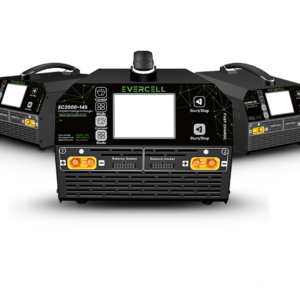
Meet the Evercell EC2000-14S Drone Battery Charger
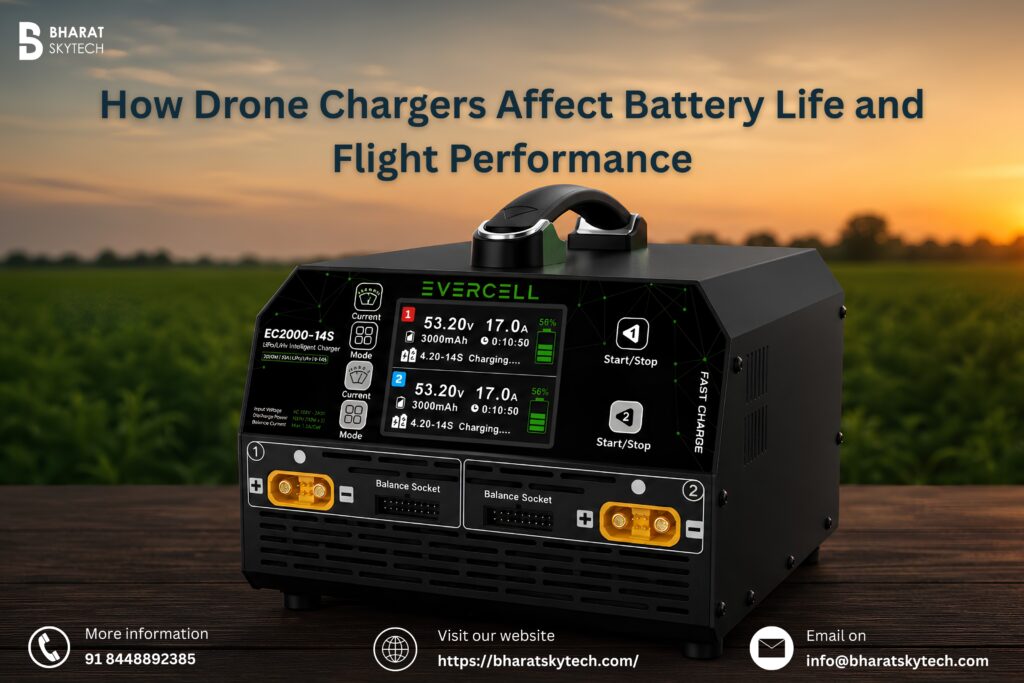
Everything discussed above — current control, cell balancing, dual chemistry support, storage management, field durability, and protection circuitry — comes together in a single unit in the Evercell EC2000-14S. It’s a dual-channel, BIS-approved agriculture drone charger built and supported in India, designed specifically for the way agriculture, industrial, and heavy-lift drone fleets actually operate: high pack counts, tight turnaround windows, and long days in the field.
Technical Specifications of Evercell EC2000-14S Drone Battery Charger
| Specification | Details |
|---|---|
| Model | EC2000-14S |
| Battery Type | LiPo / LiHV |
| Voltage Range | 22.2 – 62.3 V |
| Cell Count | 6–14S |
| Current Range | 5–30 A (Adjustable) |
| Max Charge Power | 2000 W |
| Charging Modes | Charge / Storage / Hub |
| Efficiency | >91% |
| Input Voltage | 100–240 VAC |
| Input Frequency | 50–60 Hz |
| Max Cut-off Voltage | 62.3 V |
| Connector | AS150U-M (Industrial) |
| Display | 3.2″ Color LCD |
| Protection | Over-voltage & Reverse-polarity Protection |
| Operating Temperature | Up to 40 °C |
| Dimensions | 265 × 200 × 140 mm |
| Weight | 4.6 kg |
| Certification | BIS-Approved, Make in India |
Choosing the Right Charger for Your Fleet
Before selecting a drone battery charger, it’s worth running through four questions: Does it match your fleet’s cell count, up to 14S or higher? Does it support your battery chemistry, including LiHV? Is it fast enough to keep your fleet flying, while still offering the control to charge gently when needed? And will it survive your operating environment, with support available where you actually work? A charger that fails any one of these will eventually cost you either money, flight time, or safety — which is exactly why a proper drone charging guide starts with these four questions, not with a spec sheet.
Final Thought
Battery life and flight performance are not determined by the battery alone — they’re shaped, cycle after cycle, by the charger behind it. Charge current control, accurate cell balancing, chemistry-aware voltage ceilings, and proper storage management are what separate a battery that lasts a full season of hard agricultural flying from one that quietly loses capacity within a few months. For operators running agriculture, industrial, or heavy-lift drones in India, investing in a purpose-built agriculture drone charger like the Evercell EC2000-14S isn’t an accessory upgrade — it’s a direct investment in fleet uptime, battery lifespan, and consistent flight performance in the field, day after day.
Ready to standardize your fleet on a charger built for Indian field conditions? Request a bulk quote for the Evercell EC2000-14S and keep your battery investment protected all season.