

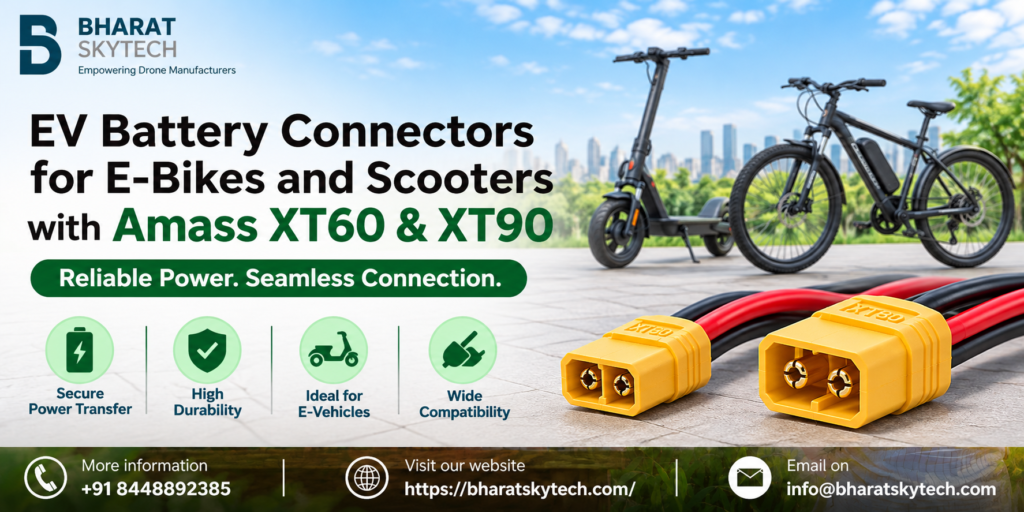
The right EV battery connector can make or break your battery pack, because a pack can be perfectly built and a poor connector will still let it down. Loose contacts, heat, sparks and voltage drop usually start at the connector, not the cells. If you build, repair or upgrade e-bikes, electric scooters or small electric vehicles, choosing the right connector is one of the simplest ways to make your setup safer and more reliable.
In this guide, we explain what an EV battery connector does, the main connector types, how Amass XT60 and XT90 compare, and how to choose the right one for your battery.
What is an EV battery connector?
An EV battery connector is the plug and socket that links a battery pack to the rest of the vehicle, such as the controller, motor or charger. It carries the full current of the system, so it needs to stay cool, hold tight and resist vibration.
A good connector does four jobs:
- Carries current with low resistance, so little energy is lost as heat
- Keeps a firm grip even on bumpy roads
- Prevents accidental short circuits through a shielded, polarised design
- Can be connected and disconnected many times without wearing out
For lithium-ion packs, which can deliver very high current in a split second, these points matter even more.
Types of EV battery connectors
There are many electric vehicle connector types, and they fall into two groups.
Charging connectors
These join a vehicle to a charging station. Examples include Type 2, CCS and CHAdeMO for cars, and the connectors found on e-bike and scooter chargers. They are designed around charging standards.
Battery and power connectors
These sit inside the vehicle and join the battery to the controller or motor. Common choices include:
- Amass XT-series (XT30, XT60, XT90): compact, gold-plated bullet connectors popular in e-bikes, scooters, drones and RC vehicles
- Anti-spark connectors (XT90-S, AS150, QS8): include a pre-charge feature for higher-voltage or high-capacity packs
- Bullet connectors: simple single-pin plugs, often used for motor phase wires
- Heavy-duty connectors: larger plugs for high-power vehicles
Amass XT60 vs XT90 for lithium EV batteries
Both connectors use gold-plated bullet contacts inside a strong nylon housing, and both have a polarised shape, so they can only be plugged in one way. The main difference is size and current capacity.
Feature | Amass XT60 | Amass XT90 |
|---|---|---|
Contact size | 3.5 mm bullet | 4.5 mm bullet |
Peak current rating | Up to about 60 A | Up to about 90 A |
Typical use | Small e-bike packs, light scooters, drones | Larger e-bike and scooter packs, higher-power builds |
Wire size (typical) | 12 to 14 AWG | 10 to 12 AWG |
Size | Compact | Slightly larger and sturdier |
Anti-spark version | Available (XT60 anti-spark) | Available (XT90-S) |
A note on ratings: the figures above are the peak ratings commonly quoted for these connectors. Continuous current is lower and depends on wire thickness, temperature and the quality of the solder joint. Always check the datasheet and leave a safety margin.
Quick rule: if your system draws less than roughly 30 A for long periods, XT60 is usually enough. For heavier loads or a bit more headroom, choose XT90.
Anti-spark connectors for EV battery packs
Have you ever seen a small spark when plugging in a battery? That spark comes from the controller’s capacitors charging instantly. One spark is not a problem, but repeated sparking wears down the contacts and can cause pitting over time.
An anti-spark connector solves this. It has a built-in resistor path that lets the capacitors charge gently before the main contacts meet. The result is:
- Longer contact life
- Less risk of damage to the controller
- A safer connection for high-capacity lithium packs
If your controller is powerful or you plug in often, an anti-spark connector such as the XT90-S is a worthwhile upgrade.
E-bike and electric scooter battery connectors
Most e-bike and electric scooter packs run at 36 V, 48 V or 52 V, and the current depends on motor power.
- 250 W to 350 W e-bike: typically a modest current draw, and an XT60 is a good fit
- 500 W scooter or e-bike: XT60 can work, but XT90 gives more comfort and headroom
- 750 W and above: XT90 or an anti-spark XT90-S is the better choice, and very high-power vehicles may need larger connectors
Vibration is the other factor. A secure, locking-style fit and clean soldering matter on rough roads. Use heat shrink and keep wiring neat to prevent rubbing and strain.
Note: Amass XT connectors suit e-bikes, scooters, and small low-voltage electric vehicles. Full-size electric cars use dedicated automotive-grade connector systems.
How to choose the right Amass connector
Use this short checklist:
- Check your maximum current. Look at the controller’s rated current and your motor power.
- Add a safety margin. Pick a connector with comfortable headroom above your normal draw.
- Match the wire gauge. Thicker wire needs a bigger connector.
- Decide on anti-spark. Choose it for powerful controllers or frequent plugging.
- Match gender and polarity. Make sure both ends of the system use the same standard.
- Buy genuine parts. Fake connectors often use thin plating and weak plastic, which leads to overheating.
How to solder an XT90 connector
A solid solder joint is as important as the connector itself. Here is a simple method:
- Prepare your tools: a soldering iron of around 60 W or more, quality solder, flux and heat shrink tubing.
- Strip the wire: remove about 8 to 10 mm of insulation.
- Tin the wire: melt a thin layer of solder onto the exposed strands.
- Fill the cup: hold the connector steady, heat the solder cup and add a little solder.
- Insert the wire: push the tinned wire into the cup while heating, and hold still until the solder flows around it.
- Let it cool: do not move the joint for 10 to 15 seconds.
- Check polarity: confirm the plus and minus markings before soldering the second wire. Reversed polarity can destroy a controller.
- Finish with heat shrink: cover the joint to insulate it and relieve strain.
Work quickly, since too much heat can soften the nylon housing. A good joint is shiny and smooth with no gaps.
Conclusion
The right EV battery connector keeps your e-bike or scooter running safely and efficiently. For lighter builds, Amass XT60 is compact and dependable. For higher power and more headroom, Amass XT90 is a strong choice, and anti-spark versions add extra protection for powerful controllers.
Match the connector to your current, use properly sized wire, solder carefully and always buy genuine parts.
Looking for reliable connectors for your battery pack? Explore the Amass XT60, XT90 and anti-spark range at Bharatsky, or contact our team to find the right fit for your build.
Frequently Asked Questions (FAQs)
What is the difference between XT60 and XT90?
XT90 has larger 4.5 mm contacts and a higher current capacity than XT60, which has 3.5 mm contacts. XT90 suits heavier loads, while XT60 is lighter and more compact.
Can I use an XT60 connector for an electric scooter battery?
Often yes, for lower-power scooters. For higher power or sustained heavy loads, XT90 is safer. Check your controller’s current rating first.
What is an anti-spark connector?
It is a connector with a built-in resistor path that lets the controller’s capacitors charge slowly, which prevents the spark you see when connecting a battery.
Are Amass connectors suitable for e-bike batteries?
Yes. Amass XT60 and XT90 are widely used in light electric vehicles, e-bikes and scooters, as long as they are matched to the current and wire size.
Why does my battery connector get hot?
Common causes are a loose or poor solder joint, undersized wire, a connector rated too low for the load, or worn contacts. Replace damaged connectors and check the current rating.
How do I know if an XT90 connector is genuine?
Buy from a trusted supplier. Genuine parts have clean moulding, crisp markings, even gold plating and a firm fit. Very low prices and loose, wobbly contacts are warning signs.