

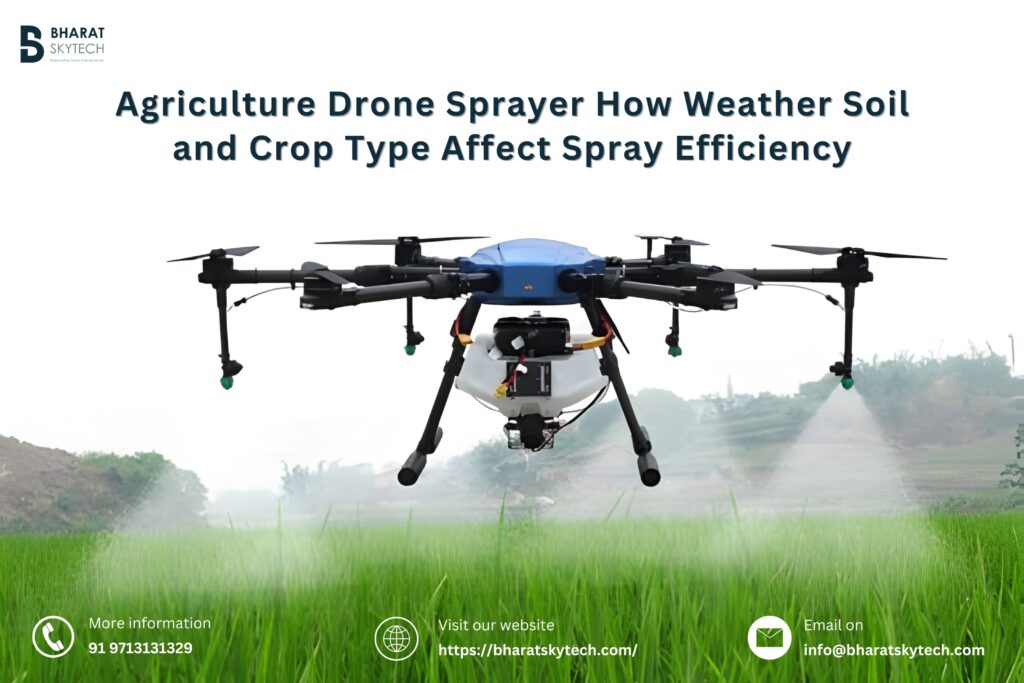
An agriculture drone sprayer has become one of the most advanced and effective tools in modern farming, especially in India where large farmlands, labour shortages, and rising input costs demand smarter solutions. Agriculture spraying drones have transformed the way pesticides, fertilizers, micronutrients, and growth regulators are applied, offering faster operations, improved accuracy, reduced chemical usage, and better crop coverage. However, despite the growing popularity of agriculture drone sprayers, their performance largely depends on several external factors. Among these, weather conditions, soil type, and crop type play the most significant role in determining overall spray efficiency, droplet deposition, drift control, and pesticide effectiveness on the field.
To fully utilize the benefits of a drone sprayer, farmers and drone operators must understand how environmental and field conditions influence the spraying results. Choosing the right parameters not only ensures maximum pest or disease control but also promotes sustainable farming by reducing chemical wastage. In this blog, we will explore how weather patterns, soil textures, and crop characteristics affect drone spraying, and how understanding these factors can help farmers achieve the best results.
The Role of Weather in Drone Spraying
Weather conditions have a direct impact on spray efficiency of agriculture drones. Drones operate in open fields where wind, humidity, temperature, and sunlight all contribute to how agricultural chemicals behave once released into the air. Every spray droplet is influenced by environmental forces, and even minor fluctuations can significantly change the outcome.
Wind speed is the first and most critical factor affecting the performance of an agriculture drone sprayer. Low wind speeds between 0–8 km/h are ideal for most crop spraying drone operations. When wind speed is within this safe range, the agriculture spraying drone can maintain a consistent spray pattern, ensuring that droplets land directly on plant surfaces. When wind speeds increase beyond 10–12 km/h, the risk of spray drift rises. Drift occurs when droplets move away from the intended target, reducing spray deposition on crops and increasing chemical loss in the environment. Because drone sprayers use ultra-low volume misting technology, which creates very fine droplets, managing drift becomes even more important. This is why operators must constantly monitor wind conditions before takeoff to achieve maximum efficiency.
Humidity also plays a major role in determining how long droplets stay airborne before evaporating. In very dry conditions, spray droplets can evaporate before reaching the crop, leading to a noticeable drop in pesticide effectiveness. High humidity, on the other hand, reduces the rate of evaporation, allowing droplets to settle more effectively on the crop canopy. For most agriculture drone sprayers, relative humidity between 50% and 80% is ideal for achieving maximum coverage and minimizing droplet loss.
Temperature affects spray results similarly. When temperatures rise above 35°C, evaporation increases dramatically. If the spray particles evaporate mid-air, the active ingredients may not reach the plant surface in the right concentration. On the other hand, extremely cold temperatures can slow down plant absorption. Ideally, drone spraying should be done early morning or late afternoon when temperatures are moderate.
Even sunlight intensity influences spray success. Some pesticides degrade quickly under direct sunlight. Spraying during peak sunlight hours may reduce their effectiveness. This is why professionals recommend using agriculture spraying drones during early hours of the day, when most environmental conditions favour efficient deposition. Understanding these weather effects helps farmers decide the best window to use their agriculture drone sprayer for maximum results.
How Soil Type Influences Spray Efficiency
Many farmers assume that drone spraying depends only on the crop canopy, but the soil type in a particular field also affects how agricultural chemicals behave. Soil characteristics such as texture, moisture content, organic matter level, and absorption capacity have a strong impact on how much pesticide is needed and how effectively it works.
Fields with sandy or porous soil tend to require slightly higher pesticide concentration because the soil does not hold moisture well, making crops more susceptible to pests and moisture stress. Drone sprayers operating on such fields must ensure proper droplet size and adequate coverage to maximize protection. Clay soil, on the other hand, retains more moisture and is prone to waterlogging, creating an environment favourable for fungal infestations. In such conditions, a crop spraying drone must use a fine, more precise droplet pattern to ensure uniform coverage on lower leaves and stems.
The soil moisture content also influences spray effectiveness. In extremely dry fields, chemical absorption by the plant may be slow, reducing the overall effect. Moist soil conditions improve plant metabolism, making pesticide uptake faster and more efficient. Drone sprayer operations performed after irrigation or light rainfall generally show better results.
Organic matter in the soil plays another important role. High organic content improves microbial activity, helping break down chemical residues more effectively. In low-organic soils, chemical persistence increases, which means farmers must adjust dosage carefully to avoid overapplication. Therefore, understanding soil type allows operators to choose the right drone spray efficiency settings, droplet size, and timing for maximum benefit.
How Crop Type Affects Drone Spray Efficiency
Each crop has a different leaf structure, canopy density, height, and growth pattern. These characteristics influence how well spray droplets land on plant surfaces and how effectively they provide pest or disease protection. An agriculture drone sprayer must adapt its flight height, speed, nozzle type, and spray volume depending on the crop type to ensure optimal coverage.
For crops like paddy (rice), which have upright leaves and dense canopies, uniform coverage requires careful adjustment of droplet size and drone height. Paddy fields benefit from slightly larger droplets to penetrate the canopy and reach the lower leaves where pests such as leaf folders and diseases like sheath blight often reside. A drone sprayer for paddy needs to maintain a flight height between 2.5 to 3 meters for proper deposition.
Cotton fields, on the other hand, are taller and have broader leaves. Cotton crops require fine misting with an even spread across leaf surfaces. A crop spraying drone operating in cotton fields must maintain a balanced droplet size to avoid runoff while still achieving full coverage. Weather conditions such as wind have a noticeable effect on cotton spraying because the tall canopy can amplify drift impact.
In wheat fields, the crop height is moderate, but the canopy is dense during peak growth stages. This requires the drone to maintain consistent speed and low altitude to ensure droplets penetrate evenly. Wheat crops also demand high accuracy because diseases such as rust or blight can spread rapidly across fields. For maximum spray efficiency, farmers must select drone spraying parameters suitable for wheat’s growth stage and canopy structure.
Vegetable crops, orchards, sugarcane, and pulses each have their unique canopy designs and vulnerabilities. In orchards, for example, drones must fly higher and adjust droplet size to reach both upper and lower leaf surfaces. For ground crops like onions or leafy vegetables, fine-droplet spraying ensures gentle, uniform deposition without damaging delicate leaves.
Understanding crop type helps drone operators choose the ideal spray pattern, droplet size, and flight path to maximize results. Using the right settings improves overall spray pattern for agriculture drones, reduces chemical wastage, and enhances pesticide performance.
Interaction Between Weather, Soil, and Crop Type
The combined effect of weather, soil, and crop type determines the overall drone spraying accuracy. For example, using a drone sprayer in a dry area with sandy soil during high wind conditions is likely to produce poor results because spray drift increases while droplet deposition decreases. Similarly, spraying on clay soil during humid weather may lead to excessive moisture accumulation, promoting fungal disease unless the correct chemical type is used.
Different combinations of soil and crop types require different strategies. Heavy soils like clay require careful water management and droplet control, especially when spraying crops like cotton or wheat that need fine misting. Sandy soils require slightly larger droplet size because fine droplets evaporate too quickly. Weather conditions such as wind and humidity influence how these droplets behave, making it essential to select the right weather window.
Crop varieties also react differently to spray conditions. Tall crops require higher flight altitudes and slightly adjusted droplet size, while short crops benefit from very fine misting. Drone operators must consider these factors before planning missions to achieve the highest level of agriculture drone spraying efficiency.
Why Modern Drones Are Better at Handling Environmental Variations
Today’s agriculture drone sprayer systems are equipped with advanced technologies such as RTK GPS, AI-based spray control, terrain-following radars, and intelligent nozzles that automatically adjust spray pressure based on flight speed. These innovations help drones compensate for minor environmental variations. For example, intelligent spraying systems can detect wind speed and adjust droplet size to maintain consistent deposition. Some high-end agriculture drone sprayers use spray drift control algorithms to improve accuracy even in slightly windy weather.
The integration of weather sensors, real-time telemetry, AI-based flight planning, and advanced nozzles significantly enhances drone performance under varying field conditions. Operators still must monitor weather forecasts and field conditions, but modern drone sprayers have reduced the margin for error.
Pesticide Behavior Under Different Environmental Conditions
Pesticides behave differently depending on the surrounding environment. Some chemicals perform best under specific temperature and humidity ranges. Contact pesticides rely heavily on proper droplet landing on leaf surfaces, while systemic pesticides depend more on plant metabolism, which is influenced by temperature and soil moisture.
Humidity helps reduce evaporation, which is beneficial for both foliar fertilizers and systemic pesticides. However, high humidity combined with low wind conditions may promote fungal growth. Temperature affects chemical volatility. Highly volatile pesticides may evaporate quickly in high heat, reducing their effectiveness. Sunlight intensity can break down some chemicals, making early morning or evening spraying the most efficient time.
Drone operators must understand these interactions to maximize chemical effectiveness and minimize wastage. Choosing the right droplet size, timing, and chemical type ensures efficient spraying regardless of environmental variations.
Conclusion: Understanding Conditions Is the Key to Efficient Drone Spraying
The performance of an agriculture drone sprayer is not determined only by drone technology, nozzles, or flight settings. Weather conditions, soil type, and crop characteristics play equally important roles. Wind speed, humidity, temperature, and sunlight determine how droplets travel through the air. Soil texture, moisture content, and organic matter influence how well chemicals work on plants. Crop canopy structure dictates droplet penetration and deposition. When all these factors are understood and combined with proper drone spraying techniques, farmers achieve maximum drone spray efficiency, better pest control, and reduced chemical wastage.
By understanding the science behind weather patterns, soil behavior, and crop structure, farmers can take full advantage of drone spraying technology. Modern agriculture spraying drones are powerful tools, but their effectiveness depends on informed decision-making and correct application practices. With the right knowledge and environmental awareness, drone spraying becomes a highly efficient, economical, and sustainable solution for modern farming.