

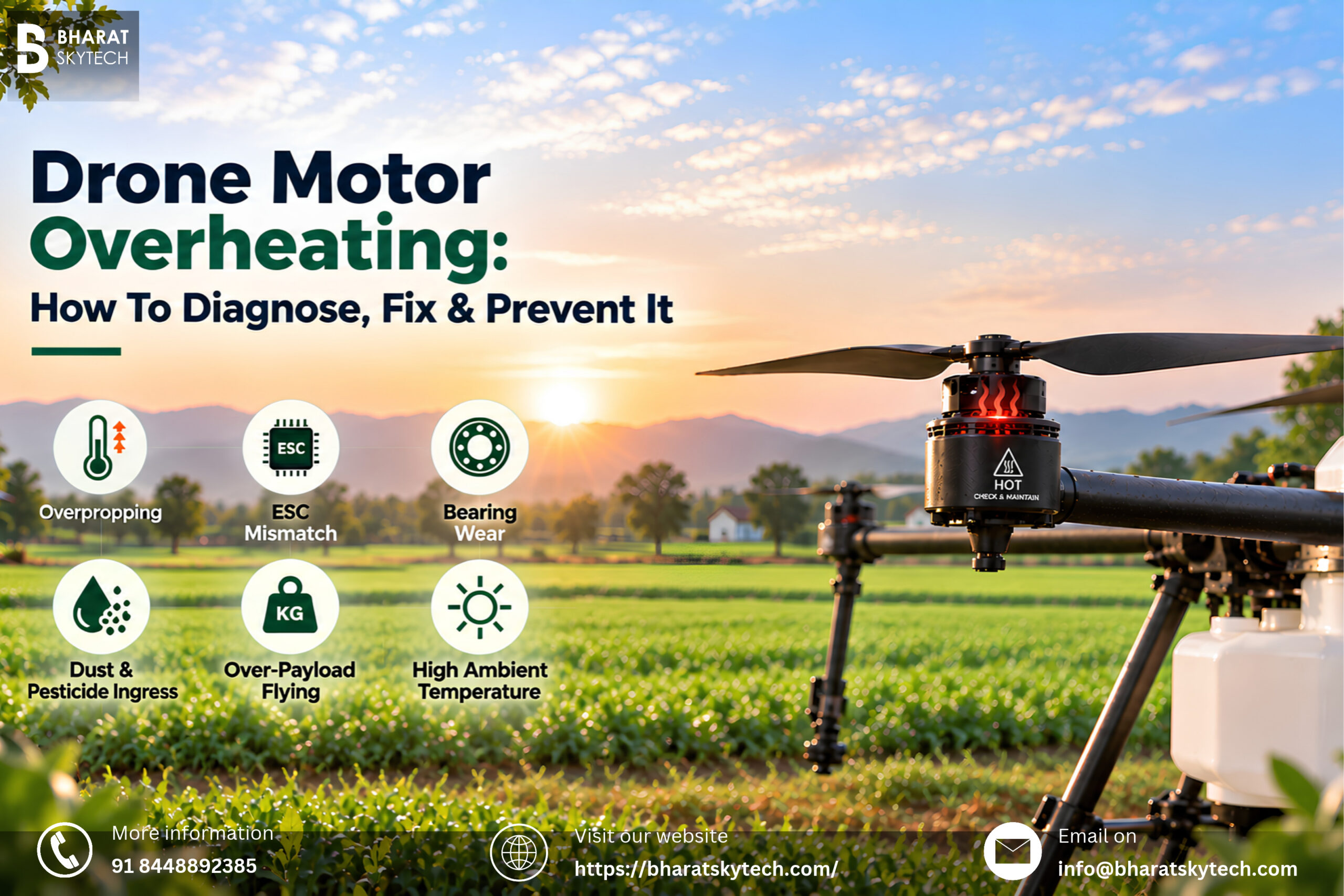
Drone motor overheating is one of the most common — and most misdiagnosed — problems agriculture drone operators run into during a spraying season. A motor that feels hot to the touch after a flight isn’t automatically failing, but a motor that stays hot, smells of burnt varnish, or trips your ESC’s thermal cutoff mid-flight is telling you something specific about your setup. The good news is that most causes are things you can check and fix in the field, without sending the motor back to a workshop. This guide walks through exactly how to diagnose an overheating motor on your own drone, what role IP rating actually plays in surviving an Indian spraying season, and how to tell the difference between a motor that’s serviceable and one that’s finished.
Why Drone Motors Overheat in the First Place
A brushless motor generates heat any time current flows through its windings — that’s normal and unavoidable. Problems start when the heat generated exceeds what the motor can shed through its casing and airflow, or when something inside the motor is creating resistance it shouldn’t have. On agriculture drones specifically, this tends to happen for a small, repeatable set of reasons rather than one mysterious fault. If you’re noticing drone motors getting hot faster than they used to, or hotter than the other motors on the same frame, the cause is almost always mechanical or electrical, not a bad batch of motors.
Field Diagnosis: What to Check, In Order
Before you assume the motor itself is bad, work through these checks. Most operators can complete this entire sequence in 15–20 minutes without any tools beyond a screwdriver and a multimeter.
1. Overpropping
This is the single most common cause of motor overheating on agriculture drones. Overpropping means the propeller is pulling more current than the motor is rated to handle continuously — either because the prop is too large in diameter or pitch for the motor’s KV rating, or because the motor is being asked to spin a prop suited to a heavier-lift configuration. Symptoms include a motor that runs noticeably hotter than its neighbours, an ESC that throttles back or cuts out under load, and current draw readings above the motor’s continuous rating on your flight controller logs. The fix is straightforward: match propeller size and pitch to the motor’s recommended range, not just whatever fits the mount.
2. ESC Mismatch
An ESC undersized for the motor’s current draw — or running outdated/incompatible firmware — will run hot itself and pass that heat straight into the motor through the connecting wires and bullet connectors. If only one arm of the drone is overheating while the others stay normal, check that arm’s ESC rating against the motor’s actual current draw under load, not just its rated maximum. A loose bullet connector on that arm is also worth checking; resistance at a bad connection generates localized heat that radiates into the motor can.
3. Bearing Wear
Worn bearings increase mechanical drag, which the motor compensates for by drawing more current — and more current means more heat. This is a leading cause of motor bearing failure after spraying season, because bearings on agriculture drones take a beating that hobby-grade motors were never designed for: pesticide mist, fertilizer dust, and moisture work their way past the seals over repeated flights. Spin the motor shaft by hand with the props off. Any grittiness, resistance, or side-to-side play in the shaft points to bearing wear. A motor with early-stage bearing wear can often be resealed and re-greased; one with visible pitting or play in the shaft needs the bearing replaced before it damages the stator.
4. Dust and Pesticide-Residue Ingress
Spraying operations put the motor directly in the path of fine chemical mist, and over a season that residue accumulates inside the motor bell and around the bearings. This does two things: it adds rotating mass that increases current draw, and it chemically degrades bearing grease and winding insulation over time. If you’re flying multiple sorties a day during peak spraying season, rinsing and drying motors (per manufacturer guidance — never direct high-pressure water into open motors) at the end of each flying day meaningfully extends service life.
5. Over-Payload Flying
Agriculture drones are often flown at or near their maximum tank capacity to reduce refill trips, but every kilogram over the recommended payload adds continuous load across all motors, not just one. Sustained overload flying is a slower, more even form of the same overheating pattern you’d see from overpropping — instead of one motor running hot, all of them run a little hotter than they should. Check your actual flying weight (frame + battery + full tank + payload accessories) against the drone’s rated maximum takeoff weight, not just the tank’s rated capacity.
6. Ambient Temperature During Indian Summer Operations
Motors rated for a certain continuous current assume a baseline ambient temperature — usually specified around 25°C in the datasheet. Flying in Indian summer field conditions, where ambient air temperature can sit well above 40°C with the airframe absorbing direct sun heat on top of that, it eats into the motor’s thermal headroom before it’s even airborne. A motor that ran comfortably in February can run noticeably hotter carrying the identical payload in May, simply because it has less margin between its operating temperature and its thermal cutoff. Scheduling spray sorties for early morning or late evening, when ambient temperatures are lower, is a practical way to claw back that margin during peak summer.
What "Not Spinning" Usually Means
A related but different symptom operators report is why is my drone motor not spinning at all when armed. This is rarely an overheating issue directly — it’s usually one of: a stalled/seized bearing (check by hand-spinning with props off), a desync between motor and ESC caused by a damaged phase wire or bullet connector, or a motor that has overheated badly enough on a previous flight that its winding insulation has failed and shorted a phase. If a motor won’t spin and feels warm at rest with no flight since the last charge, treat it as a possible winding failure rather than a simple connection issue.
How to Fix a Drone Motor in the Field
Once you’ve identified the cause, how to fix this depends on what stage it’s at:
Overpropping or ESC mismatch — re-match components to spec; no motor repair needed.
Early bearing wear (grit, no play) — clean, re-grease, and reseal; the motor can go back into service.
Residue buildup — clean the motor bell, windings, and bearings per manufacturer instructions, then re-lubricate.
Overload flying — no motor fix required; adjust payload and flight planning.
Heat-related winding damage — this is not field-repairable. A winding that has browned, smells burnt, or shows visibly melted insulation needs the motor replaced, not repaired.
Drone Motor IP Rating: The Spec That Decides Whether a Motor Survives a Season
Of everything covered here, drone motor ip rating is the single specification that determines whether a motor survives an Indian spraying season intact. IP (Ingress Protection) ratings are written as two digits — the first for solid particle protection (dust), the second for liquid protection (water and, by extension, chemical mist). A motor rated IPX6, for example, is built to withstand powerful water jets from any direction, which matters directly for agriculture use: it’s the same exposure profile as pesticide and fertilizer spray drift during a flight. Motors without a meaningful IP rating — common on general-purpose or FPV-oriented motors — rely on shaft seals and bearing grease alone to keep moisture and chemical residue out, which is exactly why motor bearing failure after spraying season is so common on motors not built for agricultural use. When you’re sourcing a replacement motor for a spray drone, the IP rating on the datasheet should carry as much weight as the KV rating and thrust figures — a high-thrust motor with poor ingress protection is a season-one failure waiting to happen on a sprayer.
When a Motor Is Serviceable — And When It's Finished
Serviceable: mild external heat after normal flights, gritty-but-intact bearings, dust/residue buildup with no chemical or thermal damage to windings, current draw slightly above spec due to a mismatched prop that hasn’t yet caused internal damage.
Finished: browned or melted winding insulation, a burnt-varnish smell, visible bearing play or seizure, a motor that has stalled repeatedly under load (each stall event spikes current and cooks the windings further), or a motor that overheated badly enough to warp its bell or damage magnets. Continuing to fly a motor in this state doesn’t just risk that motor — it risks the ESC and, on a heavy payload drone, the airframe itself if a motor fails mid-sortie.
If you’re unsure which category a motor falls into, a simple rule helps: motors fail from heat cumulatively, not suddenly. A motor that has been run hot repeatedly is closer to failure than its current single-flight symptoms suggest, even if it’s still spinning normally today.
How to Prevent Motor Overheating
Most of the fixes above are reactive — this is how to stop the problem before it starts. A few habits will do more for motor life than any single repair:
Match components before you fly, not after a failure. Confirm propeller size/pitch and ESC rating against the motor’s spec sheet every time you swap parts, rather than assuming compatibility because something physically fits the mount.
Build cleaning into your flying day, not your maintenance schedule. Rinsing and drying motors at the end of each spraying day (per manufacturer guidance) keeps pesticide and fertilizer residue from working into the bearings and windings before it becomes motor bearing failure after the spraying season.
Check payload against rated takeoff weight, not just tank capacity. A drone flown consistently near its max weight runs every motor a little hotter, all season long — this is cheaper to correct with a scale than with a motor replacement.
Shift sorties to cooler hours in peak summer. Early morning or evening flights claw back thermal headroom that Indian summer ambient heat otherwise eats into before the drone even takes off.
Buy for the exposure, not just the thrust figures. When sourcing a replacement or a new motor, treat drone motor IP rating as a core spec, not an afterthought — at least IPX6 for any motor that will see regular spray drift.
Followed consistently, these five habits are what separate a motor that lasts a full spraying season from one that needs replacing mid-season.
Conclusion
Most overheating problems on agriculture drones trace back to a mismatch somewhere in the power system — prop to motor, ESC to motor, or payload to airframe — rather than a defective motor. Working through overpropping, ESC compatibility, bearing condition, residue buildup, payload weight, and ambient temperature in that order will identify the cause in the majority of cases without needing to send the motor anywhere. What separates motors that last a full spraying season from ones that don’t is largely down to IP rating: a motor built and sealed for spray exposure will consistently outlast a general-purpose motor pressed into agricultural service, regardless of how carefully it’s flown. When in doubt about whether a motor is still serviceable, err on the side of replacement — a motor failure mid-flight on a loaded spray drone is a far more expensive outcome than a preventive swap.
Explore our full range of agriculture drone motors built for Indian field conditions, or read our guide on how proper Hobbywing motor calibration improves drone lift and speed to get the most out of your propulsion system.
Frequently Asked Questions
Is it normal for a drone motor to feel hot after a flight?
Yes, mild warmth is normal. Excessive heat, lingering heat, or one motor being much hotter than others indicates a problem.
Can a bad propeller cause a motor overheating?
Yes. Oversized or incorrect-pitch propellers can increase motor current and cause overheating.
How often should I clean motors during the spraying season?
Clean and dry motors after each flying day during heavy spraying, following the manufacturer’s guidelines.
What IP rating should I look for in an agriculture drone motor?
At least IPX6 is recommended for protection against powerful water jets and spray exposure.
Can an overheated motor be repaired?
Minor buildup or bearing issues may be repairable. Burnt windings, melted insulation, or seized bearings usually require replacement.