

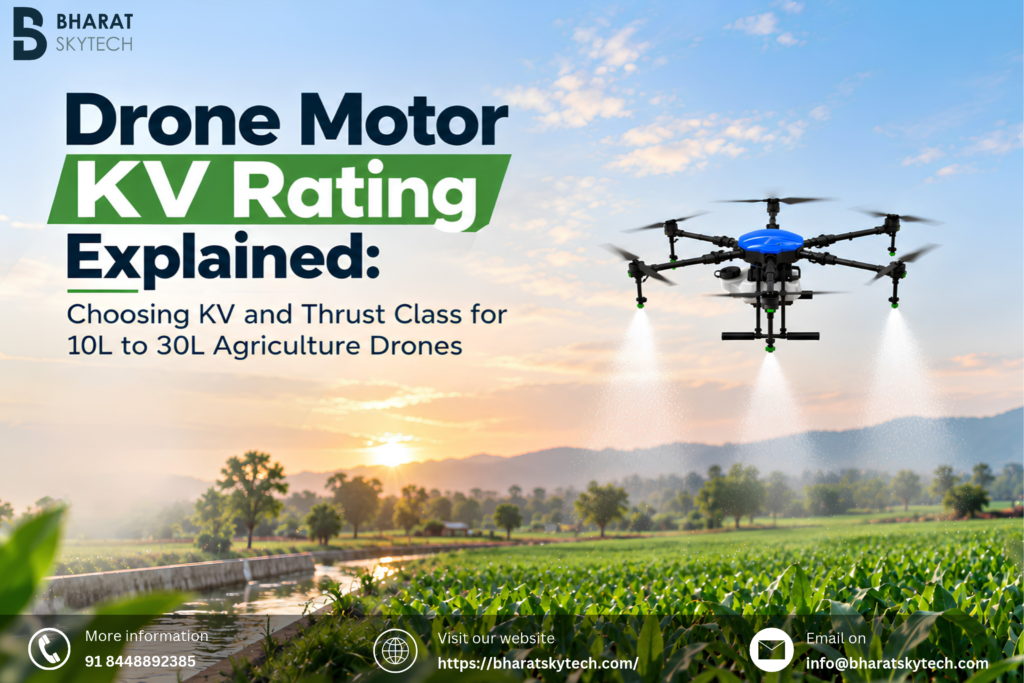
Drone motor KV rating is the number every agriculture drone builder in India eventually gets stuck on: two motors look almost identical on paper, but one is rated 100KV and the other 45KV, and nobody explains why that number changes everything about how your drone flies. Search for it online and you’ll find plenty of generic RC hobbyist explanations built around 5-inch racing quads — useless when you’re trying to lift a 20-litre tank of pesticide over a mustard field in 45°C heat.
This guide answers what is KV in drone motor terms specifically for agriculture builds, walks through a real KV-to-thrust chart across Hobbywing’s X6, X8, X9, X11, and X13 motors, and covers the mistakes that quietly kill motors on Indian farms every season.
What Does KV Actually Mean in a Brushless Motor?
Here’s the drone kv meaning in one line: KV is RPM per volt, measured with no load on the shaft. A 100KV motor spinning on a 12S battery (roughly 44.4V nominal) will theoretically spin at 100 × 44.4 = 4,440 RPM with nothing attached. That’s it. KV is not a power rating, not a thrust rating, and definitely not “kilovolts” — a mix-up that trips up a lot of first-time builders searching for a brushless motor kv rating explanation.
Under an actual propeller load, real RPM drops to somewhere between 70-85% of that no-load figure, because the propeller resists the spin. This is where torque enters the picture. A low-KV motor has more wire turns in its stator, which means more torque and less RPM per volt. A high-KV motor has fewer turns, spins faster, but produces less twisting force per amp.
For agriculture drones, this single fact decides your entire motor category: you need low KV, not high KV. A racing drone wants a screaming 2400KV motor swinging a tiny 5-inch prop. An agriculture drone swinging a 40-inch or even 56-inch carbon fibre propeller under a full spray tank needs the opposite — low RPM, high torque, and enough stator size to not cook itself in an hour of continuous spraying.
Why Agriculture Drones Run Low KV Motors
Large propellers move a bigger column of air per rotation, which means they generate the same thrust at a much lower RPM than a small propeller would. Spin a 56-inch blade at racing-drone RPM and you’d need a stator the size of a dinner plate just to survive the centrifugal stress, plus you’d burn through your battery in about ninety seconds.
Instead, agriculture-grade BLDC motors — the entire premise of an agriculture drone bldc motor — are built with wide stators and low KV so they can turn massive props slowly and efficiently, trading RPM for torque. That’s why every serious agri-drone motor line, from Hobbywing’s X-series to T-Motor’s A-series, clusters between 45KV and 150KV, while FPV racing motors live in the 1,500-4,000KV range. Two completely different design problems, wearing the same “brushless motor” label.
The KV → Voltage → Propeller → Thrust Table
This is the table that actually matters when you’re speccing a build, and it’s built from real Hobbywing X-series datasheet numbers rather than generic RC references. Use it to match your tank size to the right motor, propeller, and battery configuration before you commit to a frame.
| Tank Size | Hobbywing Motor | KV Rating | Battery / Voltage | Propeller | Max Thrust/Rotor | Recommended Payload/Rotor |
|---|---|---|---|---|---|---|
| 4L–6L | X6 Plus | 150KV | 12S–14S (46–54V) | 2480 | ~11.9–12.5 kg | 3.5–5.5 kg |
| 10L–12L | X8 (100KV D40) | 100KV | 12S (44.4–52.2V) | 3011 | ~15–15.6 kg | 5–7 kg |
| 12L–16L | X9 Plus | 100KV | 14S (53.6–58.8V) | 36190 / 3611 | ~26.5–27 kg | 11–13 kg |
| 20L+ | X11 Plus | 85KV | 12S–14S (44–61V) | 4314 | ~36–37 kg | 15–18 kg |
| 25L–30L+ | X13 (18S) | ~45KV (18S) | 18S (75–91.8V) | 5620 | ~53–57 kg | 25–27 kg |
A few things stand out once you lay it out this way. First, KV drops steadily as tank size rises — from 150KV on the smallest X6 build down to roughly 45KV on the 18S X13 — because bigger tanks mean bigger props, and bigger props need more torque, not more RPM. Second, thrust figures here are per rotor, at sea level, with the stock propeller — a quadcopter multiplies this by four, a hexacopter by six. A 20L hexacopter build on X11 Plus motors, for example, has a theoretical max lift of over 200kg across six rotors, though real-world flight thrust-to-weight targets sit closer to 2:1 or 2.5:1 for stable hover, not the absolute ceiling.
Third, notice that the X9 Plus and X11 Plus both exist in the same voltage neighbourhood but at very different KV and thrust classes — this is exactly why checking a drone motor thrust chart against your actual all-up weight (tank full, not empty) matters more than picking a motor by tank-size label alone. If you’re unsure how to read a full datasheet, a drone motor thrust calculator that factors in throttle percentage against current draw will save you from an oversized or undersized pick.
For the full spec sheets and combo pricing on each of these, see our agriculture drone motor range and the complete Hobbywing product line.
CW vs CCW: Why Rotation Direction Isn't Optional
Every multirotor — quad, hex, or octo — needs an equal split of clockwise (CW) and counter-clockwise (CCW) motors. Each spinning propeller creates a reaction torque that tries to rotate the entire airframe in the opposite direction. Left uncancelled, the drone would spin uncontrollably around its yaw axis the moment it left the ground.
By mounting CW motors on alternating arms and CCW motors on the others, those reaction torques cancel out, and the flight controller uses small speed differences between the two groups to control yaw precisely. This is why Hobbywing sells the X6, X8, X9, X11, and X13 motors — and their propellers — as matched CW/CCW pairs rather than a single universal part. A hexacopter needs three CW and three CCW; a quad needs two and two. Buying the wrong rotation for an arm position is a common and completely avoidable build mistake — always check your frame’s arm layout diagram before ordering motors, not after.
Common Drone Motor Selection Mistakes in India
Sizing the motor to the empty drone instead of the full tank weight.
A 20L tank filled with pesticide adds roughly 20kg the moment you start the mission. Builders who size motors against the dry airframe weight end up flying an underpowered, overheating system the second the tank is topped up. Always size against maximum all-up weight, not curb weight.
Chasing a cheaper high-KV motor and pairing it with an oversized prop to compensate.
This is one of the most common failures reported by Indian agri-drone service providers. A high-KV motor forced to swing a large-diameter propeller draws far more current than its winding is rated for, runs hot within minutes, and shortens bearing and winding life dramatically — sometimes within a single spraying season.
Ignoring voltage compatibility between motor and battery.
The X9 Plus is rated for 14S; running it on a 12S pack starves it of the voltage it needs for rated thrust, while pushing an X6 Plus motor built for 12S-14S onto a mismatched high-cell-count pack risks exceeding its max input voltage. Always cross-check the motor’s rated voltage window against your battery’s actual pack voltage before wiring anything up.
Mixing propeller pitch or brand without re-verifying current draw.
Even a correctly rated motor can pull dangerous current if paired with a propeller that wasn’t matched by the manufacturer’s own combo testing. Stick to factory-tested combos — like the X9 Plus with the 36190 or 3611 propeller, or the X11 Plus with the 4314 — unless you’ve independently bench-tested an alternative pairing.
Skipping IP-rated components for budget reasons.
Indian field conditions mean dust, pesticide residue, and monsoon humidity year-round. A motor without adequate ingress protection will fail from corrosion long before it fails from mechanical wear, regardless of how well the KV and propeller were matched.
Not asking which Hobbywing motor fits a hexacopter build.
This comes up constantly — which Hobbywing motor for a hexacopter depends entirely on tank size, not airframe type. A 10L hexacopter typically runs six X8 motors; a 20L+ hexacopter moves up to six X11 Plus units. The rotor count changes the total lift available, not which motor tier you should pick — that’s still governed by per-rotor payload from the table above.
Getting the Motor Right the First Time
KV rating, voltage, propeller size, and thrust are one linked system, not four separate specs to shop for independently. Start from your actual full-tank weight, work backward to the per-rotor payload you need, and let that number point you to the right KV class and propeller pairing — not the other way around. Whether you’re speccing a compact 10L quad on X8 motors or a heavy-lift 30L hex running X13 units, matching every part of that chain correctly is what separates a motor that lasts three seasons from one that’s smoking by the second month.
Browse the full range of genuine Hobbywing agriculture drone motors, or explore individual combos for the X6, X8, and X9 series if you’re still narrowing down your build.
Conclusion
Getting KV right isn’t about memorizing a number — it’s about starting from your full-tank weight and working backward through torque, propeller size, and voltage until you land on a motor that can carry that load all season without cooking itself. A 10L build on X8 motors and a 30L hex on X13 units are solving the same equation with different inputs, and skipping any one variable — voltage compatibility, factory-tested prop pairing, or IP rating for field conditions — is usually what turns a three-season motor into a two-month failure. Use the KV-to-thrust table as your starting point, but always cross-check it against your actual payload before you place an order. If you’re still unsure which Hobbywing motor fits your build, Bharat Skytech‘s team can help you match KV, voltage, and propeller to your exact tank size before you buy.
Frequently Asked Questions (FAQs)
How do I convert KV to RPM?
Multiply KV by your battery’s nominal voltage. A 100KV motor on 14S (roughly 51.8V nominal) gives a no-load figure near 5,180 RPM — real RPM under a loaded propeller will land noticeably lower.
Is a higher or lower KV motor better for heavy lift?
Lower. Every brushless motor kv chart for industrial and agricultural UAVs shows KV falling as rated payload rises, because larger propellers need torque, not raw RPM.
Does KV rating alone tell me if a motor will work for my build?
No — treat motor kv rating as one input alongside stator size, max continuous current, voltage compatibility, and the specific propeller it’s rated to swing. Two motors with the same KV can behave very differently depending on stator winding and cooling design.