
Drone radar sensor have become a key element in the safe and intelligent operation of UAVs. As the use of drones in agriculture, industrial inspection, surveillance, and mapping grows at an incredible rate the demand for which they perform a reliable obstacle detection has become primary. A drone radar sensor enables unmanned aerial vehicles in real time to see out other aircraft and objects, and to operate safely in very complex and undefined environments.
At Bharat Skytech we focus on the development and sale of professional grade agriculture drones and advanced UAV electronics which include high performance radar sensors for precise obstacle avoidance
What is a drone radar sensor?
A drone radar sensor which is an electronic device which uses radio waves to identify objects in the drone’s flight path. As opposed to optical sensors that use cameras or light detection radar sensors do well in:
- Poor visibility conditions.
- Weary agricultural fields.
- Fog and drizzle.
- Night time operations.
- Bright sunlight conditions.
Radar systems transmit radio frequency waves which they also use to determine the distance, speed, and location of objects.
Why do we use drone radar sensors in agriculture drones?
Agricultural drones work in ever changing and uncertain environments.
In fields we see:
- Forests.
- Electric towers.
- Cables.
- Farm buildings.
- Variable topography.
- Dynamic obstacles.
Without the proper obstacle detection the risk of collision goes up. A drone radar sensor which:
- Auto obstacle detection.
- Instant response.
- Improved flight performance.
- Reduced chance of crash.
- Increased operation efficiency.
- Improved pilot safety.
For large scale spray tasks radar sensors in drones are a must.
How Drone Detection Radars Function.
Drone radars use radio frequency transmission and return information. The process includes:
- The radio wave section of the system puts out electromagnetic waves.
- Waves break at the barrier.
- Refracted waves back to the sensor.
- The system measures distance and position.
- The flight control system which in turn modifies the drone’s movement.
In the span of milliseconds this process takes place which in turn enables real time obstacle avoidance.
Types of Drone Radar Sensors
1. Forward Radar
Detects obstacles in front of the drone during forward motion.
2. Rear Radar
Detects objects behind the drone during reverse movement or braking.
3. Multi-Directional Radar
Covers front, back, sides, and sometimes downward detection for full obstacle awareness.
For agriculture drone systems, integrating both front and rear radar provides maximum operational safety.
We Sell Professional Drone Radar Sensors at Bharat Skytech
At Bharat Skytech we have solutions in the form of high performance obstacle avoidance radar systems which are perfect for agriculture and industrial UAV platforms.
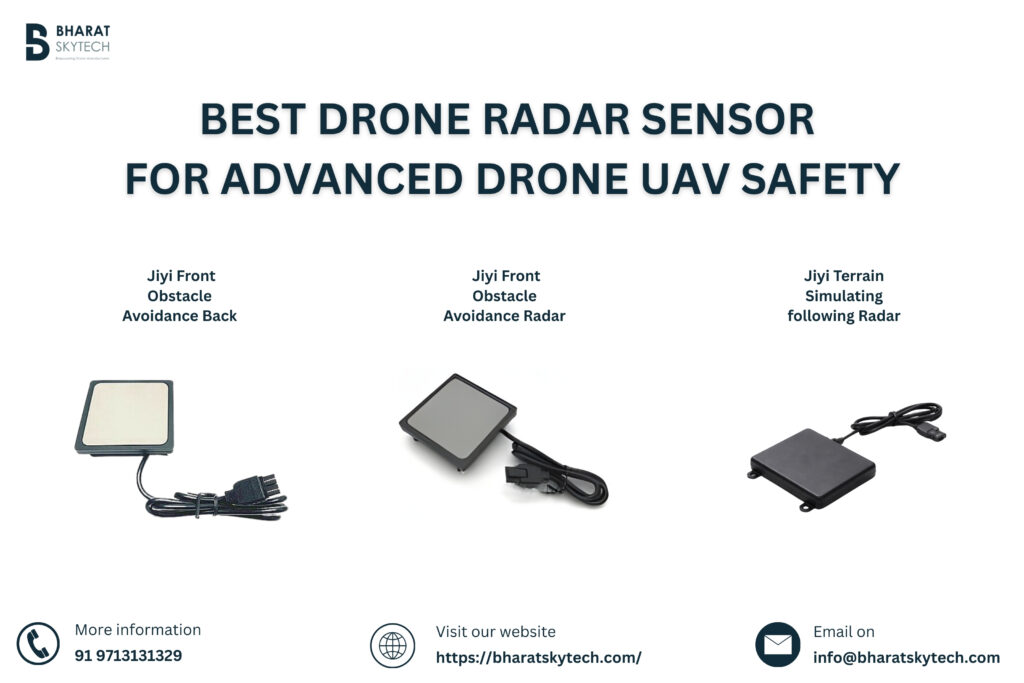
1. Jiyi Obstacle Avoidance Radar Back (UAV-R21-B) Rear Radar
The Jiyi Obstacle Avoidance Radar Back (UAV-R21-B) Rear Radar is engineered for accurate rear obstacle detection during reverse movement and landing.
Key Benefits
- Accurate rear obstacle detection
- Stable performance in agricultural fields
- Reliable signal processing
- Compatible with professional flight controllers
- Designed for multi-rotor UAV platforms
Rear radar is particularly useful during landing, reverse movement, and confined-area operations.
Technical Specifications
Specification | Details |
Modulation Mode | FMCW |
Center Frequency | 24.125 GHz |
Ranging Range | 1 – 25 meters |
Ranging Accuracy | 0.1 meter |
Range Resolution | 0.6 meter |
Output Frequency | 40 Hz |
Power Consumption | 3.0W @ 25°C |
Operating Voltage | 9V – 28V |
Operating Temperature | -20°C to +85°C |
Output Interface | CAN |
This radar is compatible with various types of professional UAV systems and integrates easily with advanced flight controllers.
2. Jiyi Obstacle Avoidance Radar Front (UAV-R21-F) Forward Radar
The Jiyi Obstacle Avoidance Radar Front (UAV-R21-F) Forward Radar delivers precise forward obstacle detection to prevent frontal collisions.
Key Features
- Real-time forward detection
- Fast response system
- Optimized for agriculture drones
- Stable communication with UAV systems
- Reliable performance in dust and low visibility
Forward radar sensors are critical in crop spraying missions where trees, wires, or poles may suddenly appear in the flight path.
Technical Specifications
Specification | Details |
Detection Range | 1 – 25 meters |
Accuracy | ±0.1 meter |
Modulation Mode | FMCW |
Center Frequency | 24.125 GHz |
Power Consumption | 3.0W @ 25°C |
Operating Voltage | 5V |
Interface | UART / TTL |
Resolution | 0.6 meter |
Field of View | 120° Horizontal, 30° Vertical |
Working Temperature | -20°C to 60°C |
Weight | 80g |
IP Rating | IP67 |
Dimensions | 12 × 11 × 6 cm |
Shipping Weight | 0.142 kg |
Warranty | 3 Months (Manufacturing Defects) |
3. Jiyi Terrain Simulating following Radar
The Jiyi Technology Terrain Following Radar is a high-precision sensor designed to maintain stable and accurate altitude over uneven terrain for consistent and safe UAV operations.
Key Features
- 24GHz Radar Technology – Accurate terrain measurement with MMIC design.
- 3cm Precision – Stable detection up to 15m range.
- Consistent Height Output – Unaffected by drone tilt.
- IP67 All-Weather – Works in dust, fog & light rain.
- Lightweight & Efficient – <50g, only 1.5W power.
The Jiyi Technology Terrain Following Radar ensures stable altitude over uneven terrain for accurate and uniform crop spraying.
Technical Specifications
Specification | Details |
Product Weight | < 50g |
Center Frequency | 24.125 GHz |
Modulation Mode | FMC |
Usage Environment | Avoid obstruction below; stay away from water mist |
Altimetry Range | 0.3 – 15m (relative to ground) |
Altimetry Accuracy | 0.05m |
Output Frequency | 50Hz |
Power Consumption | 1.5W @ 25°C |
Working Voltage | 6 – 28V |
Working Temperature | -20°C to +85°C |
Output Interface | CAN |
Benefits which come from the use of Jiyi Radar Sensors in Agriculture Drones.
Integrating both front and rear radars into the system offers:
- Near full scope of environment awareness
- Improved flight auto pilot.
- Reduced operator load.
- Improved safety in spraying operations.
- Care of pricey drone gear.
- Adherence to professional UAV guidelines.
For high performance drone systems we have that radar technology protects investment and efficiency.
Drone Radar Sensor vs Vision-Based Sensors
Radar Sensor | Vision Sensor |
Works in dust & fog | Affected by visibility |
Detects through light rain | Limited in bad weather |
Reliable in low light | Needs sufficient lighting |
Strong range detection | Dependent on camera clarity |
In agriculture environments, radar sensors are generally more dependable due to challenging field conditions.
Integration with Flight Controllers
Drone radar systems report into the flight control board constantly. At which point an obstacle is detected:
- Distance info is sent out at once.
- The system determines risk of collision.
- The drone decreases speed, stops, or changes course.
This smart automation which in turn decreases pilot response time and improves operational safety.
Key uses of Drone Radar Sensor
Agriculture Drones
- Pesticide application during farming.
- Agro precision.
- Field mapping is also named as Field matching.
Industrial Inspection
- Line maintenance.
- Wind power station monitoring.
- Infrastructure audit.
Surveillance & Security
- Cross border surveillance.
- Industrial safety.
Delivery Drones
- City navigation.
- Environments with many obstacles.
When Choosing a Drone Radar System to Use which of the Following To Consider.
In choosing a radar sensor for your UAV consider:
- Detection distance.
- FOV.
- Compatibility for flight controllers.
- Weather wear and tear.
- Process time.
- Size and dimensions.
- Energy use.
Selecting a proven and reliable radar system is key to long term stability.
What does Bharat Skytech offer in terms of Drone Radar Sensors?
Bharat Skytech is a dependable supplier of agricultural drones and professional UAV systems in India. We provide:
- True Jiyi radar sensors.
- Ag drone compatibility.
- Support team.
- Good quality products.
- Across India shipping.
- Professional UAV experience.
We are aware of the issues in agricultural drone which we supply components that perform to.
Future of Drone Radar Sensor Technology
As the UAV technology improves, in the area of:
- Autonomy in navigation.
- AI enabled obstacle avoidance.
- Intelligent farming automation.
- Agri precision missions.
- Fully automatic spraying systems.
Advanced radar in combination with GPS and intelligent flight control will be what the future of safe UAV operations holds.
Final Reflections.
Drone radar sensors are a requirement not a choice; they are fundamental for professional safe UAV operations. In agriculture, over industrial sites, and in the most challenging of environments which include lots of obstacles that is where radar based detection outperforms.
Explore at Bharat Skytech our wide range of professional drone radar sensors and agriculture UAV components to design better, safer drone systems today.